PuniCodex

Extended Lore

𓁣 Ptḥ

Etymology · Orthography · Cult · Iconography · Reception · Sources

Tier 1 Ptḥ.com
Ptḥ — Craftsmen, Creation, Memphis
01

Quick Facts

Essential information about Ptḥ, Craftsmen, Creation, Memphis

Original Script𓁣
Unicode RestorationPtḥ
Reconstructed Pronunciation/pəˈtaːħ/
PantheonEgyptian
DomainCraftsmen, Creation, Memphis
MeaningSculptor (Egyptian ptḥ)
ClassificationTier 1
Primary DomainPtḥ.com
Sacred SymbolsDjed pillar, Was scepter, Artists' tools, Bull (Apis), Scarab and mummiform shape
02

Etymology & Word Family

From original script to Unicode restoration

Original Script 𓁣 Ptḥ — "Sculptor (Egyptian ptḥ)"
Unicode Restoration Ptḥ Restored stress, length, and script
Modern ASCII ptah Plain-ASCII fallback

The name Ptḥ carries the orthographic signature of the egyptian tradition: 𓁣. Unicode restoration recovers what ASCII flattens.

03

Unicode Character Breakdown

Character-by-character philological analysis

CharacterUnicodeNameBlockPhonetic Role
PU+0050Latin Capital Letter PBasic LatinSame
tU+0074Latin Small Letter TBasic LatinSame
ḥU+1E25Latin Small Letter H with Dot BelowUnknownH-with-dot: voiceless pharyngeal
—N/ADropped characterEgyptian orthographyDropped: merged into ḥ

The Tier 1 classification reflects how much of the original phonology this restoration preserves — stress and vowel length for Greek names, distinctive letters and diacritics for every other tradition.

04

Cult & Worship

How the sacred was kept — rites, sanctuaries, remains

The Cult

Ptḥ's principal cult was centered at Hut-ka-Ptḥ in Memphis, where a vast temple enclosure, colossal statues of Ramses II, and the Serapeum for the burial of Apis bulls formed one of Egypt's great religious complexes. Priests of Ptḥ oversaw craft guilds, and votive stelae from workshops across Egypt invoke him as patron of artisans, metalworkers, and sculptors. The Apis bull, identified with Ptḥ's living herald, was mourned, embalmed, and interred with royal ceremony. The cult persisted from the Old Kingdom through the Graeco-Roman period and influenced later Serapis worship at Alexandria.

In the Earth

Ptḥ's primary cult center was the temple complex at Hut-ka-Ptḥ in Memphis, where remains of a vast enclosure, colossal statues of Ramses II, and the Serapeum where Apis bulls were buried have been excavated. The Shabaka Stone, now in the British Museum, preserves the Memphite Theology. Statues, stelae, and offering tables from workshops across Egypt invoke Ptḥ as patron of craftsmen, while composite Ptḥ-Sokar-Osiris figures are common in funerary assemblages from the Late and Ptolemaic periods.

05

Iconography

How Ptḥ was imaged across the ages

The Image

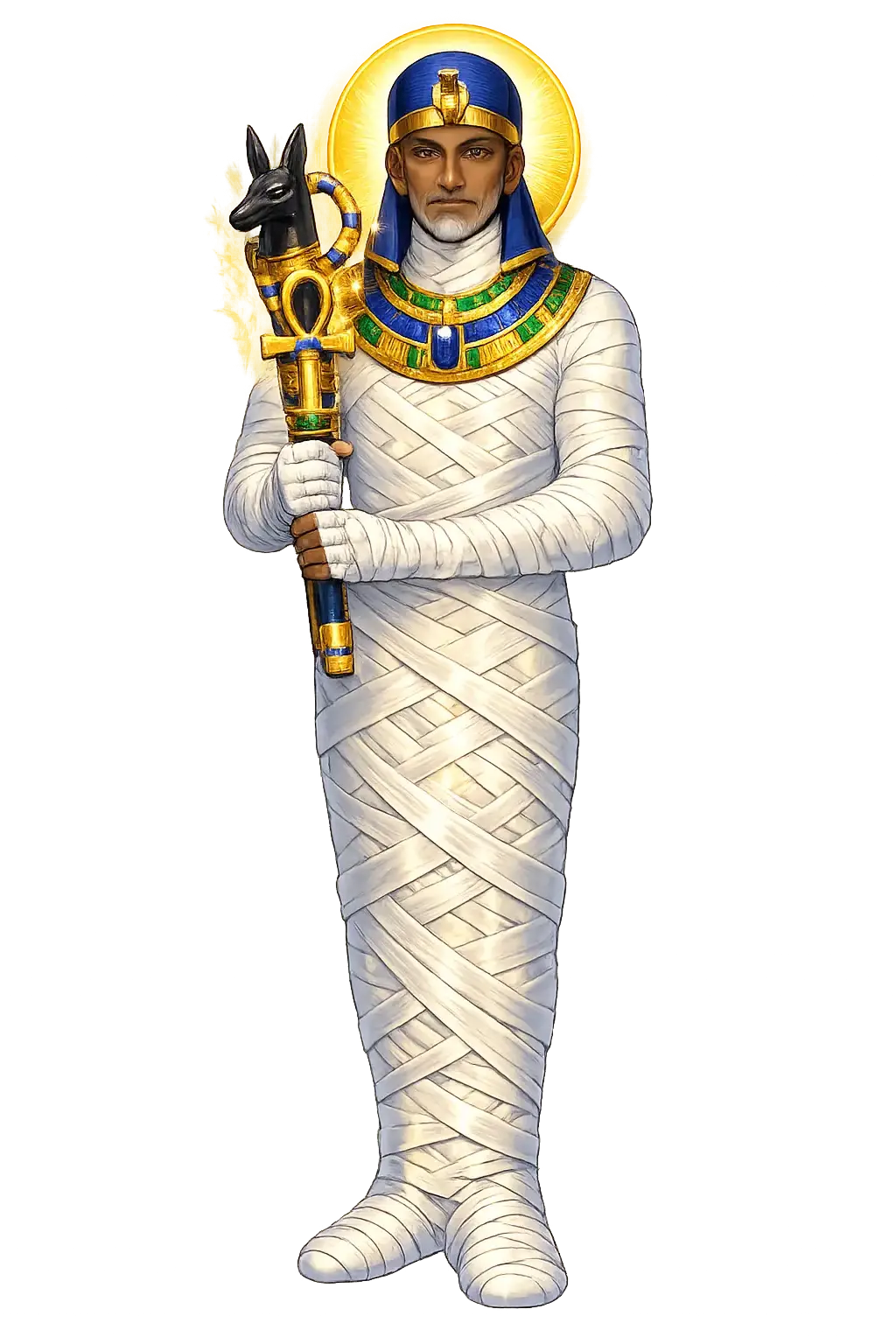
Ptḥ was shown as a tightly wrapped, mummiform man holding a was-scepter and an ankh, often wearing a close-fitting cap and a straight false beard. This emblematic form emphasized his identity as divine craftsman and patron of metals and stone. Temple reliefs at Memphis, Karnak, and elsewhere depict him fashioning the king's ka on a potter's wheel. The British Museum's Shabaka Stone preserves the Memphite Theology in hieroglyphic text, while bronze and stone statuettes of Ptḥ circulated widely as votive offerings.

06

Reception & Transformation

The name after its own age — transmission, translation, survival

Afterlives

Ptḥ's intellectual prestige reached its widest audience through the Memphite Theology, preserved on the Shabaka Stone and studied by Egyptologists as a sophisticated account of creation through divine thought and speech. Greeks identified him with Hephaistos and, later, with the syncretic Serapis of Ptolemaic Alexandria, a figure who crossed into Hellenistic and Roman religion. The image of the seated, mummiform craftsman influenced later Egyptianizing art and esoteric movements, and modern scholarship has reclaimed Ptḥ as a patron of material creativity. His imagery continues to shape popular understandings of Egyptian craftsmanship, sacred technology, and the idea that the divine first creates by intellectual plan and then by skilled execution.

Identifications Across Traditions

Ptḥ absorbed and was absorbed by neighboring gods. With Sokar and Osiris he formed the mortuary triad Ptḥ-Sokar-Osiris. With the Apis bull he produced Osiris-Apis, the Hellenistic Sarapis worshipped across the Mediterranean. Greeks identified him with Hephaestus because both were divine craftsmen, and Roman Egypt exported the syncretic Sarapis as far as Britain and the Rhine. Ptḥ's creative theology also influenced later Platonic and Judeo-Christian ideas of the demiurge and the Logos, though the connections are debated.

Modern Legacy

The very name Aígyptos derives from Ptḥ's temple, Hut-ka-Ptḥ. His city, Memphis, remained a religious capital for millennia, and his craftsmen shaped the temples and tombs that still define Pharaonic visual culture. In modern Egyptology, Ptḥ stands as the theologian-creator, the god who thinks and speaks the world into order. Contemporary artists, architects, and makers continue to find in him a patron of the patient transformation of raw material into meaning.

07

The Meditation

What Ptḥ means — beyond the dictionary

Ptḥ teaches that making is a sacred act. Before the chisel strikes stone, the heart must see the form and the tongue must name it. In an age of mass production, Ptḥ asks us to recover the dignity of craft: the slow, deliberate work by which thought becomes thing. To restore his name in Unicode is to remember that Egypt was not only a land of kings and priests but a civilization of makers, and that the first maker was a god who spoke the world into shape.

08

Frequently Asked Questions

Common questions about Ptḥ, Craftsmen, Creation, Memphis, and Unicode restoration

01How do you pronounce Ptḥ?

In reconstructed pronunciation, Ptḥ is /pəˈtaːħ/ — approximately puh-TAHKH — the final consonant is a dry, breathy 'kh' made in the back of the throat, not the soft 'h' of English.

02What does Ptḥ mean?

Ptḥ means Sculptor (Egyptian ptḥ) in the egyptian tradition.

03What are the symbols of Ptḥ?

Ptḥ is associated with Djed pillar (Stability and the backbone of Osiris; Ptḥ is often shown grasping it as a maker of lasting order), Was scepter (Dominion and the power to command matter into form), Artists' tools (The chisel, level, and square of the sculptor and architect), Bull (Apis) (The living Apis bull was worshipped as Ptḥ's earthly herald at Memphis), Scarab and mummiform shape (Ptḥ-Sokar-Osiris as the nocturnal regenerator of the dead).

04Why restore Ptḥ in Unicode?

Plain ASCII ptah strips the stress, length, and script that make the name specific. Unicode restoration returns the name to its original written dignity.

05What is the most important myth about Ptḥ?

“The Heart and Tongue That Made the Gods” — the Memphite Theology story that anchors the mythology of Ptḥ, told in full on the lore page.

09

Scholarly Sources

The philological foundations of this restoration

Every claim on this page is grounded in established scholarship. The orthographic restorations follow disciplinary convention. The etymological chain follows the best available reference works. This is not invention — it is resurrection through scholarship.

◈

Lexicography & Philology

  • Faulkner, R. O. A Concise Dictionary of Middle Egyptian. Oxford: Griffith Institute, 1962.
  • Wb
◎

Primary Texts

  • Shabaka Stone (Memphite Theology)
◉

Archaeology & Art History

  • Material evidence — iconography, inscriptions, and temple archaeology — for Ptḥ and related cults.
✦

Religious Studies

  • Faulkner, A Concise Dictionary of Middle Egyptian
  • Wb (Erman & Grapow, Wörterbuch der ägyptischen Sprache)
  • Allen, Middle Egyptian: An Introduction to the Language and Culture of Hieroglyphs
  • Assmann, Egyptian Solar Religion in the New Kingdom
  • Hornung, Conceptions of God in Ancient Egypt
  • Zabkar, A Study of the Ba Concept in Ancient Egyptian Texts
  • Herodotus, Histories 3.27–29 (the Apis and Cambyses)
  • Griffiths, The Origins of Osiris and His Cult
Return

The Surface Awaits

You have traced the name from its earliest attestation to its Unicode restoration. Now return to the myth. The story is where the name lives.

Back to Lore
Ptḥ mascot