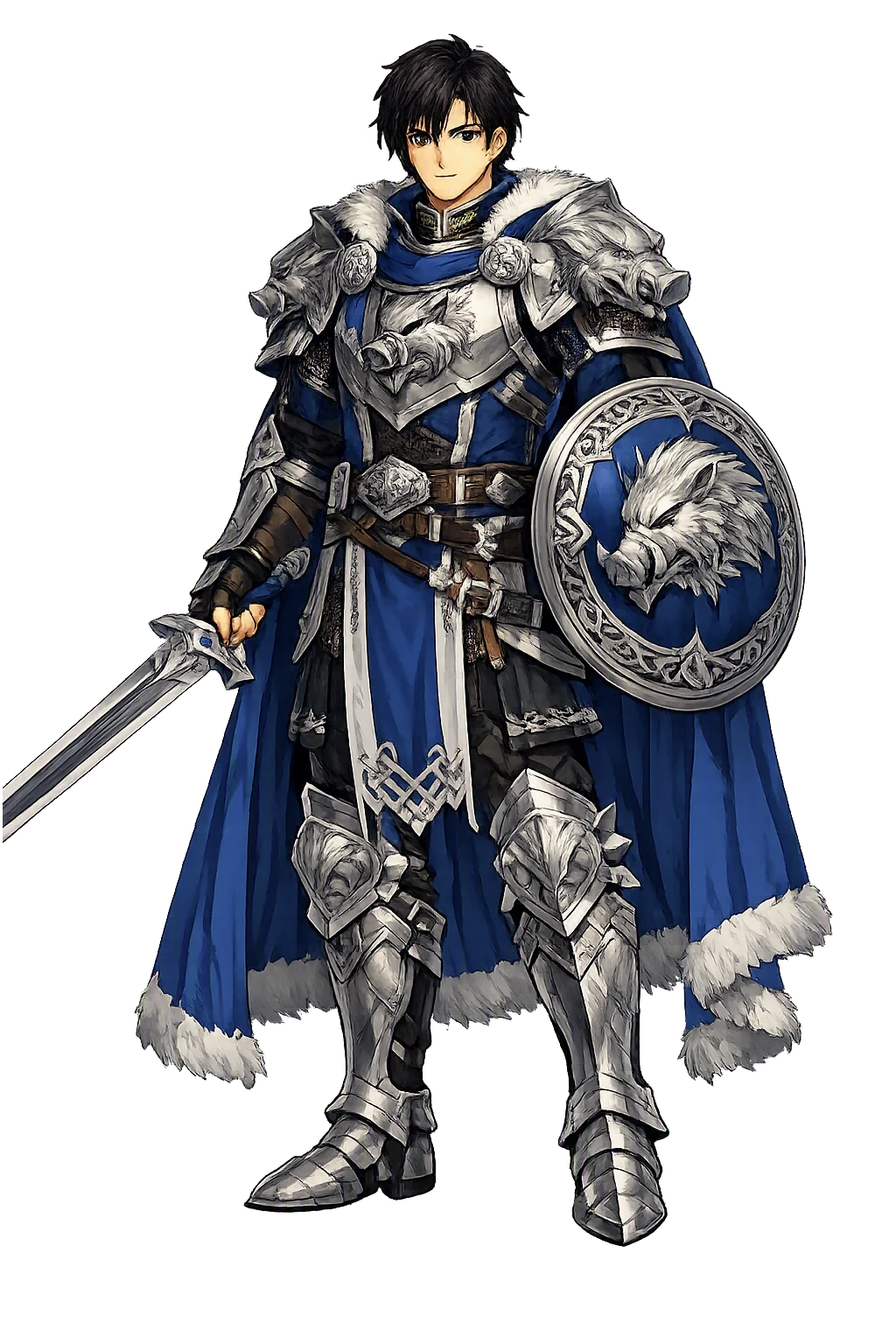
Stories of Pryderi
Pryderi's mythology is unique in Welsh prose: he is the only character who appears in all Four Branches of the Mabinogi, and his life is the thread the whole cycle is strung on. The First Branch gives his birth, theft, and naming; the Second carries him through the Irish war as one of the seven survivors; the Third empties his kingdom and takes him captive; the Fourth kills him. Every word of it is medieval Welsh prose, preserved in two great manuscripts.
Pryderi is born to Pwyll and Rhiannon after the nobles of Dyfed have pressed for an heir, and on the night of his birth the six women set to watch all fall asleep — and the child is gone. Terrified of the blame, the women kill the pups of a hound, smear the blood on Rhiannon's face, lay the bones beside her, and swear she has destroyed her own son; her penance at the horse-block begins, and it will last until the boy comes home. The child, meanwhile, has fallen into the strangest rescue in Welsh prose. Teyrnon Twrf Liant, a lord of Gwent Is Coed by the sea, loses a foal every May-eve; keeping watch over his mare, he sees a great clawed hand reach through the window to seize the newborn foal, and strikes it off with his sword. Outside the door he finds a baby boy wrapped in silk brocade. He and his wife rear the child as their own and call him Gwri Wallt Euryn — Gwri of the Golden Hair.
Gwri grows with uncanny speed — at the end of his first year sturdier than a child of three, at two like a boy of six — and year by year he bears the very likeness of Pwyll. When Teyrnon hears of Rhiannon's penance, he knows what he must do, and he and his wife bring the boy to Arberth. The court sees the likeness at once, and Rhiannon says that if this is true, her pryder — her care, her anxiety — is lifted from her. Pwyll declares that the boy should take his name from the word his mother spoke when the news was brought to her, and so the child is named Pryderi. The penance ends; Teyrnon will take no reward beyond the boy's friendship; and Pryderi is fostered with Pendaran Dyfed until he is of age, when Pwyll gives him the realm.
When Bendigeidfran — Brân the Blessed — leads the host of Britain into Ireland to answer the wrong done to Branwen, the war ends in near-total ruin: the Irish are destroyed, and of the host of the Island of the Mighty only seven men come back alive, bearing Brân's wounded head. The tale names them, and the first two it names are Pryderi and Manawydan, with Glifieu, Taliesin, Ynawg, Gruddieu, and Heilyn. With the others Pryderi feasts seven years at Harlech, where the Birds of Rhiannon sing, and eighty years at Gwales in Penfro in the Assembly of the Wondrous Head — a man who has sailed out of his own branch into the middle of someone else's tragedy, and who carries its grief home into the Third.
After Pwyll's death, Pryderi rules Dyfed and gives his mother Rhiannon in marriage to Manawydan fab Llŷr; with his wife Cigfa, the four come home to Arberth. There comes a peal of thunder and a fall of mist, and when it lifts, Dyfed is emptied — not a soul, not a dwelling, not a beast remains. After years of hand-craft that English market towns punished for making work too good to allow, a shining white boar leads Pryderi and Manawydan to a fortress that was never there before. Against Manawydan's counsel Pryderi goes in, lays hold of a golden bowl hanging by chains above a marble fountain — and his hands stick to the bowl, his feet to the slab, and speech leaves him. Rhiannon goes in after him, takes hold of the same bowl, and is caught beside him; fort, bowl, and both prisoners vanish.
Manawydan undoes the spell by patience: he catches the one slow mouse stripping his third ripe field of wheat, condemns it to hang as a thief, and names his price to the bishop sent to beg it off — Pryderi and Rhiannon released, the enchantment lifted, no vengeance taken. The mouse is the wife of Llwyd fab Cilcoed, who had laid the spell to avenge his friend Gwawl, the suitor Rhiannon refused. Pryderi comes home with a gate-hammer about his neck, Rhiannon with the collars of asses about hers; the land wakes, and the Third Branch ends with the four feasting as they began. The myth is the cycle's thesis in parable: what enchantment took, only patience could restore.
Among Pryderi's treasures are the hobeu, the first swine ever brought to Wales — a gift to his house from Arawn of Annwn, which Pryderi had sworn neither to sell nor to give until the herd had bred twice its number. Gwydion fab Dôn comes to his court in the guise of a poet, is refused the pigs, and conjures twelve stallions with golden harness, twelve greyhounds with golden collars and leashes, and twelve golden shields — apparitions good for a day and gone by morning — and trades them for the herd. When the glamour fades, Pryderi musters Dyfed and comes north, and the war that follows forces the crime Gwydion and Gilfaethwy commit against Goewin. At the peace-talks Pryderi demands single combat, for it was because of him the hosts had come; at Y Felenrhyd, the tale says, Gwydion slew him 'by strength and valour, and by magic and enchantment'. They buried Pryderi there, at Maen Tywynog above Y Felenrhyd — and his grave, the Fourth Branch says, is there.
Son of Pwyll, King
Pryderi is the hinge of the whole Mabinogi: the only figure who walks through all Four Branches — stolen on the night of his birth and found outside a stable door, named from his mother's lifted anxiety, emptied out of Dyfed by an enchanter's mist, and killed at last in single combat by Gwydion's craft. Son of Pwyll and Rhiannon, lord of Dyfed, he is the king the tales keep taking things from — and the name he carries is the Welsh word for care.
Outside Teyrnon's stable, where a great clawed hand had come for the newborn foal, lay an infant wrapped in silk brocade — the stolen heir of Dyfed.
Rhiannon looks at the boy and says her pryder — her care, her anxiety — is lifted from her; from that word the child is named Pryderi.
Hanging by chains above a marble fountain in a fortress that was never there before: when Pryderi grasps it, his hands stick, his feet root to the slab, and his voice dies.
The hobeu, first pigs ever brought to Wales — Arawn of Annwn's gift to the house of Pwyll — which Gwydion wins with illusory gold and pays for with Pryderi's life.
From the original script to the living URL
Pryderi
The name survives in scholarly transliteration. Pryderi is the standard Celtic romanisation, documented in academic sources — “Care, anxiety”. Because the spelling uses only Latin letters, the form is the same in both ASCII and Unicode.
No indigenous writing system is securely attested for individual celtic names. The form shown is a modern scholarly transliteration.
pryderi
The plain pryderi form is identical to the Unicode restoration. Because this name is already written in Latin letters, no diacritics, stress, or script information were lost — only capitalization differs.
Pryderi
The Unicode restoration does not need to recover lost marks for Pryderi. Its value is canonical spelling and consistent cataloguing, not the reconstruction of erased orthography. The domain is readable as-is to both DNS and humanity.
Pryderi.com
This restoration is written entirely in ASCII letters — no Punycode encoding stands between Pryderi and the DNS. The domain reads identically to machines and to human eyes.
Owned, ideal, and ASCII forms of Pryderi
Pryderi
The full Unicode restoration. pryderi.com is not in the PuniCodex collection — it is watched for release; if it drops, this temple upgrades to an owned flagship.
How Pryderi was spoken
How Pryderi is preserved in writing
No indigenous writing system is securely attested for individual celtic names. The form shown is a modern scholarly transliteration.
Contribute scholarly provenance →The lore you have read is the living myth. Extended Lore opens the scholarly vault beneath it: the cult and its material remains, a history of the image, the name after antiquity, a meditation on what the name still means, and the full scholarly apparatus — etymology, orthography, sources.
Enter Extended Lore