The Living Myth
Forethought, Fire, Craft · The Forethinker · Champion of Mortals
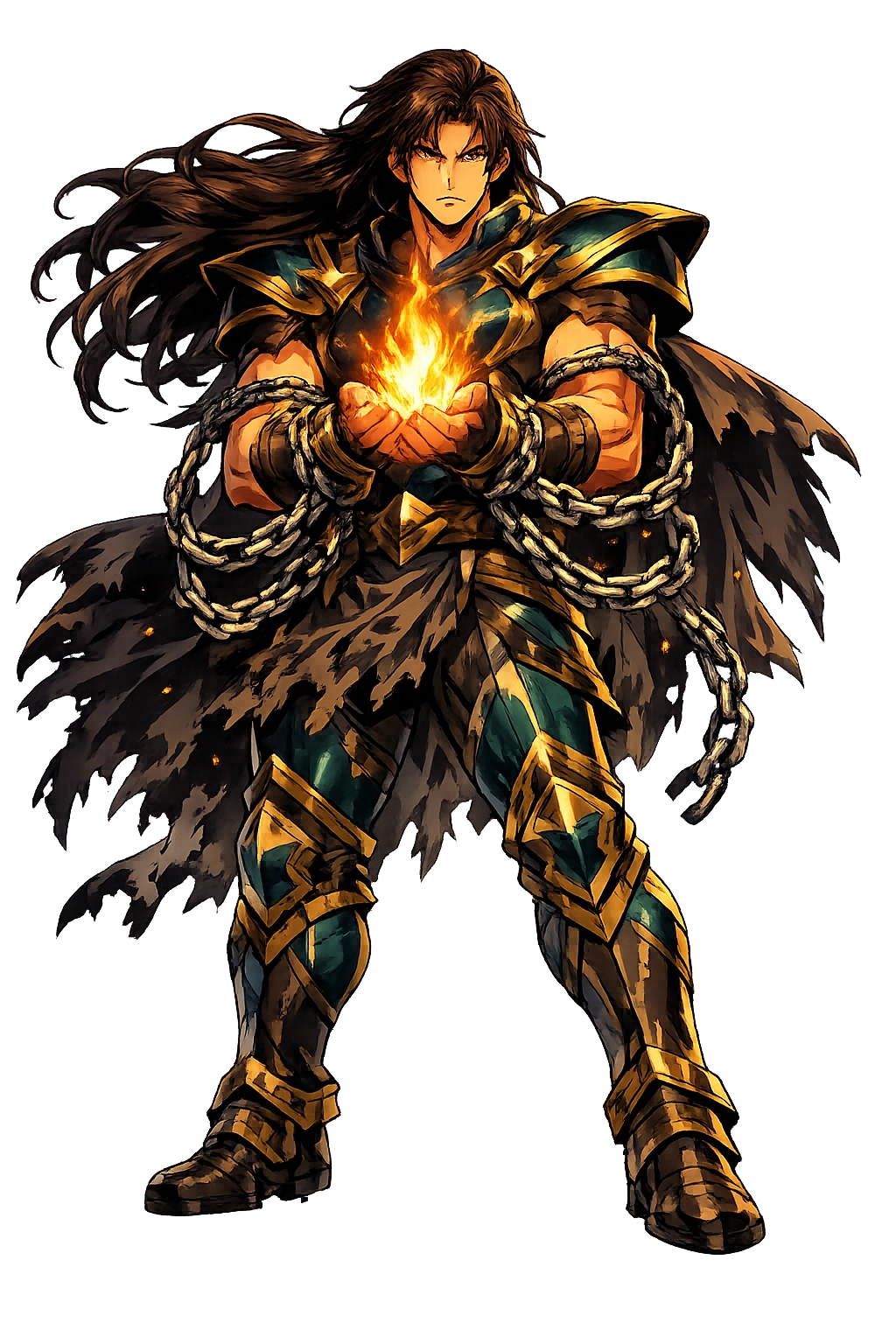
Stories of Promētheús
Prometheus' myths, preserved chiefly by Hesiod and Aeschylus, are Greece's founding meditation on progress and its price: every human power begins as a theft, and every theft must be paid for — in sacrifice, in suffering, and in the knowledge that foresight alone can carry.
At Mekone, Hesiod tells us in the Theogony (535-557), Prometheus cut up a great ox and arranged two portions: one of fat-wrapped bones that gleamed white and inviting, one of meat and entrails hidden in the ox's paunch. He invited Zeus to choose. Zeus saw through the trick — Hesiod says he knew, and chose the bones anyway, 'and in his heart his soul was angered' — binding mortals thereafter to burn the white bones for the gods on smoking altars. The Works and Days (47-58) makes the same deception explain why the earth feeds us only at the cost of labor. The myth makes sacrifice itself a memorial of a trick: every burnt offering reenacts the moment gods and mortals divided the world between them — and learned to distrust each other.
When Zeus, angry at the division, withheld fire from mortals, Prometheus stole it back — in Hesiod's Theogony (562-571) from the gods themselves, in later art from the forge of Hephaestus or the wheel of the sun-chariot — and carried it to earth hidden in the hollow stalk of a giant fennel. Aeschylus' Prometheus Bound (109-111, 450-506) has the hero list what followed: brick houses instead of caves, shipbuilding, numbers, writing, medicine, divination, mining — the whole armory of civilization purchased with one theft. Fire, the Greeks observed, is the one technology that multiplies all others; giving it to mortals made them nearly godlike, and therefore unbearable. The myth reads progress itself as an act of divine larceny: every human power begins by taking what heaven meant to keep. And Hesiod, tellingly, refuses to celebrate the theft — for him the fire is what made Pandora necessary, technology the first link in a chain that ends in toil.
Zeus answered the theft with a gift of his own. Hephaestus mixed earth with water and shaped a maiden, Athena dressed her and taught her crafts, Aphrodite poured grace and cruel longing into her breast, Hermes gave her 'a bitch's mind and a thievish character' (Hesiod, Works and Days 60-82), and every god added something — so they named her Pandora, 'All-gifted,' 'because all the Olympians gave her a gift, a bane to industrious men.' The Theogony (570-616) adds the jar she carries, from which fly out the sorrows, toils, and diseases that had never before touched mortal life. The myth is a bitter inversion of Prometheus' gift: where the Titan gave mortals divine power, Zeus sends a divine shape concealing ruin — and, in Hesiod's telling, the first woman becomes the price of fire itself.
For his crimes Zeus bound Prometheus to a pillar or a cliff in the Caucasus and set an eagle — his own bird — to feed each day on the Titan's liver, which grew back each night, making the agony unending (Hesiod, Theogony 521-525 and fr. 343 M-W; Apollodorus, Library 1.7.1; 2.5.11). Aeschylus' Prometheus Bound opens on the very fastening of the chains — Hephaestus, who nails him to the rock, weeps as he works: 'against my will, against my will; necessity compels me' (lines 18, 42). Near the play's close Heracles appears, guided by the sufferer's own prophecy, to shoot the eagle and free him — reconciliation purchased only because the Titan finally knows when to yield. The punishment is framed as the rebel's necessary tuition: power without limit, the gods insist, must end even for Titans.
Prometheus held one card Zeus could not take: he knew that the sea-goddess Thetis was fated to bear a son greater than his father, and that Zeus or Poseidon, both then suitors, would fall to him (Aeschylus, Prometheus Bound 186-192, 756-770; Apollodorus, Library 3.13.5-6). Zeus released him from torment in exchange for the warning; Thetis was married to the mortal Peleus, and her son Achilles became, as Homer sings, the greatest of the Achaeans — yet mortal, and so no threat to the throne. The episode turns knowledge into the coin in which even Zeus must pay: Prometheus suffers, but he is never powerless, because information in his keeping is worth more than thunderbolts. The myth's final lesson is that foresight, even when chained, still bargains with power on equal terms.
Fire, Craft, Foresight, and Human Civilization
Promētheus is the Titan who sided with mortals. He gave humanity fire, taught the arts of civilization, and accepted eternal punishment for his mercy. He is the patron of every outcast intelligence that chooses compassion over obedience.
He stole fire from Olympus in a hollow fennel stalk and gave it to humanity — the origin of every technology (Hesiod, Theogony 562-571).
He tricked Zeus at Mekone, dividing the sacrificial ox so the gods got bones wrapped in fat and mortals kept the meat (Hesiod, Theogony 535-557).
Writing, numbers, astronomy, medicine, shipbuilding, and mining — the arts that make cities possible (Aeschylus, Prometheus Bound 450-506).
Bound to a Caucasian rock, his liver eaten daily by an eagle — the price of his gift to mortals, until Herakles came (Apollodorus, Library 2.5.11).
From the original script to the living URL
Προμηθεύς
The name in its original Greek form. Promētheús (Προμηθεύς) is attested in the source tradition — “Forethinker (from πρό + μῆτις)”. Its aspirated consonants, diphthongs, long vowels, and acute accents carry the full phonetic and orthographic weight of the source tradition.
prometheus
Reduced to plain prometheus, the name loses everything that made it specific: aspirated consonants, diphthongs, long vowels, and acute accents. What remains is an ASCII string that machines can parse but that no longer speaks with its original voice.
Promētheús
The Unicode restoration recovers what ASCII flattened. Promētheús restores aspirated consonants, diphthongs, long vowels, and acute accents, returning the name to its original written dignity. The domain encodes to Punycode, but the browser displays the truth.
Promētheús.com → xn--promthes-u5a0w.com
The non-ASCII characters in Promētheús are encoded while the ASCII remains visible. To the DNS, it is Punycode. To humanity, it is Promētheús.
Owned, ideal, and ASCII forms of Promētheús
Promētheús
Restores Προμηθεύς. The live temple domain — promētheús.com.
promētheus
Restores Προμηθεύς. A second live spelling — promētheus.com.
prometheus
Flattens Προμηθεύς. The plain ASCII fallback — what DNS and legacy systems see.
How Promētheús was spoken
How Promētheús travels from ancient script to the modern URL
Greek Προμηθεύς; from πρό “before" + μῆτις “counsel, cunning", hence “forethinker".
Forethought, Fire, Craft
The Unicode restoration Promētheus preserves Greek stress and length; the ASCII form prometheus loses these features.
The lore you have read is the living myth. Extended Lore opens the scholarly vault beneath it: the cult and its material remains, a history of the image, the name after antiquity, a meditation on what the name still means, and the full scholarly apparatus — etymology, orthography, sources.
Enter Extended Lore