The Living Myth
Sea, Earthquakes, Horses · The Earth-Shaker · Master of Waves
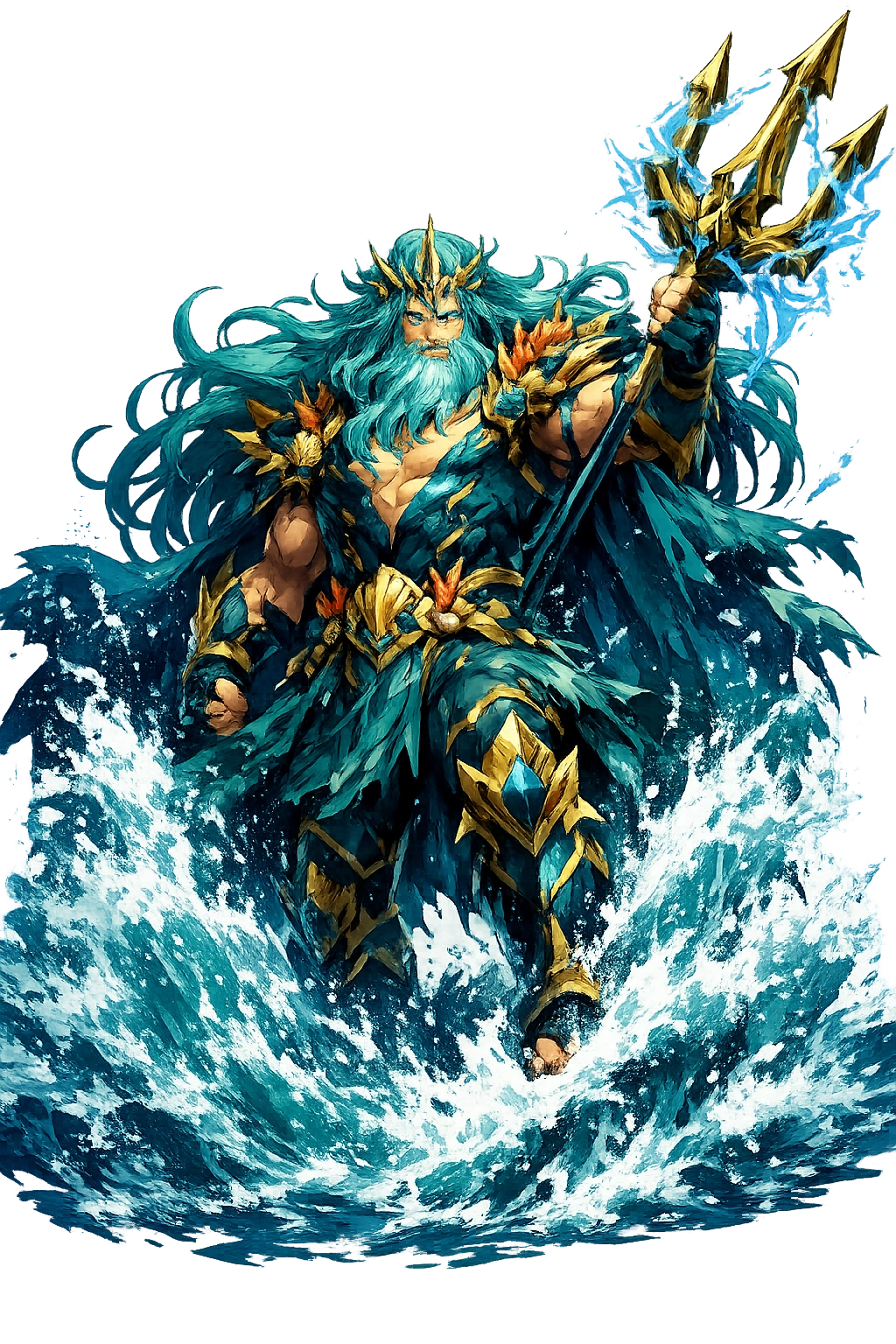
Stories of Poseidôn
Poseidôn's myths dramatize the rage of the excluded. He is a great Olympian, co-equal of Zeus by lot, yet he is repeatedly thwarted — by Athena at Athens, by Odysseus after the blinding of Polyphemos, by the very mortals whose sacrifices he demands. His stories are the Greek meditation on power that cannot get what it wants.
When the Titans fell, the three sons of Kronos divided the cosmos not by combat but by lot — a detail Homer preserves in Poseidon's own indignant speech. Zeus drew the sky, Hades the murky darkness, and Poseidon the grey sea, where he rules among his wife Amphitrite and the old sea gods; the earth and high Olympus were left in common (Iliad 15.187–193; Hesiod, Theogony 881–885). The arrangement makes Poseidon formally co-equal with Zeus, and his mythology repeatedly tests that equality: he complains in the Iliad that Zeus forgets it, he storms against Athena's city, he competes with Zeus's authority over Troy. The sea he rules is the perfect emblem of his rank — vast, restless, and impossible to fence. Poseidon's realm is the part of the cosmos that refuses to be governed, and the god is the part of divinity that refuses to be content.
Poseidon and Athena competed for the patronage of Attica, and their contest marks the Acropolis still. He struck the rock with his trident and produced a salt spring — or, in some tellings, the first horse — while Athena planted the olive tree, the first of the 'contest olive' whose descendant was shown to visitors for centuries (Pseudo-Apollodorus, Bibliotheca 3.14.1; Herodotus 8.55; Pausanias 1.24.5). Cecrops, the earth-born king, judged for the goddess, whose gift gave food, oil, and wood; the Athenians told the story so faithfully that they preserved both tokens, the spring and the tree, within the Erechtheion. Poseidon flooded the land in revenge and demanded costly propitiation — the Athenians gave him the first fruits of every harvest. The myth encodes a political insight the Athenians lived by: sea power must yield to civic wisdom, but it must never be forgotten.
Trapped in the cave of the Cyclops Polyphemos — Poseidon's son by the nymph Thoosa — Odysseus blinded the giant with a stake hardened in the fire and escaped beneath the sheep, taunting the wounded monster from the safety of his ship. Polyphemos prayed to his father: 'grant that Odysseus, the city-sacker, may never reach his home' (Homer, Odyssey 9.526–536). Poseidon heard, and the prayer is the engine of the entire Odyssey: every storm, every wreck, every year of wandering flows from it, while the sea god carries his grievance to the councils of Olympus and beyond Zeus's attempts to close it (Odyssey 1.20–79; 13.125–145). Poseidon never forgives. The myth makes him the obstacle that gives the return its meaning — a hero tested by a god who measures out, in wind and wave, the full price of a single moment of hubris.
Poseidon is Hippios, the Horseman, and the Greeks told several stories of how he made the horse. In the Athenian version he produced the first stallion and mare in his contest with Athena; in another, still stranger, he pursued Demeter in her grief-driven flight and the goddess hid herself as a mare, whereupon Poseidon took stallion form and from that union sprang the wonder-horse Arion, 'swift as the whirlwind' (Pausanias 8.25.5–8, drawing on Arcadian tradition). Later poets said simply that he struck a rock with his trident and the first horse stepped out of the breaking surf. The sources disagree on mechanism but not on meaning: the horse, like the wave, is beautiful, powerful, and capable of sudden destruction. Thessalian cavalry and Athenian chariots alike raced in his honor, because the thunder of hooves is the closest sound on land to the sea he rules.
When Minos of Crete prayed for a bull to sacrifice to Poseidon, the god sent a magnificent white bull up from the sea — and Minos, coveting it, sacrificed another animal instead, keeping the god's bull in his herds (Pseudo-Apollodorus, Bibliotheca 3.1.3–4; cf. Bacchylides 17 for the sea-borne bull). Poseidon's revenge was precise. He inspired Minos's wife Pasiphae with a monstrous passion for the bull; the engineer Daidalos built the wooden cow in which she could approach it; and from that union was born the Minotauros, kept in the labyrinth and fed with Athenian tribute until Theseus killed it. A single withheld sacrifice thus unmade a dynasty. The myth teaches the strict economy of divine exchange: Poseidon gives generously — springs, horses, bulls — but the gift is a contract, and the contract is enforced to the third generation.
Sea, Earthquakes, Horses, and Storms
Poseidôn is the lord of the waters that surround and threaten every Greek city. He is not a gentle sea; he is the earth-shaker, the tamer of horses, the sudden storm that overturns ships and cracks land. His power is older than Zeus's in some traditions, and his rivalry with Athena for Athens defines the tension between maritime force and civic wisdom.
Poseidôn commands the Mediterranean itself — calm or wrathful, generous or deadly.
His trident strikes rock and splits the earth; every tremor is his chariot passing beneath.
He created the horse, whether as a gift to Athens or as a creature of the breaking wave.
The sudden gale, the waterspout, and the drowning wave all answer to him.
From the original script to the living URL
Ποσειδῶν
The name in its original Greek form. Poseidôn (Ποσειδῶν) is attested in the source tradition — “Lord of the Earth (from πόσις + δᾶ)”. Its diphthongs, long vowels, and acute accents carry the full phonetic and orthographic weight of the source tradition.
poseidon
Reduced to plain poseidon, the name loses everything that made it specific: diphthongs, long vowels, and acute accents. What remains is an ASCII string that machines can parse but that no longer speaks with its original voice.
Poseidôn
The Unicode restoration recovers what ASCII flattened. Poseidôn restores diphthongs, long vowels, and acute accents, returning the name to its original written dignity. The domain encodes to Punycode, but the browser displays the truth.
Poseidôn.com → xn--poseidn-y0a.com
The non-ASCII characters in Poseidôn are encoded while the ASCII remains visible. To the DNS, it is Punycode. To humanity, it is Poseidôn.
Owned, ideal, and ASCII forms of Poseidôn
Poseidôn
Restores Ποσειδῶν. The live temple domain — poseidôn.com.
Poseidōn
Restores Ποσειδῶν. A second live spelling — poseidōn.com.
poseidon
Flattens Ποσειδῶν. The plain ASCII fallback — what DNS and legacy systems see.
How Poseidôn was spoken
How Poseidôn travels from ancient script to the modern URL
Greek Ποσειδῶν; usually analysed as πόσις “lord, husband" + δᾶ “earth" (Doric for γῆ), hence “lord of the earth".
Sea, Earthquakes, Horses
The Unicode restoration Poseidôn preserves Greek stress and length; the ASCII form poseidon loses these features.
The lore you have read is the living myth. Extended Lore opens the scholarly vault beneath it: the cult and its material remains, a history of the image, the name after antiquity, a meditation on what the name still means, and the full scholarly apparatus — etymology, orthography, sources.
Enter Extended Lore