PuniCodex

Extended Lore

Ποσειδῶν Poseidôn

Etymology · Orthography · Cult · Iconography · Reception · Sources

Tier 1 Poseidôn.com · Poseidōn.com
Poseidôn — Sea, Earthquakes, Horses
01

Quick Facts

Essential information about Poseidôn, Sea, Earthquakes, Horses

Original ScriptΠοσειδῶν
Unicode RestorationPoseidôn
Reconstructed Pronunciation/po.sei.dɔ́ːn/
PantheonGreek
DomainSea, Earthquakes, Horses
MeaningLord of the Earth (from πόσις + δᾶ)
ClassificationTier 1
Primary DomainPoseidôn.com
Sacred SymbolsTrident, Horse, Bull, Dolphin, Pine tree
02

Etymology & Word Family

From original script to Unicode restoration

Proto-indo-european *potsi-dhāǵʰ- lord of the earth/waters
Original Script Ποσειδῶν Poseidôn — "Lord of the Earth (from πόσις + δᾶ)"
Unicode Restoration Poseidôn Restored stress, length, and script
Modern ASCII poseidon Plain-ASCII fallback

From πόσις "lord, husband" + δᾶ (Doric for γῆ "earth"), later reinterpreted as "sea".

03

Unicode Character Breakdown

Character-by-character philological analysis

CharacterUnicodeNameBlockPhonetic Role
PU+0050Latin Capital Letter PBasic LatinPi
oU+006FLatin Small Letter OBasic LatinShort omicron
sU+0073Latin Small Letter SBasic LatinSigma
eU+0065Latin Small Letter EBasic LatinShort epsilon
iU+0069Latin Small Letter IBasic LatinShort iota
dU+0064Latin Small Letter DBasic LatinDelta
ôU+00F4Latin Small Letter O with CircumflexLatin-1 SupplementCircumflex: long omega with stress
nU+006ELatin Small Letter NBasic LatinNu

The Tier 1 classification reflects how much of the original phonology this restoration preserves — stress and vowel length for Greek names, distinctive letters and diacritics for every other tradition.

04

Cult & Worship

How the sacred was kept — rites, sanctuaries, remains

The Cult

Poseidon's cult ran wherever the sea or the fault line did — which is to say, everywhere in Greece. His great panhellenic seat was Isthmia beside Corinth, where the Isthmian Games were founded in 582 BCE and celebrated every second year; the stadium and temple sequence there have been excavated on the ground. On the Attic cape the Doric temple at Sounion watched over sailors' homecoming, while inside the Erechtheion the salt spring and the trident-scarred rock of his contest with Athena were shown to visitors into Roman times. Attica kept his midwinter festival Poseidea, and bulls were his characteristic victim. At Calauria (Poros) an ancient amphictyony of maritime states centered on his sanctuary — the refuge where Demosthenes took poison in 322 BCE rather than fall to Macedon. Helike in Achaea, his own cult city, vanished in the earthquake and tsunami of 373 BCE, read by all Greece as the god's own blow.

In the Earth

The marble Temple of Poseidon at Sounion (ca. 444–440 BCE) stands on the Attic cape where sailors first saw home, its Doric columns framing the Aegean. At Isthmia, his panhellenic sanctuary northwest of Corinth, excavations have revealed a temple sequence from the seventh century BCE, the stadium and starting-line for the Isthmian Games founded in 582 BCE, and the unusual twin harbor works. The city of Helice in Achaea, sacred to Poseidon Helikonios, sank beneath the sea in an earthquake and tsunami of 373 BCE — ancient witnesses read the disaster as the god's punishment, and its ruins were still visible underwater in Roman times (Pausanias 7.24–25). The Tainaron promontory housed a cave sanctuary associated with the underworld. On Crete and at Pylos, Linear B tablets name po-se-da-o, and the great bronze statue hauled from Cape Artemision — Zeus or Poseidon, his trident lost — is the most famous image of a Greek god in the world.

05

Iconography

How Poseidôn was imaged across the ages

The Image

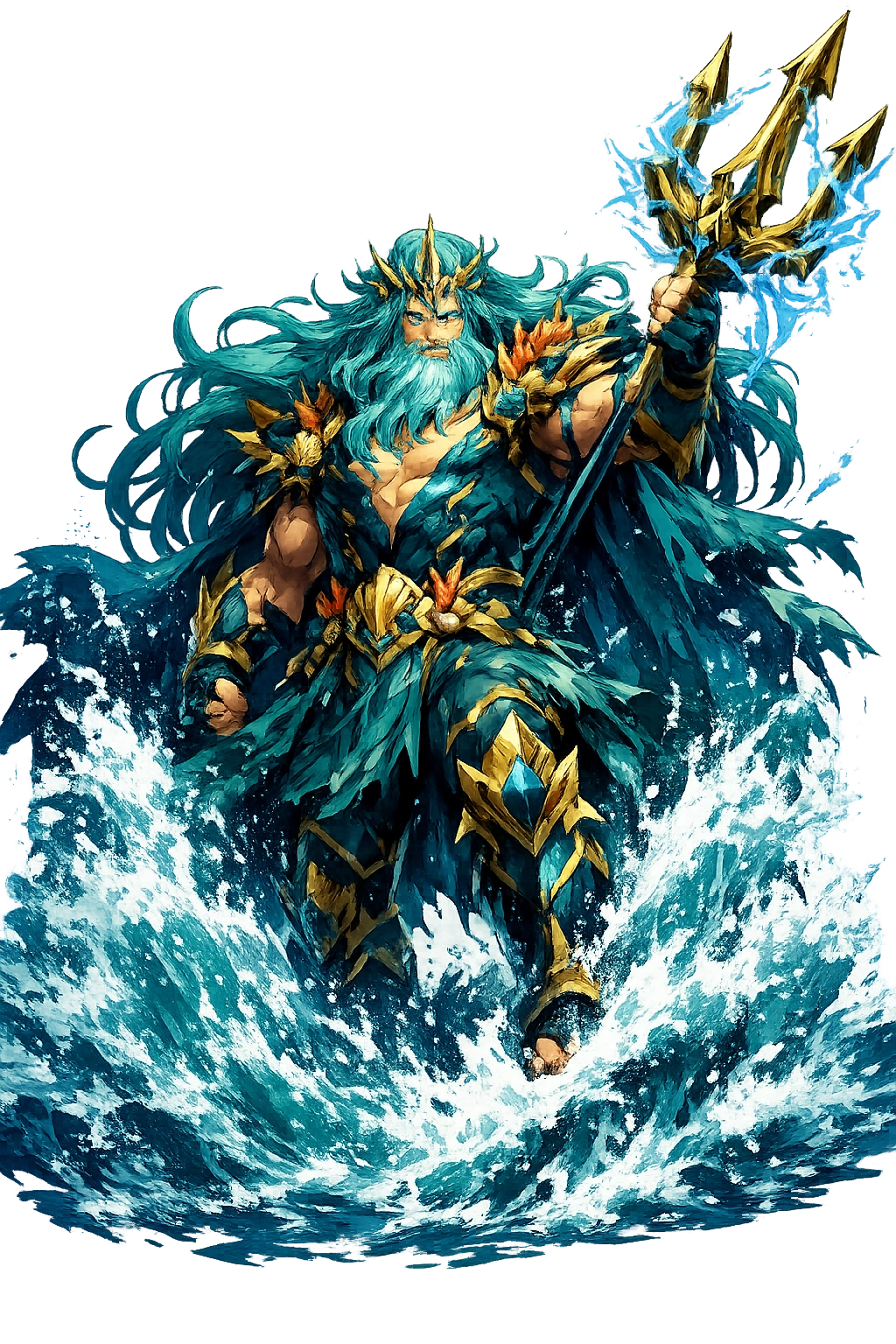
Recognize Poseidon by what he carries: the trident, often with a dolphin at his feet or a horse at his side — a bearded, powerful god whom Archaic art only slowly distinguishes from Zeus, since both are mature and majestic and the weapon that would decide the question is so often lost. The supreme case is the bronze god hauled from Cape Artemision (c. 460 BCE, National Archaeological Museum, Athens), arm cocked to hurl — trident or thunderbolt gone, identity undecided. The Parthenon's west pediment fixed him in Athens' civic memory, rising from the earth against Athena in the contest for Attica. Vase painters developed his other selves: Hippios receiving horse sacrifice, the bull stepping out of the sea. The Hellenistic Poseidon of Melos repeats the mature type, and in Roman floor mosaics the image froze into its final, endlessly copied form — the sea's emperor, beard streaming like a wave.

06

Reception & Transformation

The name after its own age — transmission, translation, survival

Afterlives

Poseidon's transmission after antiquity ran through Byzantium and the printing press — Rome's chapter belongs to his syncretism, where Neptune already sits enthroned. Medieval Europe knew him chiefly through mythography and the Homeric manuscripts preserved in the Greek East: the ship-wrecking enemy of Odysseus, glossed in the margins of the Odyssey's medieval codices and allegorized as the element of water itself. Renaissance humanism re-grounded him textually — the Greek epic printed at the end of the fifteenth century, then Chapman's and Pope's English translations making his storms household reading — and artistically, as Neptune presides over the fountains of sixteenth- and seventeenth-century Italy, from Ammannati's colossus in Florence's Piazza della Signoria to Bernini's Neptune and Triton. Modern scholarship twice remade him: first in the nineteenth and early twentieth centuries, when the line from Preller through Nilsson read him as an older, chthonic earth-shaker beneath the Homeric sea-lord; then in 1952, when Ventris and Chadwick's decipherment of Linear B restored po-se-da-o of Pylos and Knossos — a god already great a thousand years before Homer, and perhaps once greater than Zeus. Every generation since has re-fought the Artemision question: which weapon did he hold, and does the sea god rule the water, or the land beneath it?

Identifications Across Traditions

The Romans identified Poseidôn with Neptunus, an Italic water god originally associated with springs and rivers, whom Greek influence remade into the lord of the sea; his festival, the Neptunalia, was celebrated in midsummer under tents of foliage. In art his chariot drawn by hippocamps became one of antiquity's most copied images, and the trident migrated with him as a universal emblem of maritime sovereignty — it still rides the flag of Barbados. The planet Neptune, discovered in 1846 and glimpsed only through mathematics before it was seen, bears his name, as does every submarine that ever dove. In medieval and Renaissance Europe he presided over the iconography of the ocean itself, from mosaics to fountains.

Modern Legacy

Poseidôn's legacy is the recognition that the sea is never truly conquered. Every Greek colony, fisherman, and sailor lived under his power, and the Isthmian Games at Corinth — his panhellenic festival — drew the world every two years. His trident appears on coins and admiralty seals from antiquity to the present, and the seafarer's prayer before departure descends from his cult. In an age of climate change and rising seas, his ancient title Earth-Shaker has taken on literal force: the tsunamis of 365 and 365 CE that struck Crete and Alexandria were anciently read as his blows. Restoring Poseidôn restores the name by which the Greeks addressed the water that both feeds and threatens every civilization.

07

The Meditation

What Poseidôn means — beyond the dictionary

Poseidôn is the god of what the Greeks could not control. The sea was not a highway to them; it was a vast, unpredictable power that could swallow cities. Earthquakes were worse — no warning, no defense, no explanation except the anger of the god. Poseidôn therefore represents the limits of human mastery, the forces that mock our plans.

Yet he is also the giver of horses, one of the most useful and beautiful creatures in the ancient world. This double nature is typical of Greek religion: the same god who destroys also provides. To honor Poseidôn is not to deny danger but to acknowledge it — to build the city with the sea in mind, to pray before sailing, and to accept that the earth may shake.

08

Screen & Culture

Where Poseidôn echoes through film, television, and games — and how

09

Frequently Asked Questions

Common questions about Poseidôn, Sea, Earthquakes, Horses, and Unicode restoration

01How do you pronounce Poseidôn?

In reconstructed pronunciation, Poseidôn is /po.sei.dɔ́ːn/ — approximately 'poh-SAY-done' — the second syllable is light, the third is long, pitched, and powerful.

02What does Poseidôn mean?

Poseidôn means Lord of the Earth (from πόσις + δᾶ) in the greek tradition.

03What are the symbols of Poseidôn?

Poseidôn is associated with Trident (Weapon and scepter in one; with it he strikes the earth to raise springs, islands, and earthquakes), Horse (His creation and his creature — the breaker of waves made flesh, honored in his epithet Hippios, 'Horseman'), Bull (The sacrificial animal he demands; the white bull he sent from the sea to Minos carried a curse when it was withheld), Dolphin (Rescuer and messenger of sailors; the dolphin leaping before a ship was read as the god's escort), Pine tree (Sacred to him and the source of masts and keels — the tree that becomes the ship, his mobile temple).

04Why are there different spellings of Poseidôn?

Each form is a historically attested restoration rather than a mistake: Poseidōn is the macron-only form (LSJ convention: length only, no circumflex). PUNICODEX registers the full set so the tradition is preserved under every defensible spelling.

05Why restore Poseidôn in Unicode?

Plain ASCII poseidon strips the stress, length, and script that make the name specific. Unicode restoration returns the name to its original written dignity.

06What is the most important myth about Poseidôn?

“Lord of the Sea by Lot” — the The Division story that anchors the mythology of Poseidôn, told in full on the lore page.

10

Scholarly Sources

The philological foundations of this restoration

Every claim on this page is grounded in established scholarship. The orthographic restorations follow disciplinary convention. The etymological chain follows the best available reference works. This is not invention — it is resurrection through scholarship.

◈

Lexicography & Philology

  • Liddell, H. G., Scott, R., & Jones, H. S. A Greek-English Lexicon. Oxford: Clarendon Press, 9th ed. 1996.
  • Pape, W., & Benseler, G. E. Wörterbuch der griechischen Eigennamen. Braunschweig: Vieweg, 1884.
  • Beekes, R. S. P. Etymological Dictionary of Greek. Leiden: Brill, 2010.
◎

Primary Texts

  • Homer, Iliad 15.184–199
  • Homer, Odyssey 1, 9, and 13
  • Pseudo-Apollodorus, Bibliotheca 3.1 and 3.14
  • Pausanias, Description of Greece 8.25
◉

Archaeology & Art History

  • Material evidence — iconography, inscriptions, and temple archaeology — for Poseidôn and related cults.
✦

Religious Studies

  • Herodotus 8.55
  • Burkert, Greek Religion
Return

The Surface Awaits

You have traced the name from its earliest attestation to its Unicode restoration. Now return to the myth. The story is where the name lives.

Back to Lore
Poseidôn mascot