
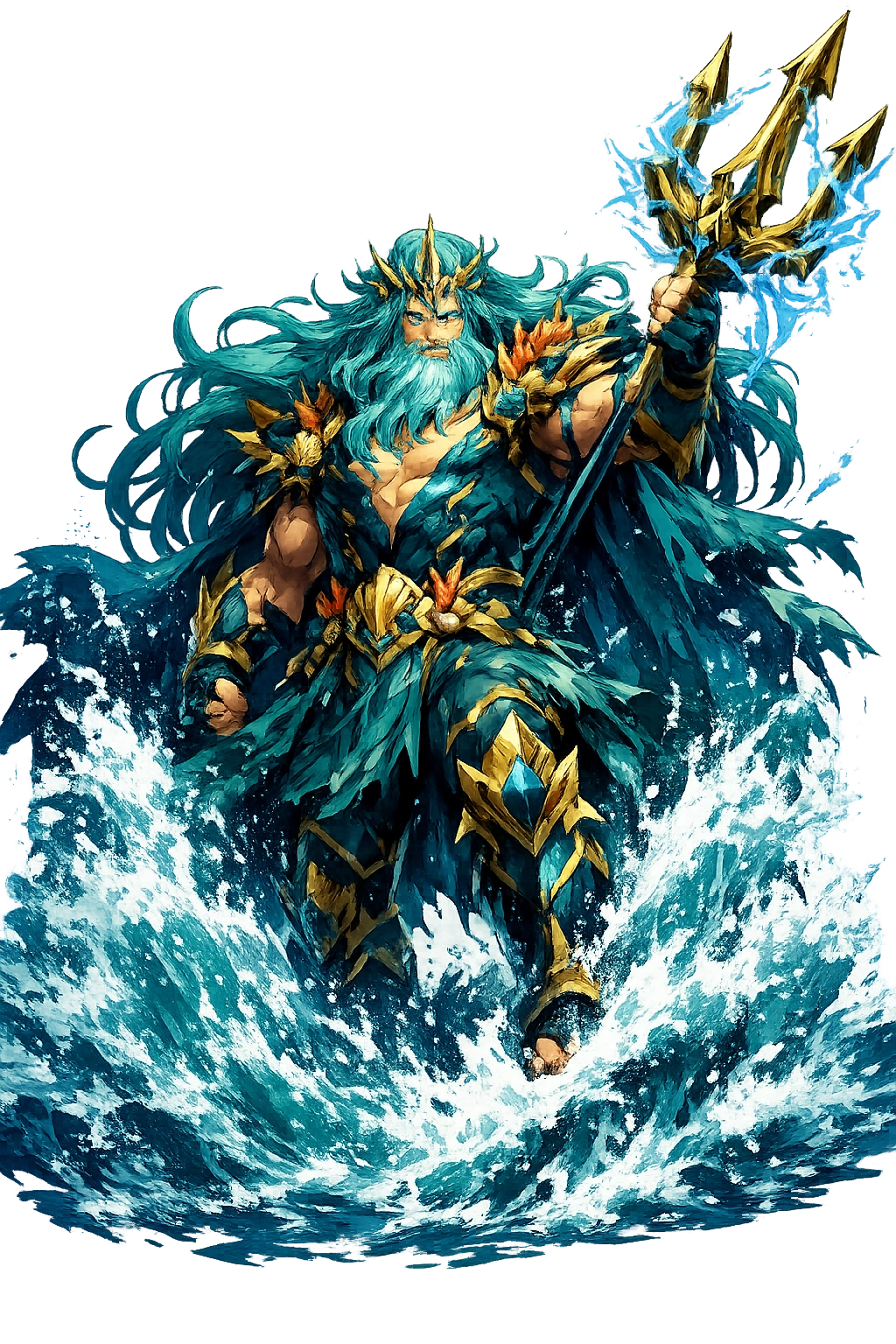
Why Poseidôn is spelled that way — and what it costs to get it right
There is a version of this name the early internet had to settle for: poseidon. This is the file on how Poseidôn replaced it.
Poseidôn's myths dramatize the rage of the excluded. He is a great Olympian, co-equal of Zeus by lot, yet he is repeatedly thwarted — by Athena at Athens, by Odysseus after the blinding of Polyphemos, by the very mortals whose sacrifices he demands. His stories are the Greek meditation on power that cannot get what it wants.
At a Glance
- Restored name: Poseidôn
- ASCII form: poseidon
- Meaning: "Lord of the Earth (from πόσις + δᾶ)"
- Domain of influence: Sea, Earthquakes, Horses
- Pantheon: Greek
- Classification: Tier 1
- Original script: Ποσειδῶν
- Series: The Restoration Files, No. 396 of 546
The Name Before the Marks
The name is attested as Ποσειδῶν, on the evidence Homer, Iliad 15.184–199 and Homer, Odyssey 1, 9, and 13 set down. On the evidence, it means "Lord of the Earth (from πόσις + δᾶ)".
Strip Poseidôn to poseidon and one piece of evidence vanishes:
- o → ô — Circumflex: long omega with stress: the stress position the ASCII form cannot show.
A reader who knows the marks hears the name correctly on the first try. A reader who never sees them never gets the chance.
Spoken, the name runs `/po.sei.dɔ́ːn/` — 'poh-SAY-done' — the second syllable is light, the third is long, pitched, and powerful.
The Temple That Stands Now
The restored name is not a plaque; it is an address. The temple of Poseidôn lives at /poseidon/, with its mythology in the lore halls, its peer-reviewed record in the Scholarly Edition, and its place in the pattern atlas on the patterns floor.
Tier-1 is not a compliment; it is a measurement. This restoration keeps something the ASCII form provably loses, and the measurement is repeatable.
Where the Name Stood First
The marble Temple of Poseidon at Sounion (ca. 444–440 BCE) stands on the Attic cape where sailors first saw home, its Doric columns framing the Aegean. At Isthmia, his panhellenic sanctuary northwest of Corinth, excavations have revealed a temple sequence from the seventh century BCE, the stadium and starting-line for the Isthmian Games founded in 582 BCE, and the unusual twin harbor works. The city of Helice in Achaea, sacred to Poseidon Helikonios, sank beneath the sea in an earthquake and tsunami of 373 BCE — ancient witnesses read the disaster as the god's punishment, and its ruins were still visible underwater in Roman times (Pausanias 7.24–25). The Tainaron promontory housed a cave sanctuary associated with the underworld. On Crete and at Pylos, Linear B tablets name po-se-da-o, and the great bronze statue hauled from Cape Artemision — Zeus or Poseidon, his trident lost — is the most famous image of a Greek god in the world. The temple on the web is the newest of these addresses — the first one that fits in a pocket.
The Archetype at Work
The pattern atlas seats this temple in 4 industries, each match argued and weighted: Maritime, Shipping & Ocean Industries (lord of the waters that surround and threaten every Greek city; the sea itself, with a temper and a trident.); Disaster Resilience & Recovery (ennosigaios, the Earth-Shaker; earthquake and tsunami risk was his remit before it was an industry.); Environmental & Climate Services (rising seas are his encroachment; the coast's oldest adversary in a warming century.). The Resonance File reads those seats through the myths themselves.
In the Sacred Texts
The Greek tradition is not a vibe; it is a library. The Sacred Texts collection holds Theogony, Homeric Hymns, and Works and Days — the primary sources the temple's scholarship is built on. The temple is the argument; the texts are the evidence.
The File Continues
The temple's founding dispatch tells the name's story; its Resonance File reads the myths into the industries; the blog index holds the whole archive.
Continue the series — previous file: Póntos (read it here) · next file: Prajāpati (read it here).
The Restoration Files are written from the same canonical record as the temples themselves: the lexicon, the lore catalog, the pattern atlas, and the cited scholarly sources. If a file ever disagrees with its temple, the temple is right — tell us, and the file will be corrected.