
Why Póntos is spelled that way — and what it costs to get it right
There is a version of this name the early internet had to settle for: pontos. This is the file on how Póntos replaced it.
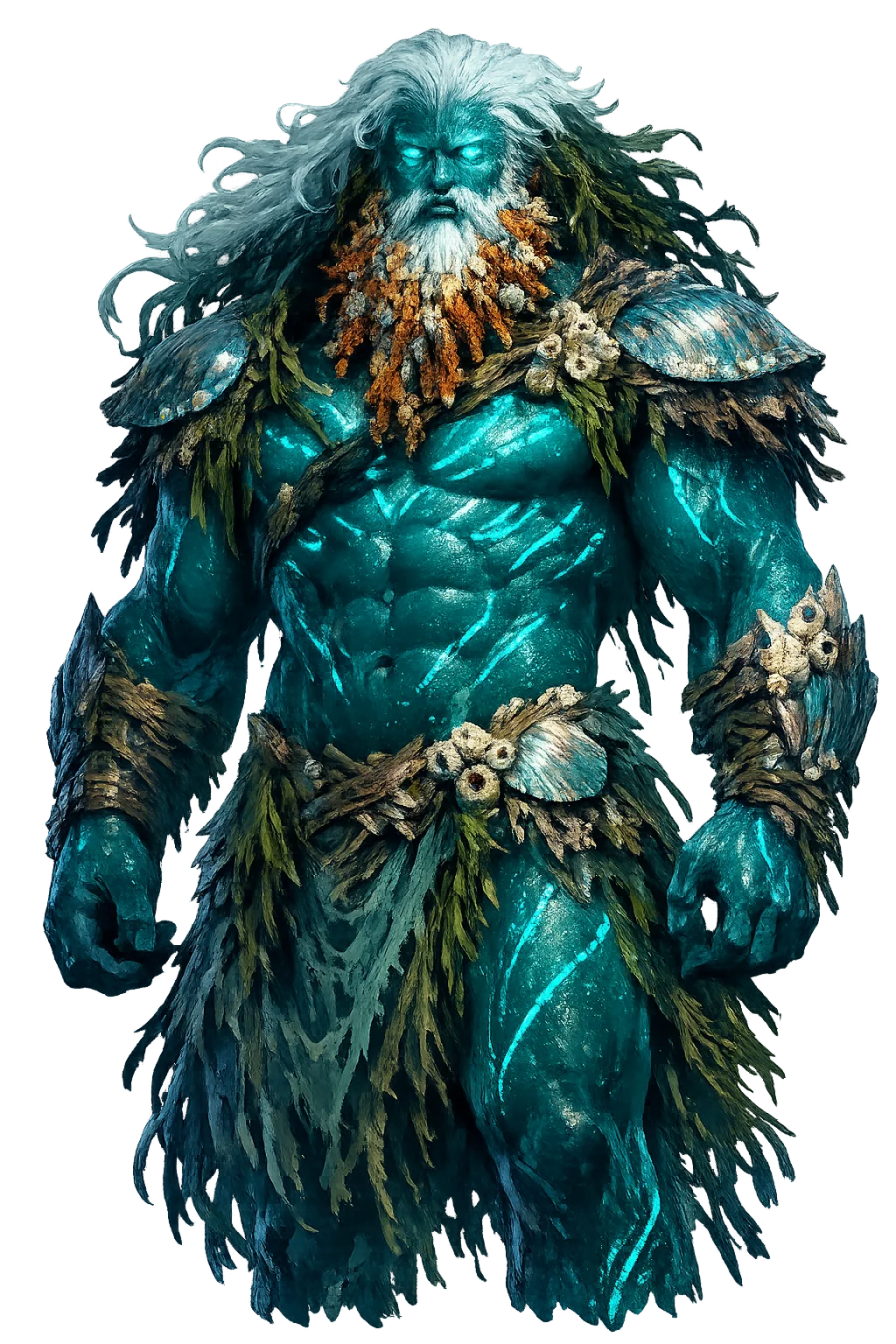
Póntos has few myths because he is a personification rather than a character — yet his importance is genealogical. He is the primordial sea, the wet element itself, and the source of the sea's entire divine population: the kindly old Nereus, the monstrous Phorcys and Ceto, the wondrous Thaumas, and the hard-hearted Eurybia.
At a Glance
- Restored name: Póntos
- ASCII form: pontos
- Meaning: "Sea (from πόντος)"
- Domain of influence: The Primordial Sea
- Pantheon: Greek
- Classification: Tier 2
- Original script: Πόντος
- Series: The Restoration Files, No. 395 of 546
The Name Before the Marks
The name is attested as Πόντος, on the evidence Hesiod, Theogony 131–132, 233–239, 265–269, 375–377 and Homer, Iliad and Odyssey (pontos as the open sea) set down. On the evidence, it means "Sea (from πόντος)".
Strip Póntos to pontos and one piece of evidence vanishes:
- o → ó — Acute on omicron: the stress position the ASCII form cannot show.
These are the small, provable things a restoration is made of: not taste, not branding — attestation.
Spoken, the name runs `/pón.tos/` — 'PON-toss' — the first syllable is pitched and short, like the peak of a swell.
The Temple That Stands Now
The restored name is not a plaque; it is an address. The temple of Póntos lives at /pontos/, with its mythology in the lore halls, its peer-reviewed record in the Scholarly Edition, and its place in the pattern atlas on the patterns floor.
The restoration keeps one feature the ASCII form drops. One is enough to matter, and the label says so plainly: Tier-2.
Where the Name Stood First
Greek colonies around the Pontos Euxeinos preserve sanctuaries and harbor works at Olbia, Sinope, Trapezous, and Pantikapaion (Kerch); the Milesian colony of Olbia produced bone plaques and coinage honoring local river and sea powers. Shipwrecks such as Tektaş Burnu and the Black Sea deep-water surveys associated with Robert Ballard document the trade routes that made the Pontic world a single maritime economy. No sanctuary of Póntos himself is known — the primordial sea was honored in the harbors, not housed in temples — which is itself the archaeological signature of a personification worshipped as environment rather than lord. The temple on the web is the newest of these addresses — the first one that fits in a pocket.
The Archetype at Work
The pattern atlas seats this temple in 3 industries, each match argued and weighted: Maritime, Shipping & Ocean Industries (the primordial sea itself, older than Poseidṓn’s rule — where the storm-god is the weather, Póntos is the water.); Environmental & Climate Services (the sea as environment rather than deity; ocean conservation's primordial stakeholder.); Ancestry & Heritage Services (father of Nereus, Phorkys, and Keto; the sea's whole divine dynasty begins with him.). The Resonance File reads those seats through the myths themselves.
In the Sacred Texts
The Greek tradition is not a vibe; it is a library. The Sacred Texts collection holds Theogony, Homeric Hymns, and Works and Days — the primary sources the temple's scholarship is built on. The temple is the argument; the texts are the evidence.
The File Continues
The temple's founding dispatch tells the name's story; its Resonance File reads the myths into the industries; the blog index holds the whole archive.
Continue the series — previous file: Poliahu (read it here) · next file: Poseidôn (read it here).
The Restoration Files are written from the same canonical record as the temples themselves: the lexicon, the lore catalog, the pattern atlas, and the cited scholarly sources. If a file ever disagrees with its temple, the temple is right — tell us, and the file will be corrected.