The Living Myth
Underworld, Wealth, the Dead · "The Rich One" — Roman lord of the underworld and of buried wealth
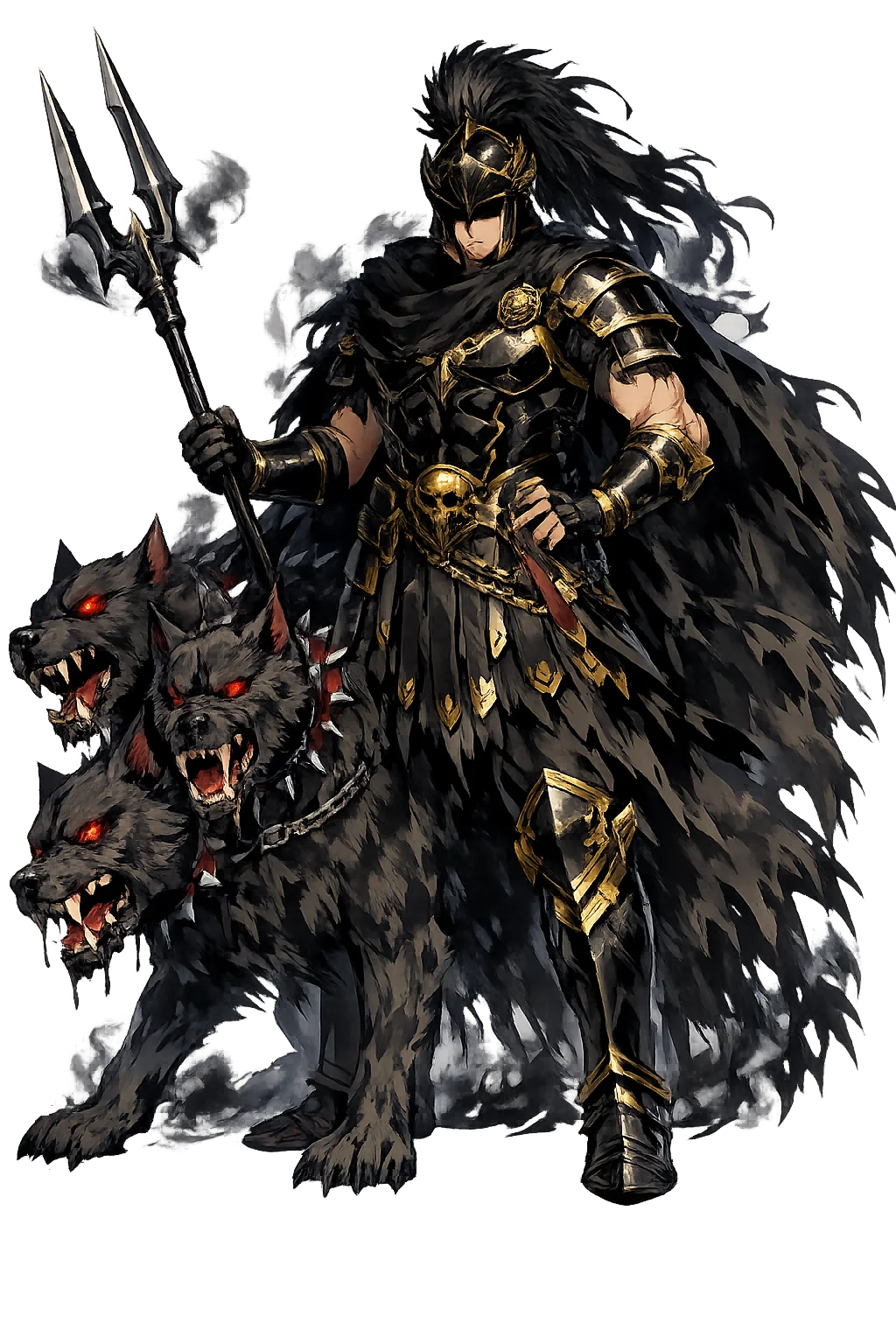
Stories of Plūtō
Plūtō's Roman myths retell the Greek cycle with a merchant's accent: the underworld as treasury as much as tribunal. Ovid gives the rape of Proserpina, Virgil and Ovid the one descent that moved him, Apollodorus the thieves who failed, Hesiod the older wealth-god beneath the name, and Rome's own calendars the gate that opened three days a year.
Ovid tells the Roman rape with a landscape's grief (Metamorphoses 5.385–571). In the meadow below Henna, Proserpina gathers flowers — violets, lilies, crocuses — and laughs when the narcissus springs up, a trap set by Venus for the sake of her son Cupid's empire. The ground opens; Plūtō, 'the lord of the dark', carries her down through the pool of Cyane, whose waters, forbidden to speak, dissolve the nymph herself into a spring. Cerēs searches with torches lit at Etna's flame; she turns the mocking boy Ascalabus into a spotted gecko, and opens the cattle of the old man who sheltered her until he curses his own gift. Jupiter arbitrates: the girl who has eaten is bound to the deep. Six pomegranate seeds — or one, in the older Greek telling — divide the year between mother and husband, spring and summer above, autumn and winter below. The myth is Rome's charter for the agricultural year: what is buried is not lost, and what returns must first have descended.
When Orpheus lost Eurydice to a snake, he did what no mortal does: he went down singing. Virgil's account (Georgics 4.453–527) makes the underworld itself soften — the Danaids' urn rests, Ixion's wheel stands still, Tityos' vultures pause — and Ovid adds (Metamorphoses 10.1–85) that even the king and queen of the deep wept, a first for both. The condition was set: lead her up, and do not look back until you stand in daylight. At the very border, love or doubt turned his head, and she was reclaimed — a second death, and this one his own doing. The Romans read the myth as Plūtō's one audited exception: the deep can be moved, exactly once, and only by the thing it does not possess — a mortal voice persuasive enough to make law pause. Every later descent of European poetry, Dante's, Monteverdi's, Gluck's, walks the same road under the same rule.
Not all who descended came to sing. Pirithous, having rashly sworn to marry a daughter of the highest god, persuaded his friend Theseus to descend with him and carry off Proserpina herself (Apollodorus, Bibliotheca 2.5.12; Epitome 1.24). They sat upon the Chair of Forgetfulness and could not rise, their limbs bound by serpents, until Heracles — come below on his own errand for the hound — wrenched Theseus free and left Pirithous fixed in the stone of the deep, where some say he remains. The failed abduction is the myth's own footnote to the wisdom of Solon, who warned Croesus that no man may count himself happy before the end. The moral Plūtō keeps is plain and grammatical rather than cruel: the dead belong below, the living above, and the queen between is not a prize but a treaty. The exceptions are famous precisely because they are singular — one singer admitted, two thieves impaled, and the border back in order by morning.
His older Greek identity is Ploutos, Wealth — born to Demeter and the mortal Iasion 'in the thrice-ploughed fallow' (Hesiod, Theogony 969–974), and granted by Demeter to bless 'all mortal men' in the Homeric Hymn to Demeter (486–489). The folk logic is geological: wealth — grain, ore, treasure — comes from under the earth, and so the lord of under the earth is its giver. Aristophanes' comedy Plutus made him a blind old steward whose healed sight showers the just with gold — a fantasy Athens understood as precisely that. Rome kept the word's double truth: as Plūtō he is the treasury, as Dis the grave, and the same soil feeds both accounts. No ancient ever mistook him for safe; but properly approached he was the most reliable of gods — the only one whose gifts were audited every harvest and whose invoices were paid in seed corn.
Rome's own door to his kingdom stood at the Tarentum in the Campus Martius, a roofed pit — the mundus — opened by the pontiffs only three days a year, when, as Festus and Servius (ad Aen. 3.104) report, 'the door of the gloomy god is open' and no public business is done. Its greatest rite came in the republic's darkest hour: in 249 BCE the Sibylline books ordered the first Ludi Saeculares, sacrifices and games to Dis Pater and Proserpina to turn the First Punic War (Valerius Maximus 2.4.5; Zosimus 2.1–3). Augustus revived the games in 17 BCE with a liturgy preserved on stone (CIL VI 32323): after the daylight offerings to the Fates, the Ilithyiae, and Earth Mother, the city sacrificed at night, on the Tarentum, to Dis and Proserpina. The gate-myth is the state cult in miniature — Rome does not live with its underworld; it schedules it, opens it three days a year, and closes the door before the business of living resumes.
Underworld, Wealth, and the Doors of the Deep
Plūtō is Rome's underworld god in his own right — not merely Hádēs renamed, but the Latin "Rich One" who rules the dead and the buried treasure together: the god in whose name the ground gives up both its wealth and its silence.
The Plutonia — the underworld gates; Rome's own door to his realm stood at the Tarentum in the Campus Martius, opened three days a year.
His twin-name: the wealth-god Plutus — cornucopia from below, Demeter's son in the Greek telling.
The three-headed hound of the threshold — the deep's own border guard, charmed once by Orpheus' song.
The queen he took by force and kept by season — Rome's Persephonē, arbiter of the returning year.
From the original script to the living URL
PLVTO
The name in its original Roman form. Plūtō (PLVTO) is attested in the source tradition — “"The Rich One" — Roman lord of the underworld and of buried wealth”. Its macron-length vowels carry the full phonetic and orthographic weight of the source tradition.
pluto
Reduced to plain pluto, the name loses everything that made it specific: macron-length vowels. What remains is an ASCII string that machines can parse but that no longer speaks with its original voice.
Plūtō
The Unicode restoration recovers what ASCII flattened. Plūtō restores macron-length vowels, returning the name to its original written dignity. The domain encodes to Punycode, but the browser displays the truth.
Plūtō.com → xn--plt-sxa2m.com
The non-ASCII characters in Plūtō are encoded while the ASCII remains visible. To the DNS, it is Punycode. To humanity, it is Plūtō.
Owned, ideal, and ASCII forms of Plūtō
Plūtō
Restores PLVTO. The live temple domain — plūtō.com.
pluto
Flattens PLVTO. The plain ASCII fallback — what DNS and legacy systems see.
How Plūtō was spoken
How Plūtō travels from ancient script to the modern URL
The lore you have read is the living myth. Extended Lore opens the scholarly vault beneath it: the cult and its material remains, a history of the image, the name after antiquity, a meditation on what the name still means, and the full scholarly apparatus — etymology, orthography, sources.
Enter Extended Lore