Stories of Perseús
Perseus is the Argive hero of the Gorgon-slaying, the rescuer of Andromeda, and the founder of the dynasty that produces Heracles. His cycle, told most fully by Apollodorus and Ovid, turns on oracles, divine equipment, and the terrible double gift of the Gorgon's head.
Akrisios, king of Argos, went to Delphi to ask the oracle for a son and received instead a death sentence: his daughter Danaë would bear a child who would kill him. He locked Danaë in a brazen chamber sunk underground, but Zeus came upon her as a shower of gold — 'she took the gold into her lap,' as Simonides sang (PMG 543) — passing through bronze with an immortal's ease. When Perseus was born, Akrisios would not kill mother and child outright; he had them sealed in a chest and cast into the sea, which carried them gently to the island of Seriphos. There the fisherman Diktys drew them ashore and gave them his house (Apollodorus, Bibliotheca 2.2.1; cf. Pindar, Pythian 12.12–16). The oracle has already framed the whole of the hero's life: his greatness and his grandfather's death are the same event, waiting years away at a games-ground for a discus to close the circle.
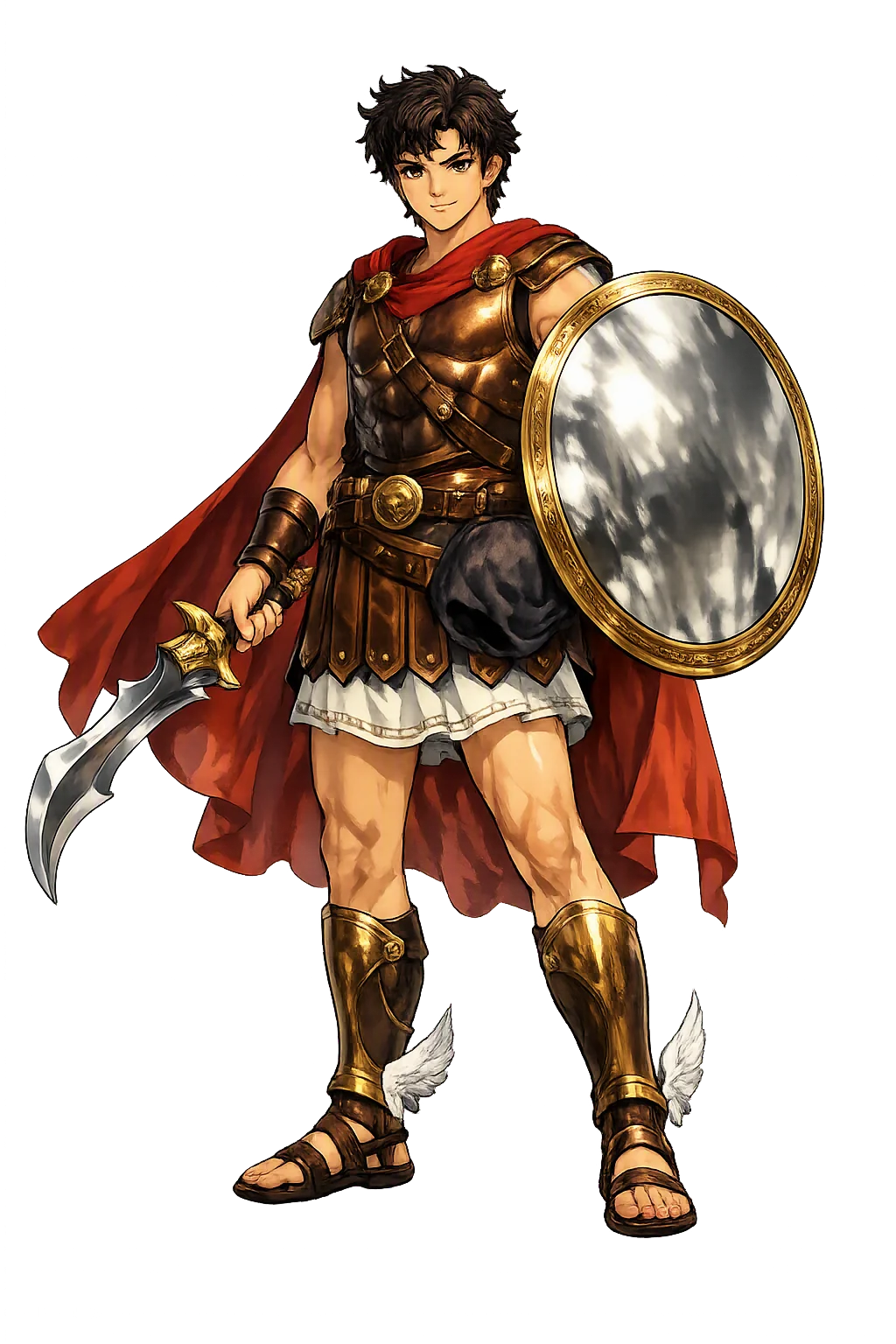
Polydectes, king of Seriphos, desired Danaë and wanted Perseus gone. Feigning a bride-price for Hippodameia, he demanded horses of his whole court; Perseus rashly promised the Gorgon's head instead — and Polydectes held him to it (Apollodorus, Bibliotheca 2.2.3). Athena and Hermes took charge of the impossible errand and led him first to the Graiai, the 'grey ones' who from birth were old women, sisters of the Gorgons, sharing a single eye and a single tooth (Hesiod, Theogony 270–273). Perseus snatched the eye as it passed from face to face and ransomed it for the road to the nymphs; from them he received the kibisis that safely holds the head, the cap of Hades that makes its wearer unseen, and winged sandals; from Hermes the adamantine harpe, from Athena the polished bronze shield (Apollodorus 2.2.3–4; Ovid, Metamorphoses 4.610ff). The quest's real lesson is assembled before the monster is met: this hero wins not by native strength but by holding hostage what others cannot do without — an eye, a tooth, and the world's best equipment.
Beyond Ocean lay the Gorgons, winged women with brazen claws and serpent hair; of the three sisters, only Medousa was mortal (Apollodorus, Bibliotheca 2.2.4). Perseus came upon them sleeping and, watching Medousa's image in the mirror-bright shield rather than the living face, struck once with the harpe. The neck opened and from it sprang Pegasus and the warrior Chrysaor — 'when Perseus cut off her head, great Chrysaor and the horse Pegasus sprang forth' (Hesiod, Theogony 280–286). The sleeping sisters woke and took the wing in pursuit, but the cap of Hades hid him, and he was gone into the air. The gods had not sent him to punish Medousa so much as to harvest her: from the monster's death leap the winged horse that will carry Zeus's thunderbolts and the father of the monster Geryon — terror and poetry born from a single stroke of the sickle-sword.
Returning with the head, Perseus flew over Ethiopia, where the sea was swallowing the land. Kassiepeia had boasted that she was fairer than the Nereids, and Poseidon answered with a flood and a ketos, a ravening sea-beast; the oracle of Ammon declared that only the chaining of Kassiepeia's daughter Andromeda would appease it. Perseus saw her on the rock 'as a marble statue gains a soul' (Ovid, Metamorphoses 4.675–678) and bargained with her parents: her hand in marriage, or let the beast have its due. He slew the ketos and freed her — and at the wedding feast met Phineus, who claimed Andromeda for himself. Perseus had borne the Gorgon's head this far wrapped in the kibisis; now he unveiled it, and Phineus with his whole company hardened into stone, swords half-drawn (Apollodorus, Bibliotheca 2.4.3; Ovid, Met. 4.663–739). The head that saved a princess then massacres a banquet: divine tools do not ask whether the hand that wields them is rescuing or revenging.
On Seriphos, Polydectes had spent Perseus' long absence persecuting Danaë, who with Diktys had fled to the temples for sanctuary. The king was feasting with his assembled islanders when the hero walked in, still dusty from the road, and held up the head: court, tyrant, and dinner-tables took the grey of stone together (Apollodorus, Bibliotheca 2.4.2–3). Perseus made Diktys king and gave the Gorgoneion to Athena, who fixed it on her aegis, where the apotropaic face guards the city of the gods ever after (Apollodorus 2.4.3). One thread of the oracle remained: at Larisa, competing in the funeral games of Teutamides, Perseus threw the discus and it veered — striking and killing a spectator who was his grandfather Akrisios (Apollodorus 2.4.4; Hyginus, Fabulae 273). Ashamed to inherit Argos by such blood, he exchanged it for Tiryns and founded Mycenae. Even the founder of dynasties cannot aim his own fate; the discus of the games closes the circle the golden shower began.
Hero
Perseus is the Greek hero who slew the Gorgon Medousa and founded the royal line of Mycenae and Argos. Son of Zeus and Danaë, he accomplishes what no god would attempt, armed only with borrowed wonders — mirrored shield, adamantine harpe, cap of Hades, winged sandals — and his name may itself be eastern: "Destroyer, possibly Persian."
With Athena's mirrored shield and Hermes' adamantine harpe he took the one head no god dared face — Medousa's.
Central domain: hero, slayer of medousa — sacker of cities, ancestor of Heracles through his son Electryon.
Athena and Hermes equip him; the kibisis holds the head; winged sandals and the cap of Hades carry him beyond Ocean.
From his dynasty — Electryon, Sthenelus, Eurystheus — come Heracles and the Argive royal line.
From the original script to the living URL
Περσεύς
The name in its original Greek form. Perseús (Περσεύς) is attested in the source tradition — “Destroyer, possibly Persian”. Its diphthongs and acute accents carry the full phonetic and orthographic weight of the source tradition.
perseus
Reduced to plain perseus, the name loses everything that made it specific: diphthongs and acute accents. What remains is an ASCII string that machines can parse but that no longer speaks with its original voice.
Perseús
The Unicode restoration recovers what ASCII flattened. Perseús restores diphthongs and acute accents, returning the name to its original written dignity. The domain encodes to Punycode, but the browser displays the truth.
Perseús.com → xn--perses-tya.com
The non-ASCII characters in Perseús are encoded while the ASCII remains visible. To the DNS, it is Punycode. To humanity, it is Perseús.
Owned, ideal, and ASCII forms of Perseús
Perseús
Restores Περσεύς. The full Unicode restoration. perseús.com is not in the PuniCodex collection — it is watched for release; if it drops, this temple upgrades to an owned flagship.
perseus
Flattens Περσεύς. The plain ASCII fallback — what DNS and legacy systems see.
How Perseús was spoken
How Perseús is preserved in writing
A bespoke provenance study for Perseús is being prepared by the PUNICODEX scholarly team.
Contribute scholarly provenance →The lore you have read is the living myth. Extended Lore opens the scholarly vault beneath it: the cult and its material remains, a history of the image, the name after antiquity, a meditation on what the name still means, and the full scholarly apparatus — etymology, orthography, sources.
Enter Extended Lore