
How Perseus got its accent back
The ASCII form perseus is missing something. Perseus restores the marks the source language used to distinguish this name from a thousand others — and those marks change how the name is read, pronounced, and understood. This post explains, with the full scholarly record behind it, what each restored mark preserves: the Greek evidence, the reconstructed sound, the myths the name carries, and the classification logic that separates Tier 1 restorations from Tier 2. By the end, the marks in Perseus will look less like ornaments and more like what they are — recovered evidence, pinned back in its proper place.
At a Glance
- Restored name: Perseus
- ASCII form: perseus
- Meaning: "Destroyer, possibly Persian"
- Domain of influence: Hero, Slayer of Medousa
- Pantheon: Greek
- Classification: Tier 1
- Original script: Περσεύς (Greek)
Overview
Perseus (perseus) — Hero, Slayer of Medousa · Destroyer, possibly Persian — belongs to the Greek tradition, where he is catalogued under the domain "Hero, Slayer of Medousa." He is one of the great Panhellenic heroes, the founder of Mycenae, the ancestor of Herakles, and the protagonist of one of the most visually compelling myths ever told. His name, like his story, carries foreign echoes: some ancient etymologists connected it to Persia, others to a root meaning "to destroy." Both possibilities add layers to a hero who moves between worlds — mortal and divine, Greek and barbarian, earth and sky.
PuniCodex restores the name as Perseus and serves its temple at its temple. The original carries both stress and vowel length, and exactly one historically valid Unicode restoration exists, which places the name in Tier 1. The plain ASCII form perseus survives as a modern convenience imposed by the early domain-name system; the restoration, not the fallback, is the form the project defends as philologically complete.
Etymology and the Name's Riddle
The name is attested in Greek as Περσεύς. Etymologically it means "Destroyer, possibly Persian." The Greek ending -εύς is characteristic of agent nouns, suggesting that Perseus is "the destroyer" or "the sacker." Ancient writers including Herodotus speculated that the hero's name was connected to the Persians, either because the Greeks borrowed the name from the east or because the hero's eastern associations made the connection plausible. Modern scholars remain divided: the name may be pre-Greek, borrowed, or independently Indo-European. The uncertainty is part of the name's mythic power.
The Greek form Περσεύς carries an acute on the final diphthong -εύ, indicating that the pitch rose on the last syllable. The diphthong itself, epsilon-upsilon, was pronounced like the "eu" in French "feu" or something close to "eh-oo." These phonetic details are not trivial. The name's foreign sound is part of its mythic power: Perseus is the hero who travels to the edges of the world, and his name sounds like it came from somewhere beyond the usual Greek horizon. It is a name that announces distance.
The ASCII form perseus survives only because the early domain-name system could not carry diacritics; it is a technological compromise, not an ancient spelling. The Unicode restoration Perseus recovers the acute accent and the long diphthong, returning to the name the sonic strangeness that made it fit a hero who visits the Gorgons and the Hyperboreans. Without the mark, the name sounds ordinary; with it, the name sounds like a journey.
The Birth of Perseus
Perseus was born from one of the most famous ordeals in Greek myth. His mother, Danaë, was imprisoned by her father Akrisios, who had been told by an oracle that his daughter's son would kill him. Zeus visited Danaë in the form of a shower of gold, and Perseus was conceived. Akrisios placed mother and child in a chest and cast them into the sea, but they survived and came to the island of Seriphos.
The birth story establishes the themes of Perseus's life: prophecy, divine intervention, and the violence of kings. Akrisios's attempt to escape fate only ensures its fulfillment. Danaë's courage in the chest prefigures her son's courage in his later adventures. And Zeus's golden descent signals that Perseus is a hero marked by the gods from the beginning. The hero who will defeat monsters is himself born from a miraculous escape.
On Seriphos, Perseus was raised by Diktys, a fisherman, while his mother endured the unwanted attentions of the island's king, Polydektes. The stepfather-tyrant is a common figure in hero myths, and Polydektes sets in motion the quest that will make Perseus famous. By sending him to fetch the head of Medousa, the king expects to be rid of the young hero. Instead, he creates a legend. The attempt to destroy the hero is the very thing that makes him.
The Quest Against Medousa
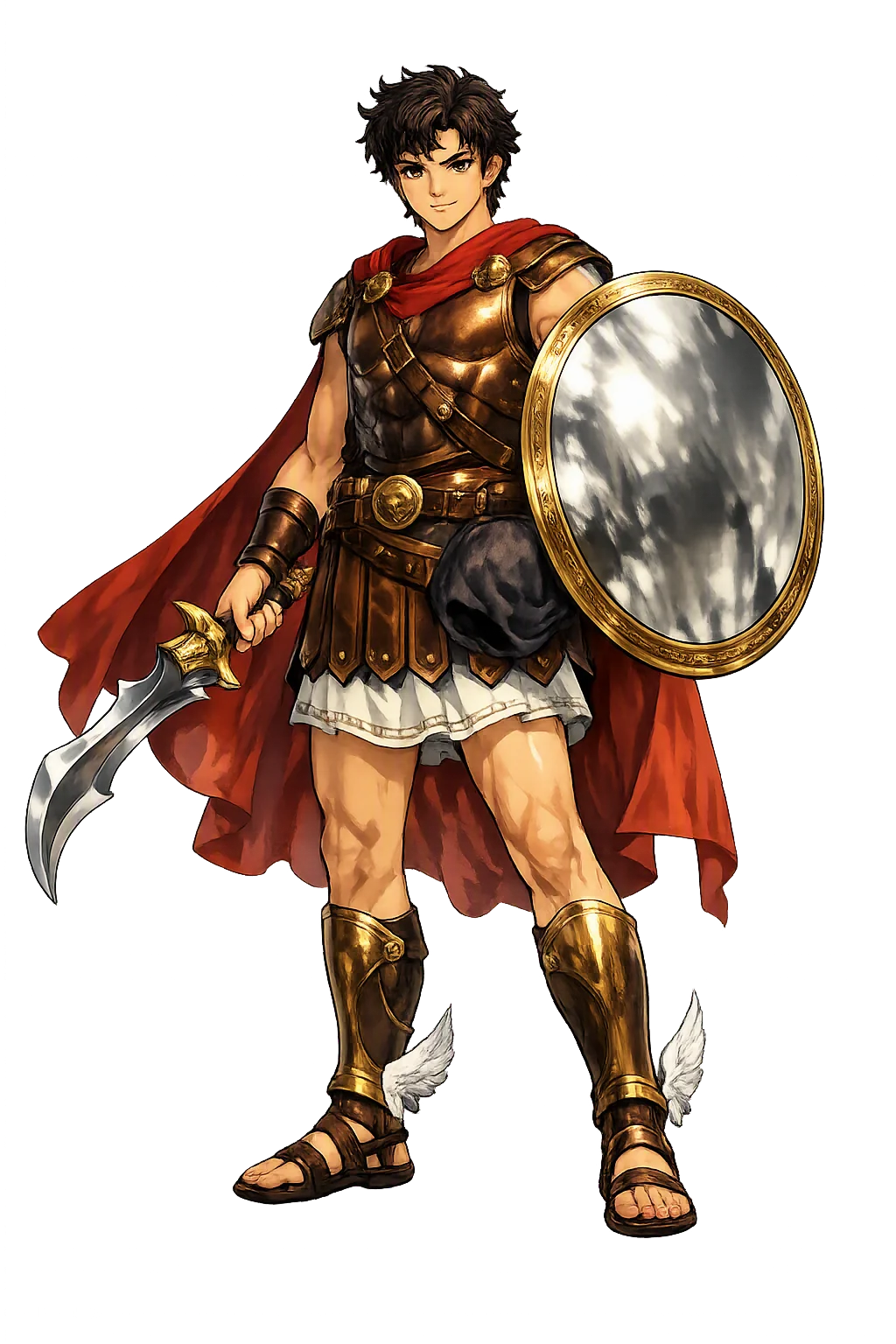
Perseus's most famous exploit is the slaying of Medousa, the Gorgon whose gaze turned living things to stone. Sent by Polydektes to fetch her head, Perseus receives divine assistance from Athena and Hermes: winged sandals, a cap of invisibility, a polished shield to use as a mirror, and a sickle-like sword. With these tools he approaches the sleeping Gorgons, decapitates Medousa, and escapes on the winged horse Pegasos, born from her blood. The scene is one of the most frequently depicted in Greek art.
The story is rich in symbolic reversals. The monster who petrifies others is herself beheaded while helpless. The hero who should be turned to stone instead uses reflection to remain unseen. The violent act produces beauty and flight in the form of Pegasos. Perseus is thus the hero of controlled transformation: he can turn the terrible into the useful, the fixed into the mobile, the deadly into the divine. His weapons are not strength alone but cunning, reflection, and divine aid.
Athena receives the Gorgon's head and places it on her shield, the aegis. This transfer makes Perseus's victory part of Athena's own power, and it links the hero forever to the goddess of wisdom and war. The head of Medousa, once a threat, becomes an apotropaic device, a way of turning terror back upon enemies. Perseus therefore does not merely defeat a monster; he supplies the gods with one of their most powerful emblems.
Andromeda and the Sea Monster
After Medousa, Perseus's adventures continue. He rescues Andromeda from a sea monster, marrying her and founding a dynasty. Andromeda had been chained to a rock as a sacrifice to appease the gods, and Perseus saves her by turning the monster to stone with the Gorgon's head. The rescue combines the motifs of dragon-slaying and marriage-by-rescue that run through Indo-European hero tales.
The marriage of Perseus and Andromeda is important for the genealogy of Greek heroes. Their children include Perses, the eponym of the Persians in some traditions, and several sons who become kings in the Peloponnese. Through them, Perseus becomes the ancestor of Herakles, linking the two greatest cycles of Greek hero myth. The rescue of Andromeda is therefore not only a romantic episode but a genealogical pivot.
The story also shows Perseus using the Gorgon's head with precision. He does not turn Andromeda to stone because he looks at her directly; he uses reflection or careful aim to target only the monster. The control he exercises over the head is a sign of his maturation as a hero. He has become the master of the terrible weapon he won, capable of using it with discrimination.
The Return and Founding of Mycenae
Perseus eventually returns to Argos, the homeland of his mother Danaë, and accidentally fulfills a prophecy by killing his grandfather Akrisios with a discus. Rather than rule Argos, he founds Mycenae, which becomes one of the greatest centers of Bronze Age Greece. The founding is described in mythic terms: Perseus follows a sign from the gods and establishes a city that will dominate the Greek mainland for generations.
Perseus's descendants include Herakles, and in this sense his myth bridges the generations of Greek heroes. He is the grandfather-figure of the greatest heroism, the one whose monster-slaying establishes the pattern that Herakles will follow and exceed. His founding of Mycenae also connects him to the archaeological world of the Mycenaean palaces, giving the myth a material anchor that later Greeks found compelling. The ruins of Mycenae were visible, and the story of their founder gave them meaning.
In death, Perseus was honored as a hero. Shrines and tombs were shown at Mycenae and elsewhere, and his story was dramatized by Aeschylus and other playwrights. His cult emphasized not only victory but also the accidental violence that shadowed even the most successful hero. The discus that killed Akrisios reminds us that Perseus, like all Greek heroes, cannot escape the pattern of fate.
Perseus in Art and Science
Perseus has never ceased to be reinterpreted. In classical art he appears on hundreds of vases, often at the moment of decapitation or the rescue of Andromeda. In the Renaissance, Cellini cast his famous bronze Perseus holding the head of Medousa, a work that revived the hero as an image of Florentine power. In modern film, Perseus has appeared in adaptations that range from faithful to fantastical, each generation finding in him a model of courage, cunning, and the defeat of apparently invincible threats.
The name Perseus has also entered science. The constellation Perseus dominates the northern sky, and the Perseid meteor shower, visible each August, appears to radiate from it. In biology, several species bear the name, and in astronomy, the Perseus Cluster is one of the most massive structures known. The hero who defeated a monster has become a label for grandeur and endurance across disciplines. His name now marks both the heavens and the microscopic world.
More abstractly, Perseus represents the hero who wins by not looking directly at danger. He uses reflection, tools, and divine help rather than raw force alone. This makes him a figure for intelligence as much as for courage, and his myth has been invoked whenever a culture wants to celebrate the victory of craft over terror. The Perseus paradigm — defeat the threat indirectly — is one of the most durable models of heroism in the Western tradition.
Perseus in Modern Film and Culture
The twentieth and twenty-first centuries have returned to Perseus repeatedly in popular media. Films such as the 1981 and 2010 versions of Clash of the Titans introduced the hero to mass audiences, often taking liberties with the myth but preserving the core image of the monster-slayer. Video games, comic books, and fantasy novels have borrowed the Gorgon's head, the winged sandals, and the rescue of Andromeda. Perseus has become a archetype of the hero who faces the impossible with divine assistance.
These modern adaptations sometimes simplify the myth, but they keep alive the central intuition: that terror can be defeated by intelligence and restraint. The hero who does not look directly at the monster is a figure for every culture that has learned to manage danger through technique rather than confrontation. Perseus's relevance is therefore not merely antiquarian. He remains a usable model for thinking about courage in a technological age.
Unicode Restoration
The restoration of Perseus is one of the clearer cases for the value of Unicode in the classical namespace. The Greek form Περσεύς has a single, well-attested transliteration, and the difference between perseus and Perseus is exactly the difference between a stripped file identifier and a living name. The acute accent on the final diphthong is not decorative; it is the pitch marker that tells a Greek reader how to pronounce the name and where to place its foreign-sounding stress.
PuniCodex classifies Perseus as Tier 1 because the Greek original preserves both stress and length, and because only one historically valid Unicode restoration exists. The temple at punicodex.com/perseus therefore stands as a precise restoration: the name of the slayer of Medousa, returned to its proper shape in the address bar. The accent is back where it belongs.
Perseus and the Heroic Paradigm
Perseus belongs to a distinct type of Greek hero: the one who succeeds through divine aid, clever tools, and precise action rather than through brute strength alone. This sets him apart from Herakles, whose heroism is defined by overwhelming power, and from Achilles, whose excellence is martial and aristocratic. Perseus is the hero as craftsman, the one who solves impossible problems by using the right instrument in the right way.
The tools Perseus receives are themselves significant. The winged sandals come from Hermes, the god of boundaries and messengers. The cap of invisibility belongs to Hades, whose realm Perseus must approach. The polished shield is a gift from Athena, the goddess of practical intelligence. The sickle is associated with harvest and sacrifice. Each tool connects Perseus to a different divine power, and together they make him a mediator between worlds.
The slaying of Medousa embodies this mediated heroism. Perseus cannot look directly at the monster, so he looks at her reflection. He cannot fight her with conventional weapons, so he uses the sickle and the shield. He cannot escape on foot, so he flies on the sandals. Every stage of the encounter requires translation: from direct to reflected perception, from frontal assault to stealthy decapitation, from earth to air. The hero's virtue is adaptability.
This paradigm has proved remarkably durable. Later heroes from many traditions share Perseus's reliance on tools and cunning. The knight with the magic sword, the spy with the gadget, the scientist with the experimental device all descend in part from Perseus. His story established the template of the hero who wins because they know how to use what they have been given.
Restoration in Context
Perseus is one of those Greek heroes whose name has never dropped out of circulation. It appears in constellations, scientific terms, films, novels, and games. Yet the form in which most people encounter it — Perseus without the acute, or perseus in lowercase — is already a reduction. The restoration Perseus recovers the mark that tells a Greek reader how the name was pronounced and where its foreign-sounding stress fell.
The restoration matters because Perseus's story is about precision. He defeats Medousa by looking at her reflection rather than directly at her. He uses the Gorgon's head with careful aim. He navigates between mortal and divine, Greek and foreign, with a craft that depends on attention to detail. A name associated with such precision should itself be precise.
In the broader context of PuniCodex, Perseus represents the kind of restoration that Unicode makes easy and necessary. The Greek form is clear, the transliteration is standard, and the loss in ASCII is obvious. There is no scholarly reason to prefer the flattened form. The restored domain therefore functions as a small but decisive vote for accuracy.
The hero who traveled to the edges of the world now has a place in the modern address bar. That place is spelled Perseus, with the accent restored. It is a modest change in appearance but a significant change in meaning. The name sounds like a journey again.
The restored name also serves as a small act of resistance against the flattening of classical culture into a handful of familiar images. Perseus is often reduced to the monster-slayer, the winged hero, the constellation. These images are not wrong, but they are incomplete. The full name, with its Greek accent, points back to the texts and artifacts that make the figure three-dimensional. It reminds us that Perseus had a mother, a grandfather, a wife, a city, and a body of stories far larger than any single scene.
Related Names
- Apóllōn — Light, Music, Prophecy
- Hekátē — Magic, Crossroads, Moon
- Níkē — Victory
- Achérōn — River of Woe
- Achilleús — War, Glory, Rage
Sources
- Homer, Iliad and Odyssey (8th c. BCE).
- Hesiod, Theogony (8th–7th c. BCE).
- Henry George Liddell & Robert Scott, A Greek-English Lexicon (1843; rev. Jones, 1940).