
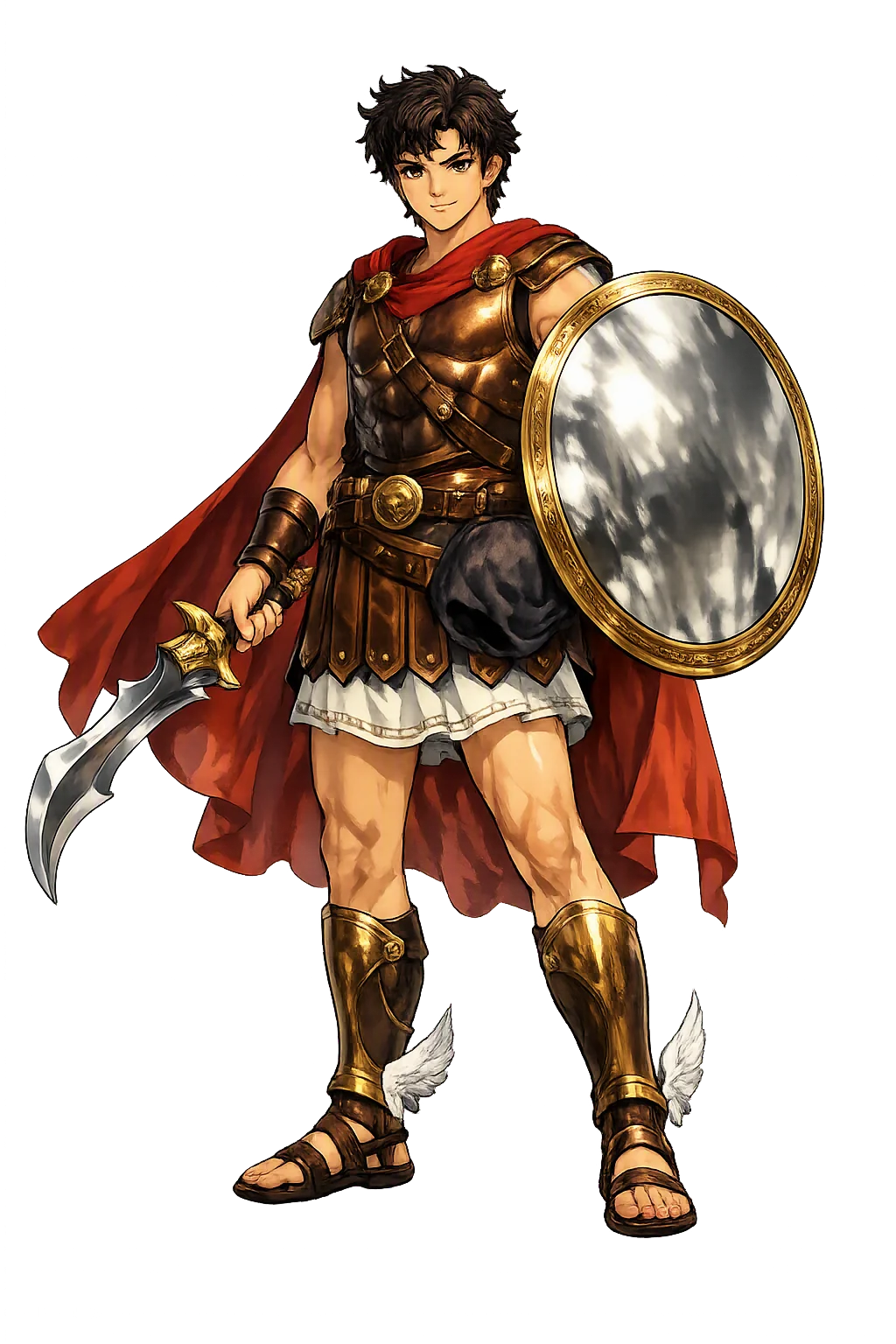
Why Perseús is spelled that way — and what it costs to get it right
There is a version of this name the early internet had to settle for: perseus. This is the file on how Perseús replaced it.
Perseus is the Argive hero of the Gorgon-slaying, the rescuer of Andromeda, and the founder of the dynasty that produces Heracles. His cycle, told most fully by Apollodorus and Ovid, turns on oracles, divine equipment, and the terrible double gift of the Gorgon's head.
At a Glance
- Restored name: Perseús
- ASCII form: perseus
- Meaning: "Destroyer, possibly Persian"
- Domain of influence: Hero, Slayer of Medousa
- Pantheon: Greek
- Classification: Tier 1
- Original script: Περσεύς
- Series: The Restoration Files, No. 390 of 548
The Name Before the Marks
The name is attested as Περσεύς. On the evidence, it means "Destroyer, possibly Persian".
Strip Perseús to perseus and one piece of evidence vanishes:
- u → ú — Same: the stress position the ASCII form cannot show.
These are the small, provable things a restoration is made of: not taste, not branding — attestation.
Spoken, the name runs `/perˈseu̯s/` — 'per-SEUS' — stress the final syllable, and let the eu glide like 'eh-oo' said in one motion.
The Temple That Stands Now
The restored name is not a plaque; it is an address. The temple of Perseús lives at /perseus/, with its mythology in the lore halls, its peer-reviewed record in the Scholarly Edition, and its place in the pattern atlas on the patterns floor.
The restoration preserves more than the ASCII form can express — stress, length, or a letter the Latin keyboard lost — which places it, mechanically, in Tier-1.
Where the Name Stood First
Pausanias walked the hero's topography: at Mycenae he saw the Persea, the spring 'where Perseus is said to have washed when he brought back the Gorgon's head' (2.16.6), and at Argos the grave-heroon the Argives claimed for him beside the sanctuary of Hera (2.18.1). The chest of Cypselus at Olympia, described by Pausanias (5.18), carried carved scenes of Perseus and the Gorgons among its archaic reliefs. The monster herself dominates the material record: the west pediment of the temple of Artemis at Corfu (c. 580 BC) displays the largest early Gorgon in Greek art, wide-eyed and tongue-out, the apotropaic face Perseus delivered to Athena. Attic and Argive vase-paintings of the sixth and fifth centuries show the whole cycle — the chest at sea, the decapitation, the petrification of Polydectes' court. The temple on the web is the newest of these addresses — the first one that fits in a pocket.
The Archetype at Work
The pattern atlas seats this temple in 4 industries, each match argued and weighted: Defense, Military & Security (primary seat: Perseus embodies hero, slayer of medousa — the core of defense.); Gaming, Fantasy & Entertainment IP (resonant seat: Perseus shares symbolic territory with gaming entertainment.); History, Archives & Records (resonant seat: Perseus shares symbolic territory with history archives.). The Resonance File reads those seats through the myths themselves.
In the Sacred Texts
The Greek tradition is not a vibe; it is a library. The Sacred Texts collection holds Theogony, Homeric Hymns, and Works and Days — the primary sources the temple's scholarship is built on. The temple is the argument; the texts are the evidence.
The File Continues
The temple's founding dispatch tells the name's story; its Resonance File reads the myths into the industries; the blog index holds the whole archive.
Continue the series — previous file: Persephonē (read it here) · next file: Perun (read it here).
The Restoration Files are written from the same canonical record as the temples themselves: the lexicon, the lore catalog, the pattern atlas, and the cited scholarly sources. If a file ever disagrees with its temple, the temple is right — tell us, and the file will be corrected.