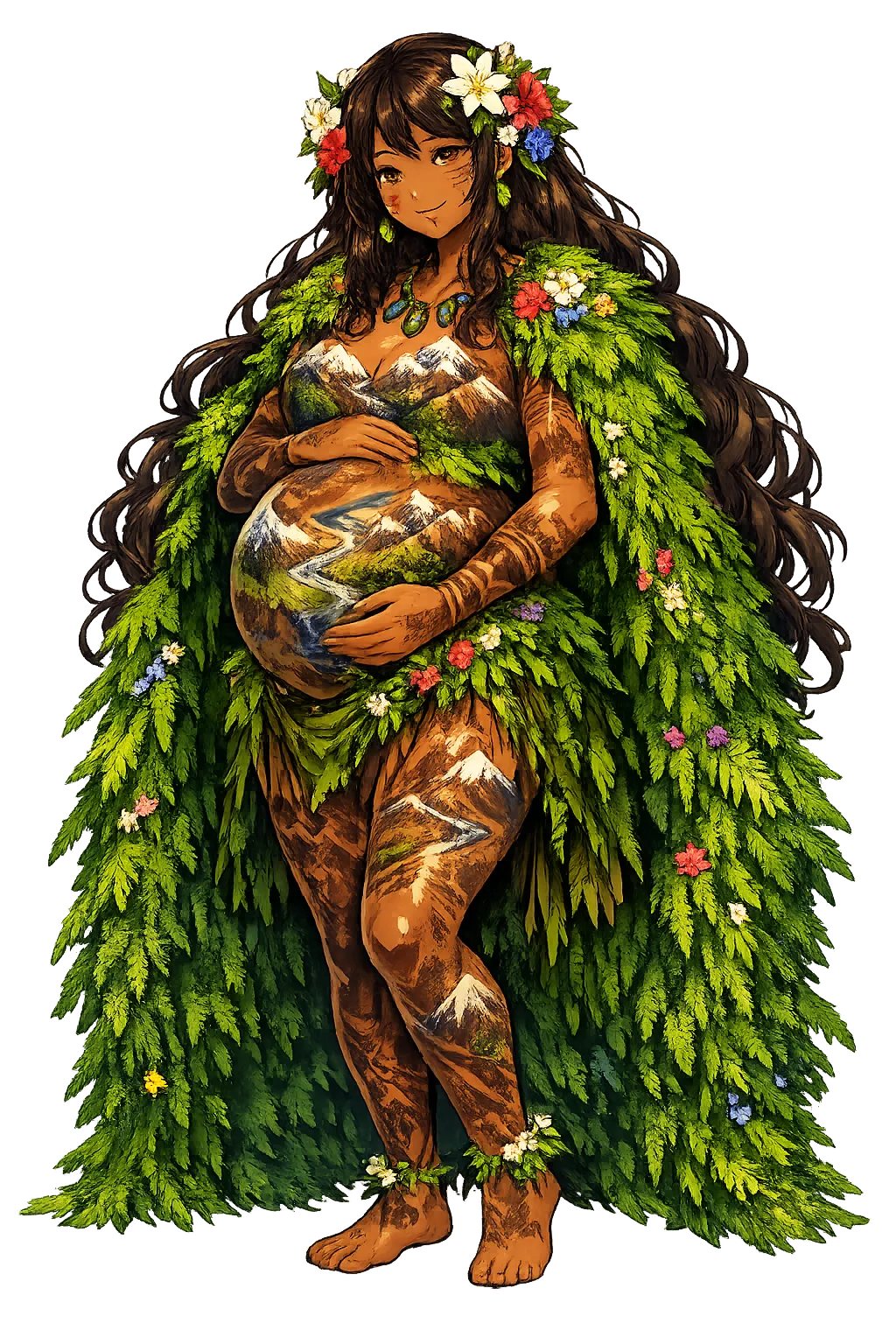
Stories of Papatūānuku
Papatūānuku's central myth — the separation of the Sky Father and Earth Mother — is the best-known creation narrative of Polynesia, recorded in many regional variants. The Māori versions written down in the nineteenth century by George Grey, Elsdon Best, and others differ in detail and genealogy, and all of them are transcripts of a living oral tradition rather than a fixed scripture. What the versions share is the argument: the world we inhabit is the aftermath of a family crisis, and its beauty and its grief are the same event seen from two sides.
In the beginning there was no sky above and no earth below in our sense — only Ranginui, the Sky, and Papatūānuku, the Earth, locked in an embrace so close that no light could enter. Their children were born into the narrow darkness between their parents' bodies: Tāne, Tāwhirimātea, Tangaroa, Tūmatauenga, Rongo, and Haumia-tiketike, with the unborn Rūaumoko stirring in the womb. Cramped and blind, the children debated their escape. Rongo-mā-Tāne and Tangaroa proposed killing the parents; Tāne counselled separation instead. Attempt after attempt failed — pushing from within, shoving from without — until Tāne lay on his back against his mother, braced his legs against his father, and thrust upward with the full strength of his body. Ranginui rose into the air with a great cry, light flooded the world, and the children stood for the first time in open space. (Grey, Polynesian Mythology; Best, Māori Religion and Mythology.) The myth insists that creation is not making something from nothing but the painful rearrangement of an original unity — space, light, and life all purchased at the price of the parents' grief.
Ranginui did not leave without mourning. From his eyes fell the rain, and Papatūānuku's longing rises from her body as the morning mist, so that the two remain in perpetual touch — his tears falling on her, her sighing rising to him. The versions differ on what happened next among the children: in Grey's telling, Tūmatauenga cursed his parents for what had been done and turned his anger on his brothers, while Tāwhirimātea fled to his father and never forgave the separation; only those who accepted their mother's gifts — the forests and birds to Tāne, the sea to Tangaroa, the kūmara to Rongo, the wild fernroot to Haumia — stayed close to her. The myth reads the weather as family feeling: every rainstorm is an embrace interrupted, and the mist at dawn is the earth answering the sky.
Tāwhirimātea, the wind, alone of the brothers refused to accept the separation. Furious at what Tāne had done to their parents, he fled to his father Ranginui, gathered an army of winds and clouds and squalls, and attacked his brothers one by one. He smashed Tāne's forests to splinters, broke Tangaroa's canoes and drove his grandchildren — the fish and the reptiles — into hiding in the sea's depths, and scattered the crops that Rongo had planted. Only Tūmatauenga stood against him and, though beaten, held his ground and did not flee. Defeated, Tāwhirimātea was driven back to the sky, where to this day he attacks Tangaroa, and his storms are the anger that never found peace. (Grey, Polynesian Mythology.) The myth gives weather a genealogy: storms are a brother's grief kept on the boil, and the calm between gales is the family's uneasy truce.
Papatūānuku is not only the beginning but the end. When people die, their bodies are returned to her — buried in her flesh, which is why Māori speak of the whenua, the land, and the whenua, the placenta, by the same word: both are the organ that feeds a person before they can feed themselves. From her body the dead pass onward, in many accounts, to the spirit world beyond, while her moisture rises as mist at dawn — sometimes remembered as her tears for Ranginui, sometimes as the milk with which she suckles her children still. The closing of the loop — birth from her body, life upon her body, return to her body — is the moral shape of the Māori cosmos, and it makes death not an exit from the world but a handover of one life back to its source.
Creation, Fertility, and the Land
Papatūānuku is the broad earth lying beneath the sky, the mother from whose body all living things spring. In Māori cosmology she and Ranginui, the Sky Father, were once locked in an embrace so tight that their children lived in darkness between them. Their separation by Tāne brought light and space into the world — and a wound of separation that still marks every creature's relation to earth and sky.
All plants, animals, and humans arise from her body; she is the source of nourishment and growth.
The Sky Father lies upon her; their separation is the primal act of creation.
The land (whenua) is her body; Māori identity is inseparable from the earth that names and sustains the people.
The dead return to her; she receives all things and makes them grow again.
From the original script to the living URL
Papatūānuku
The name survives only in scholarly transliteration. Papatūānuku is the standard Polynesian romanisation, documented in academic sources — “Earth Mother; the land that gives birth to all living things”. Its macron-length vowels preserve distinctions lost in plain ASCII.
No indigenous writing system is securely attested for individual polynesian names. The form shown is a modern scholarly transliteration.
papatuanuku
Reduced to plain papatuanuku, the name loses everything that made it specific: macron-length vowels. What remains is an ASCII string that machines can parse but that no longer speaks with its original voice.
Papatūānuku
The Unicode restoration recovers what ASCII flattened. Papatūānuku restores macron-length vowels, returning the name to its original written dignity. The domain encodes to Punycode, but the browser displays the truth.
Papatūānuku.com → xn--papatnuku-9bb97i.com
The non-ASCII characters in Papatūānuku are encoded while the ASCII remains visible. To the DNS, it is Punycode. To humanity, it is Papatūānuku.
Owned, ideal, and ASCII forms of Papatūānuku
Papatūānuku
The live temple domain — papatūānuku.com.
papatuanuku
The plain ASCII fallback — what DNS and legacy systems see.
How Papatūānuku was spoken
How Papatūānuku is preserved in writing
No indigenous writing system is securely attested for individual polynesian names. The form shown is a modern scholarly transliteration.
Contribute scholarly provenance →The lore you have read is the living myth. Extended Lore opens the scholarly vault beneath it: the cult and its material remains, a history of the image, the name after antiquity, a meditation on what the name still means, and the full scholarly apparatus — etymology, orthography, sources.
Enter Extended Lore