PuniCodex

Extended Lore

Papatūānuku

Etymology · Orthography · Cult · Iconography · Reception · Sources

Tier 1 Papatūānuku.com
Papatūānuku — Earth, Creation, Fertility
01

Quick Facts

Essential information about Papatūānuku, Earth, Creation, Fertility

Scholarly TransliterationPapatūānuku
Unicode RestorationPapatūānuku
Reconstructed Pronunciation/ˈpa.pa.tuːˈaː.nu.ku/
PantheonPolynesian
DomainEarth, Creation, Fertility
MeaningEarth Mother; the land that gives birth to all living things
ClassificationTier 1
Primary DomainPapatūānuku.com
Sacred SymbolsFlat, dark earth, Mountains and valleys, Caves, The kūmara and food plants
02

Etymology & Word Family

From original script to Unicode restoration

Proto-polynesian *papa earth, rock, foundation
Scholarly Transliteration Papatūānuku Papatūānuku — "Earth Mother; the land that gives birth to all living things"
Unicode Restoration Papatūānuku Restored stress, length, and script
Modern ASCII papatuanuku Plain-ASCII fallback

Māori Papa (earth) + tū (to stand) + ā (emphatic) + nuku (extended, far-reaching). The name describes the broad earth standing firm.

03

Unicode Character Breakdown

Character-by-character philological analysis

CharacterUnicodeNameBlockPhonetic Role
PU+0050Latin Capital Letter PBasic LatinSame, capitalized
aU+0061Latin Small Letter ABasic LatinSame
pU+0070Latin Small Letter PBasic LatinSame
aU+0061Latin Small Letter ABasic LatinSame
tU+0074Latin Small Letter TBasic LatinSame
ūU+016BLatin Small Letter U with MacronLatin Extended-AMacron: long u
āU+0101Latin Small Letter A with MacronLatin Extended-AMacron: long a
nU+006ELatin Small Letter NBasic LatinSame
uU+0075Latin Small Letter UBasic LatinSame
kU+006BLatin Small Letter KBasic LatinSame
uU+0075Latin Small Letter UBasic LatinSame

The Tier 1 classification reflects how much of the original phonology this restoration preserves — stress and vowel length for Greek names, distinctive letters and diacritics for every other tradition.

04

Cult & Worship

How the sacred was kept — rites, sanctuaries, remains

The Cult

Papatūānuku was worshipped everywhere and housed nowhere: the earth needed no temple because the earth was the temple. The evidence lies in practice rather than architecture — in the burial of the placenta (whenua, the same word as the land itself), in funeral custom returning the dead to her body, and in the karakia, the long oral litanies that address her and Ranginui together as the primal parents. The marae served as the ritual ground where genealogy tied the living community back to that first pair, and the records of Grey, Best, and White preserve the invocations still in use when they wrote. No priesthood belonged to her alone. Modern Māori life has renewed the relationship openly — kaitiakitanga, guardianship of the earth, is now a formal ethic in land care and environmental policy — but that is a contemporary flowering of the old kinship, not a surviving ancient cult.

In the Earth

There are no monumental temple sculptures of Papatūānuku comparable to those of Aztec or Greek deities; Māori sacred expression was primarily oral, architectural, and environmental. Marae and carved meeting houses (wharenui) encode genealogical narratives linking the living community to Papatūānuku and Ranginui — the meeting house itself is often read as the body of an ancestor, ridgepole as backbone, rafters as ribs. Rock art, greenstone ornaments, and burial practices reflect the cosmology of return to the earth. Nineteenth-century written records by Grey, Best, and Smith preserve the oral mythology in detail; the tradition they transcribed is itself the primary artifact.

05

Iconography

How Papatūānuku was imaged across the ages

The Image

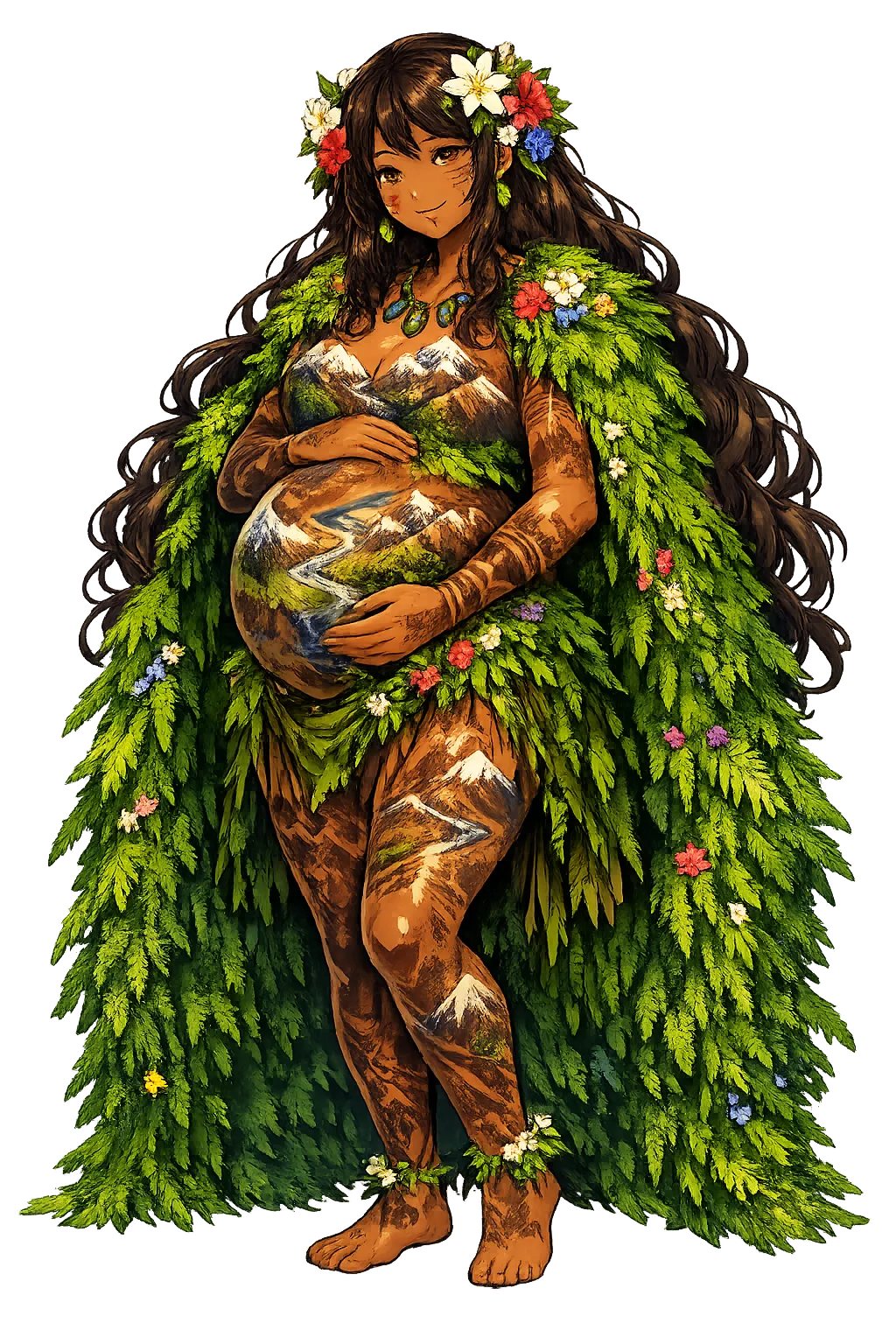
No pre-contact image of Papatūānuku survives, and none was needed: her iconography was the coastline, the mountains, the mist rising at dawn. Ancestral Māori art did not ordinarily picture gods in human form, preferring to encode cosmology in architecture — the wharenui read as an ancestor's body, ridgepole as backbone, rafters as ribs — and in the landscape itself. The visual record begins only with the colonial century: European illustrators gave the creation story human figures, and by the later nineteenth century the embracing or parting pair had become a stock subject of book illustration and, eventually, of Māori carving and painting in their own right. Modern artists across Aotearoa still return to the motif. The result is unusual among the world's great goddesses: her canonical image is a recent co-creation, an earth mother whose face was drawn first by the camera and the printing press — and has been redrawn by her descendants ever since.

06

Reception & Transformation

The name after its own age — transmission, translation, survival

Afterlives

Her transmission is the transmission of Māori writing itself. The creation cycle entered the archive when Māori scribes — above all Wiremu Maihi Te Rangikāheke, working with Governor George Grey in the 1840s and 1850s — set the oral corpus into manuscript; Grey's Polynesian Mythology (1855) carried the separation of Rangi and Papa into world literature, among the first Polynesian texts a global audience read. John White's Ancient History of the Māori (1887–1891) and Elsdon Best's Dominion Museum bulletins (1924) added regional depth, while Edward Tregear's Maori-Polynesian Comparative Dictionary (1891) fixed her name in the philological record, cognate with Papa across the eastern Pacific. S. Percy Smith's Lore of the Whare-wānanga (1913–1915) and Peter Buck's (Te Rangi Hīroa) The Coming of the Maori (1949) carried the tradition into professional anthropology; Margaret Orbell's Illustrated Encyclopedia of Maori Myth and Legend (1995) consolidated it for scholarship. The twentieth century's comparatists made the sky-earth separation a textbook case of the primal-embrace motif, and the narrative transcribed on the marae became a founding text of New Zealand letters.

Identifications Across Traditions

Papatūānuku is cognate with the Hawaiian earth mother Papa and with earth-deity figures across eastern Polynesia; her partner Ranginui answers to the Rangi-sky figures of the whole triangle. In Māoridom today she is paired with Ranginui in prayers, environmental discourse, and artistic representations of the creation story. Some Christian Māori theologians have drawn parallels between Papatūānuku and the created earth praised in the biblical psalms, without identifying the two. Contemporary environmental movements invoke her as the personification of ecological responsibility: 'kaitiaki of Papatūānuku' — guardians of the earth — has become a standard formula of Māori land-rights and conservation rhetoric, giving an ancestral name to what the West calls sustainability.

Modern Legacy

Papatūānuku has become a central figure in modern Māori cultural identity and in Aotearoa New Zealand's environmental and educational vocabulary. Schools, health services, and land-restoration projects invoke her name; environmental legislation and treaty settlements speak of the land in her terms. The phrase 'kaitiaki of Papatūānuku' expresses an ethic of guardianship that has entered national policy discourse. Internationally, she is one of the most widely recognized Polynesian deities, a symbol of indigenous earth-relationship in an era of climate crisis — proof that a nineteenth-century transcript of an older song can still govern how a nation thinks about its ground.

07

The Meditation

What Papatūānuku means — beyond the dictionary

Papatūānuku is the earth not as resource but as ancestor. To stand on her is to stand on the body of a being who loved, who was separated from her partner, and who continues to give birth despite that grief. The Māori creation story does not begin with a single male creator speaking the world into order; it begins with an embrace so close that no one can breathe, and a separation that is also a wound.

In an age of ecological extraction, Papatūānuku offers a different grammar: the land is not something we have but someone we belong to. The name Papatūānuku, with its long vowels held like a breath, says that the earth is extended, standing, and reaching. We are her reach, her standing, her return.

08

Frequently Asked Questions

Common questions about Papatūānuku, Earth, Creation, Fertility, and Unicode restoration

01How do you pronounce Papatūānuku?

In reconstructed pronunciation, Papatūānuku is /ˈpa.pa.tuːˈaː.nu.ku/ — approximately 'PAH-pah-too-AH-noo-koo' — keep the p's gentle and unaspirated, hold the ū and ā long, and give each vowel its own syllable.

02What does Papatūānuku mean?

Papatūānuku means Earth Mother; the land that gives birth to all living things in the polynesian tradition.

03What are the symbols of Papatūānuku?

Papatūānuku is associated with Flat, dark earth (Her body is the soil itself, often figured as lying prone beneath the sky), Mountains and valleys (The folds and ridges of her body, the places where her children still touch her), Caves (Openings into her body, places of birth, burial, and communication with the dead), The kūmara and food plants (Crops grown from her body, especially the sweet potato brought from Hawaiki).

04Why are there different spellings of Papatūānuku?

Each form is a historically attested restoration rather than a mistake: Papa-tū-ā-nuku is the alt form (Hyphenated analytical spelling emphasizing the components). PUNICODEX registers the full set so the tradition is preserved under every defensible spelling.

05Why restore Papatūānuku in Unicode?

Plain ASCII papatuanuku strips the stress, length, and script that make the name specific. Unicode restoration returns the name to its original written dignity.

06What is the most important myth about Papatūānuku?

“The Separation of Rangi and Papa” — the Creation myth story that anchors the mythology of Papatūānuku, told in full on the lore page.

09

Scholarly Sources

The philological foundations of this restoration

Every claim on this page is grounded in established scholarship. The orthographic restorations follow disciplinary convention. The etymological chain follows the best available reference works. This is not invention — it is resurrection through scholarship.

◈

Lexicography & Philology

  • Tregear
  • Grey
  • Best
◎

Primary Texts

  • Primary sources in the polynesian tradition for Papatūānuku.
◉

Archaeology & Art History

  • Material evidence — iconography, inscriptions, and temple archaeology — for Papatūānuku and related cults.
✦

Religious Studies

  • Grey, George, Polynesian Mythology (1855; 2nd ed. 1885)
  • Best, Elsdon, Māori Religion and Mythology (Dominion Museum Bulletin, 1924)
  • Smith, S. Percy, The Lore of the Whare-wananga (1913–1915)
  • Buck (Te Rangi Hīroa), Peter, The Coming of the Maori (1949)
  • Orbell, Margaret, The Illustrated Encyclopedia of Maori Myth and Legend (Canterbury University Press, 1995)
  • Marsden, Māori, The Woven Universe: Selected Writings (Otago University Press, 2003)
Return

The Surface Awaits

You have traced the name from its earliest attestation to its Unicode restoration. Now return to the myth. The story is where the name lives.

Back to Lore
Papatūānuku mascot