
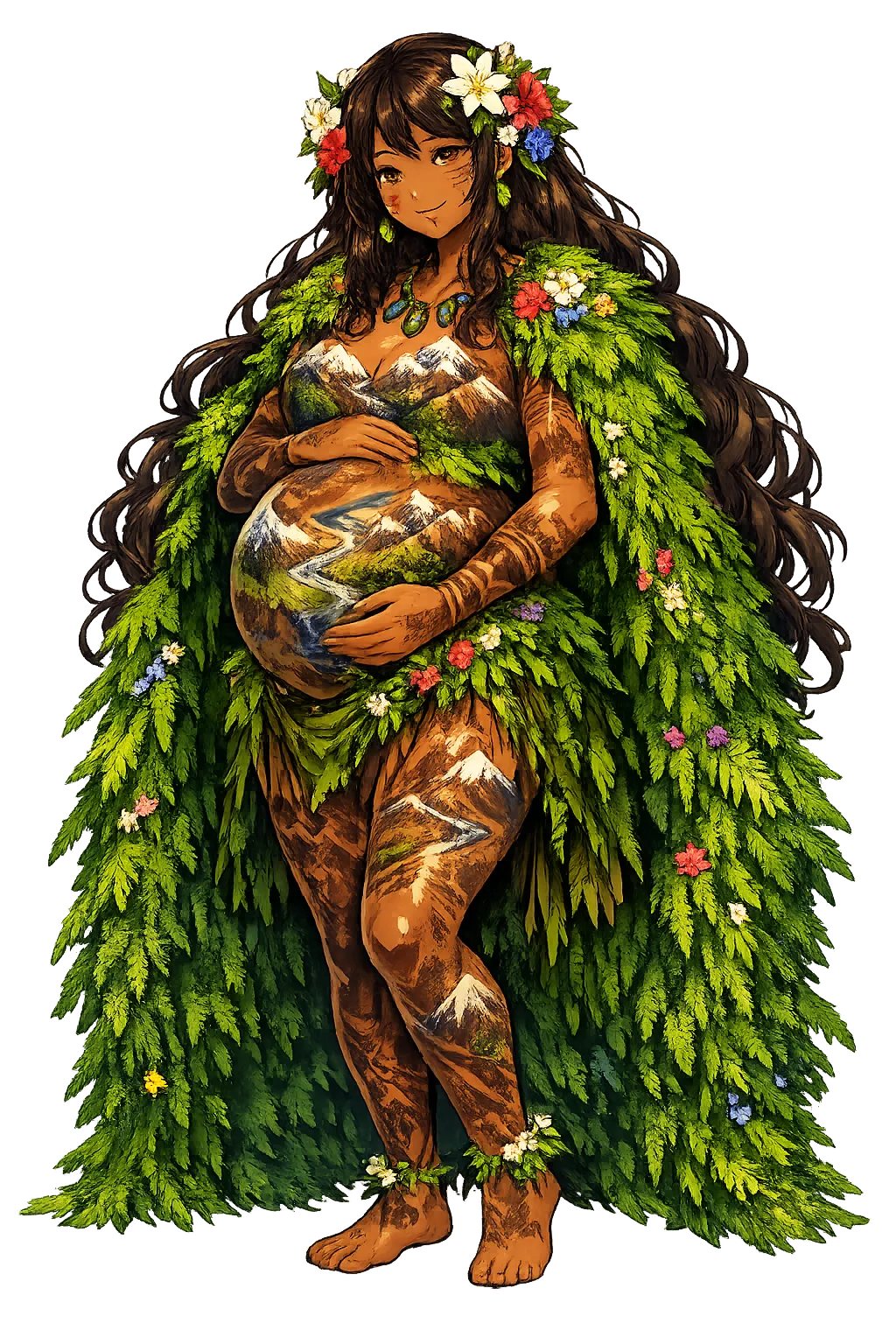
The working life of Papatūānuku: from the myths to the modern trades
The myths did not retire. They moved offices. This is the file on where Papatūānuku works now.
Papatūānuku's central myth — the separation of the Sky Father and Earth Mother — is the best-known creation narrative of Polynesia, recorded in many regional variants. The Māori versions written down in the nineteenth century by George Grey, Elsdon Best, and others differ in detail and genealogy, and all of them are transcripts of a living oral tradition rather than a fixed scripture. What the versions share is the argument: the world we inhabit is the aftermath of a family crisis, and its beauty and its grief are the same event seen from two sides.
The pattern atlas — which maps every flagship temple to the industries its archetype demonstrably resonates with, each match argued and open to challenge — seats this temple in 4 industries. This file reads those seats the way they were earned: through the myths.
At a Glance
- Temple: Papatūānuku
- Pantheon: Polynesian
- Domain of influence: Earth, Creation, Fertility
- Pattern seats: 4
- Sectors touched: Energy & Natural World · Commerce & Governance · Home & Lifestyle
- Strongest seat: Agriculture, Food & Harvest
- Series: The Resonance Files, No. 380 of 546
The Myth at Work
The Separation of Rangi and Papa. In the beginning there was no sky above and no earth below in our sense — only Ranginui, the Sky, and Papatūānuku, the Earth, locked in an embrace so close that no light could enter. Their children were born into the narrow darkness between their parents' bodies: Tāne, Tāwhirimātea, Tangaroa, Tūmatauenga, Rongo, and Haumia-tiketike, with the unborn Rūaumoko stirring in the womb. — remember the shape of that act. You will see it again, wearing a logo.
The Rain and the Mist. Ranginui did not leave without mourning. From his eyes fell the rain, and Papatūānuku's longing rises from her body as the morning mist, so that the two remain in perpetual touch — his tears falling on her, her sighing rising to him. — remember the shape of that act. You will see it again, wearing a logo.
The Seats
Each of these is argued in the atlas with a weight and a why-line. What the atlas cannot fit in one line is the whole myth — so here is each seat with its story restored.
Agriculture, Food & Harvest
Farming, grain, food production, and agtech. (Sector: Energy & Natural World)
The earth mother from whom all food comes. Swap the costume and the sentence is indistinguishable from the myth. That is what a resonance seat means.
Environmental & Climate Services
Climate science, ecology, and sustainability consulting. (Sector: Energy & Natural World)
The why-line says it in one breath: The land that gives birth to all living things; stewardship personified. That is not a resemblance; it is the same act, performed in a newer building.
Ancestry & Heritage Services
Genealogy, heritage research, and DNA ancestry. (Sector: Commerce & Governance)
Mother of the gods and of humankind; whakapapa recites every lineage in Aotearoa in layers back to her. — the atlas stops there, out of discipline. The myth keeps going: the function Papatūānuku performs in the stories is precisely the function this industry sells.
Home, Hearth & Real Estate
Property, home goods, and domestic services. (Sector: Home & Lifestyle)
The land that gives birth to all; in Aotearoa land is kin and the first address, not a commodity — her body under every title deed. — the atlas stops there, out of discipline. The myth keeps going: the function Papatūānuku performs in the stories is precisely the function this industry sells.
The Long Employment
Papatūānuku has become a central figure in modern Māori cultural identity and in Aotearoa New Zealand's environmental and educational vocabulary. Schools, health services, and land-restoration projects invoke her name; environmental legislation and treaty settlements speak of the land in her terms. The age changed. The work did not.
The Method, Stated Plainly
None of this is numerology. A seat exists only where the match can be argued from the deity’s documented domains and deeds — weighted, published, and falsifiable. The derivation, the weights, and the challenge process are public on the methodology page. If a seat in this file reads wrong, the atlas itself tells you how to prove it — and the correction becomes part of the record.
For the Ones Who Work There
If you work in agriculture, food & harvest, environmental & climate services, or any trade this temple holds a seat in, this is the honest version of what a placement means: your industry beside the story it has been re-telling all along — on the temple floor itself, before an audience that came specifically to read it. The patron tier and the advertising terms describe the mechanics; the resonance above describes the fit.
The File Continues
One of 546 Resonance Files — the series where the pantheon goes to work. Read the founding dispatch for the name, the Restoration File for the spelling, or the whole archive end to end.
Continue the series — previous: Pángǔ (read it) · next: Pārvatī (read it).
The Resonance Files are argued from the same canonical record as the pattern atlas itself: the lexicon, the lore catalog, and the cited sources. Every seat can be challenged at the methodology page — and the challenge is the point.