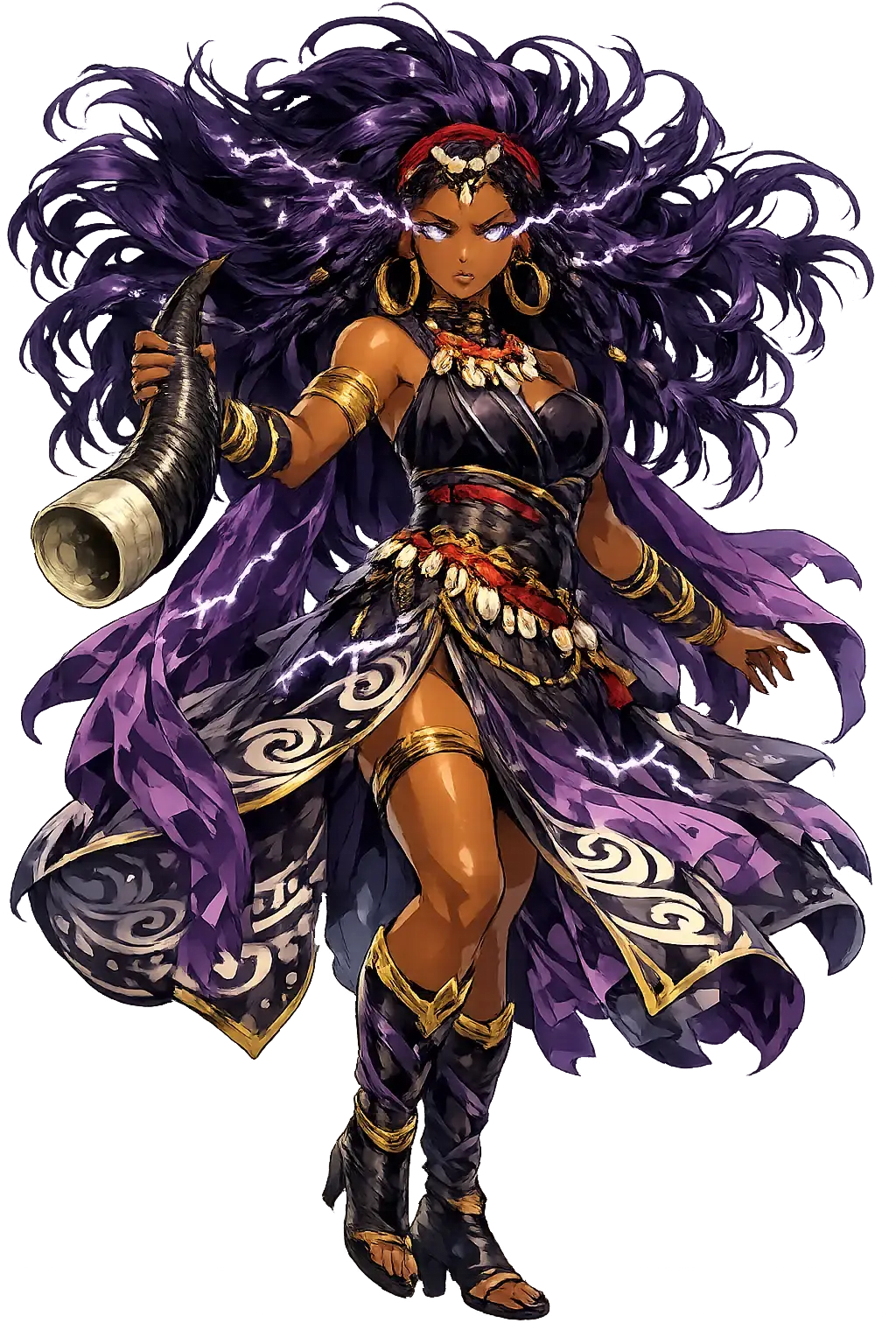
Stories of Ọya
Ọya's stories are told in Ifá divination, Candomblé praise-songs, and the oral traditions of the Yoruba and their diaspora. She is change embodied, and her myths turn on thresholds — between sky and earth, market and grave, marriage and war.
Her very name is her biography: Ọya derives from the verb yà, 'to tear, to split apart' (Abraham, Dictionary of Modern Yoruba, 1958). The name is a title of office. In ritual and story she tears whatever has outlived its time — she rips the old cloth of custom when it smothers the living, splits the storm front when the air has stood too still, and opens the ground between the marketplace of the living and the cemetery of the dead. To be mounted by Ọya in possession is to be unmade and remade: devotees whirl, brandish swords, and speak with the tearing voice of the wind. The mythology is exact about its own meaning: transformation is not a gentle persuasion but a rupture, and what refuses to be changed peaceably will be changed violently.
Ọya was wife and battlefield companion to Ṣàngó, and the traditions agree that she learned from him what no other orisha was taught — the secret of fire and lightning. Verger (Notes sur le Culte des Orisa et Vodun, 1981) records that when Ṣàngó's fortunes collapsed and he fled his kingdom, Ọya did not flee with him meekly: she tore at the sky with her winds, and some accounts say she cast herself into the river that bears her name, the Niger (Odò Ọya), rather than outlive his disgrace. Other lineages, especially in Cuba, make her the guardian of that disgrace's relics. The sources disagree about her end and do not care to reconcile; what matters is the pattern — she is the only one who shared the thunderer's power and the only one who did not abandon him. Her lightning is inherited, and inheritance is loyalty.
Candomblé narratives of Bahia tell how Ọya — Iansã — met the buffalo at the edge of her river and made an alliance with it: the beast's brute strength married to her whirlwind speed (Verger 1981; Mason, Four New World Yoruba Rituals). In the Ketu rites her dancers lower their heads and charge like buffalo herds; the horns that crown her shrines are the treaty made visible. The Yoruba sources behind the diaspora tale are sparser, and scholars treat the buffalo complex as a New World amplification of older river-storm imagery — but the meaning is continuous with the homeland tradition: Ọya governs the force that cannot be reasoned with, only ritually befriended. A community that honours the buffalo-woman is a community that has decided not to be trampled by what it refuses to acknowledge.
In the diaspora liturgies and the older Ifá-related traditions alike, Ọya stands at the gate of the cemetery, not as death's mistress but as its border guard. Mason (1985) describes her ruling the passage between the market — the noisy, bargaining world of the living — and the quiet acreage of the dead; the hurricane that precedes her arrival is the escort of souls in transit. Devotees say she receives the dead the way she receives everything else: at speed, without sentimentality, and with absolute attention. The mythology resolves an apparent paradox — the goddess of life-giving storm as guardian of the grave — by refusing it: for Ọya, death is not the opposite of change but its final form, and the gate is simply the last threshold she is asked to tear open.
Storms, Change, and the Cemetery Gate
Ọya is the orixá of wind, lightning, and radical change — the storm that tears down what is finished so that something new can grow. She is the only female warrior to ride into battle beside the thunder-god Ṣàngó, and she guards the threshold between the marketplace and the grave. Her name means 'she tore', and tearing is her ministry.
She arrives as a sudden gust that uproots trees and old assumptions.
Wife of Ṣàngó and fearless general, she carries a sword and the irukere fly-whisk.
She rules the cemetery gate and guides souls through transformation.
Crossroads and markets are her terrain, where chance and commerce meet change.
From the original script to the living URL
Ọya
The name survives only in scholarly transliteration. Ọya is the standard Yoruba romanisation, documented in academic sources — “She who tore”. Its original diacritics and script distinctions preserve distinctions lost in plain ASCII.
No indigenous writing system is securely attested for individual yoruba names. The form shown is a modern scholarly transliteration.
oya
Reduced to plain oya, the name loses everything that made it specific: original diacritics and script distinctions. What remains is an ASCII string that machines can parse but that no longer speaks with its original voice.
Ọya
The Unicode restoration recovers what ASCII flattened. Ọya restores original diacritics and script distinctions, returning the name to its original written dignity. The domain encodes to Punycode, but the browser displays the truth.
Ọya.com → xn--ya-58s.com
The non-ASCII characters in Ọya are encoded while the ASCII remains visible. To the DNS, it is Punycode. To humanity, it is Ọya.
Owned, ideal, and ASCII forms of Ọya
Ọya
The live temple domain — ọya.com.
oya
The plain ASCII fallback — what DNS and legacy systems see.
How Ọya was spoken
How Ọya is preserved in writing
No indigenous writing system is securely attested for individual yoruba names. The form shown is a modern scholarly transliteration.
Contribute scholarly provenance →The lore you have read is the living myth. Extended Lore opens the scholarly vault beneath it: the cult and its material remains, a history of the image, the name after antiquity, a meditation on what the name still means, and the full scholarly apparatus — etymology, orthography, sources.
Enter Extended Lore