Stories of Ouranós
Ouranós is the first tyrant of Greek cosmogony: a father who fears his children and is destroyed by one of them. His fall sets the pattern of divine succession that runs through Kronos and Zeus — each generation overthrowing the last.
Hesiod's Theogony (126–138) gives the sky the strangest birth in Greek myth: Gaia, having no partner, bears Ouranós starry, equal to herself, to cover her on every side — a husband built to be a roof. With him she then mates and bears the twelve Titans, first of whom is Ōkeanos; she bears also the Ourea, the Mountains, and Pontos, the barren Sea, the last ‘without delightful love’. The union of Ouranós and Gaia is the Greeks' first hieros gamos, the sacred marriage of sky and earth from which the ordered world grows: his rain falls into her, and she brings forth. The myth means that the cosmos itself began as a marriage — and that the first marriage was also the first hierarchy, with the sky pressing down upon the earth like a lid. Everything that follows in Greek cosmogony is contained in that image: a roof that loved too hard, and a floor that could not breathe.
Ouranós grew to hate the children Gaia bore him, and as each was born he pushed it back into its mother and hid it from the light (Theogony 154–160). Gaia groaned under the strain, and in her pain she fashioned a great sickle of grey adamant and spoke to her sons — but all were afraid, except great-hearted Kronos, the youngest, the crooked of counsel. She hid him in ambush, and when Ouranós came at evening, spreading himself over Gaia in desire, Kronos reached out with his left hand and with his right swung the long sickle, and in one stroke cut off his father's genitals and threw them behind him (Theogony 161–181). The blood's drops fell on Gaia; the severed members were carried over the sea. Even in mutilation Ouranós keeps one power — the power to name: he calls his sons Titanes, ‘strainers’, for their overreaching (Theogony 207–210). The myth means that the first act of government in the universe was the prevention of birth — and the first revolution was a mother's revenge.
The consequences of the castration spread across three elements. Where the genitals fell into the sea, white foam gathered around the immortal flesh, and from it a maiden grew — Aphrodítē, ‘the foam-born’, who first touched land at Cythera and came ashore at Cyprus, attended by Eros and beautiful Desire (Theogony 182–200). Where the drops of blood struck Gaia, she bore the Erinyes, the implacable Furies who punish oath-breakers and kind-murder; the Gigantes, the earth-born Giants; and the ash-tree nymphs, the Meliai, from whom mankind draws its stock (Theogony 183–187). One wound thus generated the three great counter-forces of the later cosmos: love, vengeance, and rebellion. The myth means that every order secretes its own enemies — the powers that will one day threaten Zeus's rule were born from the wound that ended Ouranós's.
Ouranós's sky did not become safe simply because the gods ruled it. In the underworld, Odysseus meets the Aloadae, Otos and Ephialtes, sons of Poseidôn by Iphimedeia, who were the tallest and handsomest mortals ever reared after the famous Orion — and who, at nine years old, threatened war on the gods themselves: they would pile Pelion on Ossa, and Ossa on Olympus, to make a stairway into heaven (Odyssey 11.305–316). They had already chained Ares in a bronze jar for thirteen months, until their stepmother Eriboea told Hermês and the god of thieves freed the god of war. Apollo struck the brothers down before they reached manhood — ‘for they would have done it’, Homer says, had Phoibos not killed them. The myth means that heaven is defined by its attackers: the sky matters because something always wants to climb it, and the boundary between mortal ambition and divine order is defended only by violence.
Heaven, Primordial Father, Cosmic Roof
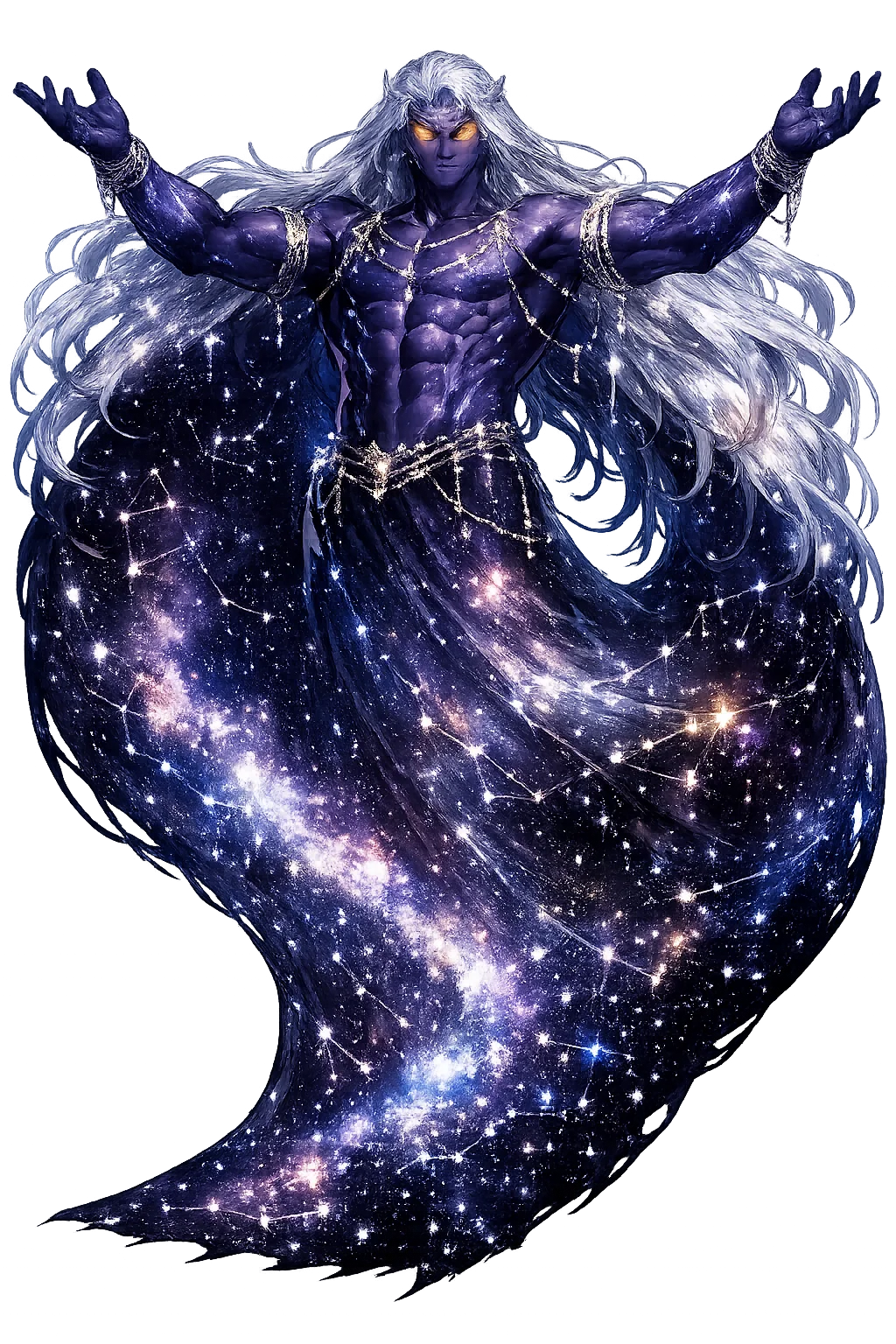
Ouranós is the personification of the sky, the primordial father whose body forms the vault of heaven. Born from Gē without a mate, he became her consort and the first ruler of the cosmos — until his son overthrew him in the most famous act of violence in Greek myth.
The solid dome overhead, starry and equal to the earth in size — a living god whose body is the roof of the world.
With Gē he fathered the Titans, the Cyclopes, and the Hundred-Handers — the entire first generation of gods.
Kronos castrated him with the adamant sickle Gē forged, ending his rule and inaugurating the age of the Titans.
His mutilated body became the visible heavens, the outer boundary of the cosmos that no mortal may cross.
From the original script to the living URL
Οὐρανός
The name in its original Greek form. Ouranós (Οὐρανός) is attested in the source tradition — “Heaven, sky”. Its acute accents carry the full phonetic and orthographic weight of the source tradition.
ouranos
Reduced to plain ouranos, the name loses everything that made it specific: acute accents. What remains is an ASCII string that machines can parse but that no longer speaks with its original voice.
Ouranós
The Unicode restoration recovers what ASCII flattened. Ouranós restores acute accents, returning the name to its original written dignity. The domain encodes to Punycode, but the browser displays the truth.
Ouranós.com → xn--ourans-fxa.com
The non-ASCII characters in Ouranós are encoded while the ASCII remains visible. To the DNS, it is Punycode. To humanity, it is Ouranós.
Owned, ideal, and ASCII forms of Ouranós
Ouranós
Restores Οὐρανός. The live temple domain — ouranós.com.
ouranos
Flattens Οὐρανός. The plain ASCII fallback — what DNS and legacy systems see.
How Ouranós was spoken
How Ouranós is preserved in writing
A bespoke provenance study for Ouranós is being prepared by the PUNICODEX scholarly team.
Contribute scholarly provenance →The lore you have read is the living myth. Extended Lore opens the scholarly vault beneath it: the cult and its material remains, a history of the image, the name after antiquity, a meditation on what the name still means, and the full scholarly apparatus — etymology, orthography, sources.
Enter Extended Lore