PuniCodex

Extended Lore

Οὐρανός Ouranós

Etymology · Orthography · Cult · Iconography · Reception · Sources

Tier 1 Ouranós.com
Ouranós — Sky
01

Quick Facts

Essential information about Ouranós, Sky

Original ScriptΟὐρανός
Unicode RestorationOuranós
Reconstructed Pronunciation/oː.ra.nós/
PantheonGreek
DomainSky
MeaningHeaven, sky
ClassificationTier 1
Primary DomainOuranós.com
Sacred SymbolsStarry sky, Adamantine sickle, Mountains, Rain and dew
02

Etymology & Word Family

From original script to Unicode restoration

Original Script Οὐρανός Ouranós — "Heaven, sky"
Unicode Restoration Ouranós Restored stress, length, and script
Modern ASCII ouranos Plain-ASCII fallback

The name Ouranós carries the orthographic signature of the greek tradition: Οὐρανός. Unicode restoration recovers what ASCII flattens.

03

Unicode Character Breakdown

Character-by-character philological analysis

CharacterUnicodeNameBlockPhonetic Role
OU+004FLatin Capital Letter OBasic LatinO uppercase
uU+0075Latin Small Letter UBasic Latinu same
rU+0072Latin Small Letter RBasic Latinr same
aU+0061Latin Small Letter ABasic Latina same
nU+006ELatin Small Letter NBasic Latinn same
óU+00F3Latin Small Letter O with AcuteLatin-1 SupplementAcute on o
sU+0073Latin Small Letter SBasic Latins same

The Tier 1 classification reflects how much of the original phonology this restoration preserves — stress and vowel length for Greek names, distinctive letters and diacritics for every other tradition.

04

Cult & Worship

How the sacred was kept — rites, sanctuaries, remains

The Cult

Ouranós was not worshipped in cult. As the primordial sky, he is a cosmogonic abstraction whose body is the visible heavens rather than a temple statue. Greek religion directed ritual upward—to Zeus Olympios, to celestial gods, to oath-taking under the open sky—but not to Ouranós as a person. There are no festivals or priesthoods in his name; the sources treat him as a defeated ancestor whose castration sets the world in motion. The absence of cult is theologically appropriate: a god who is the sky itself cannot be enclosed in a sanctuary.

In the Earth

Ouranós was not worshipped in temples; his presence is cosmogonic and iconographic. Greek vase painters of the fifth century BCE depicted the castration with Gaia rising from the ground, the falling sickle, and the severed flesh — the earliest narrative art of a cosmic crime. In Roman art he survives as Caelus: the bearded sky-god spreading his starry mantle appears on sarcophagus fronts, altar reliefs, and the Augustan Belvedere Altar in the Vatican (Tellus between personifications of Air and Sea, with Caelus above). The planet Uranus, discovered by William Herschel in 1781 and named by Johann Bode, is his modern monument.

05

Iconography

How Ouranós was imaged across the ages

The Image

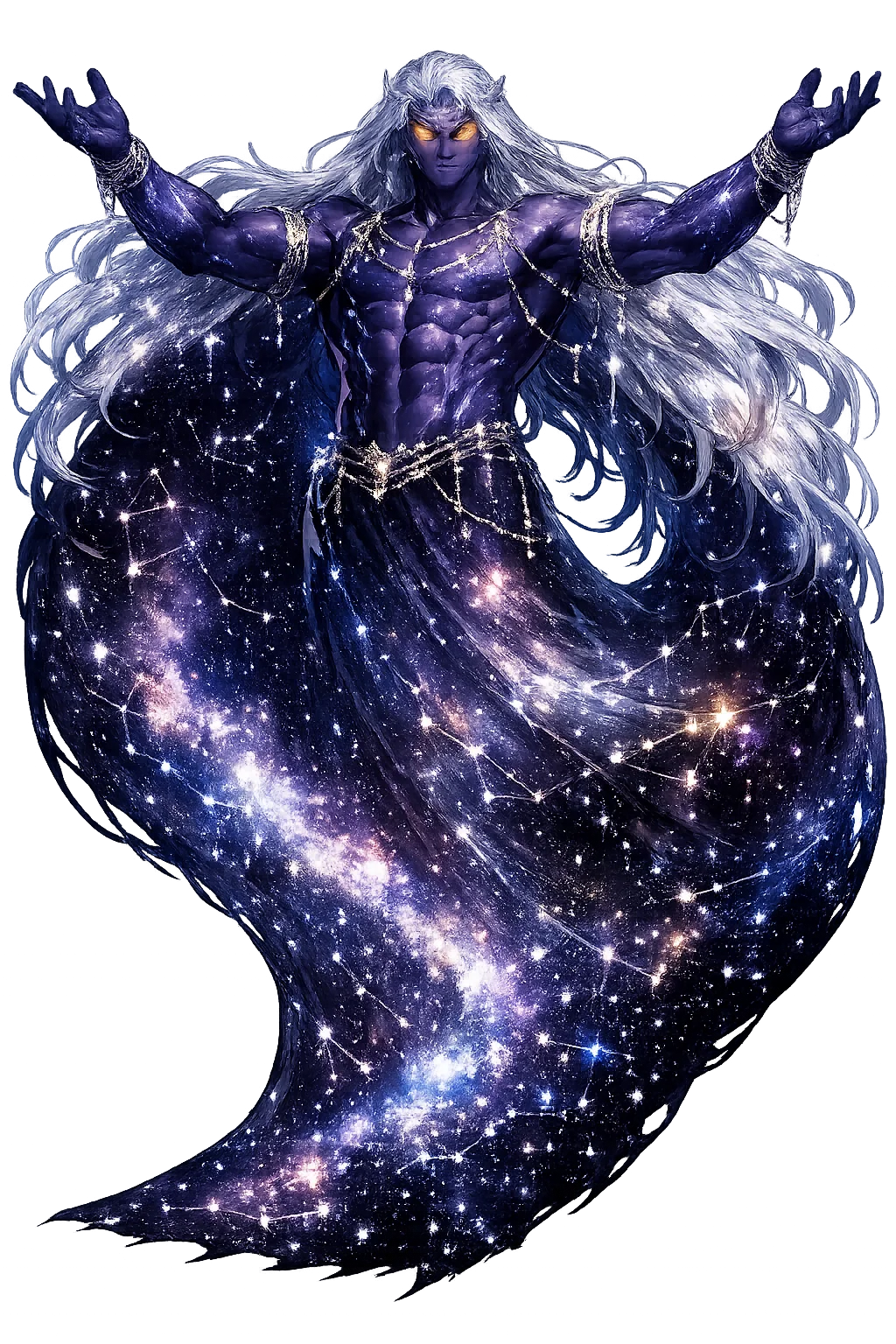
Ouranós is imaged above all at the moment of his violent separation from Gaia. Fifth-century BCE vase painters showed Gaia rising from the ground, Kronos wielding the sickle, and the falling severed flesh from which the Erinyes and Meliai spring. In Roman art he survives as Caelus: a bearded sky-god spreading a starry mantle, carved on sarcophagus fronts, altar reliefs, and the decorative programs of imperial buildings. The image influenced medieval and Renaissance depictions of God the Father and the celestial sphere. Because he is the sky, his most enduring portrait is not anthropomorphic but cosmic: the starry dome itself.

06

Reception & Transformation

The name after its own age — transmission, translation, survival

Afterlives

Ouranós traveled from Hesiod's Theogony into Orphic cosmogonies, Stoic allegory, and Roman epic, where he became the ancestor of Jupiter and the philosophical symbol of the celestial sphere. Medieval and Renaissance artists read his castration through Neo-Platonic and Christian lenses as the separation of heaven and earth or the triumph of time over primordial chaos. The name gave English 'Uranus,' which William Herschel attached to the seventh planet in 1781, turning the primordial sky-god into an astronomical fixture. Astronomers still pronounce his name when naming features on the planet Uranus, a final transformation of sky into map. Modern popular culture invokes him in science fiction, video games, and fantasy pantheons, usually as a remote cosmic patriarch. His reception is thus a history of abstraction: a god who began as the sky became a word for outer space.

Identifications Across Traditions

Ouranós had no independent Roman cult; the Romans rendered him as Caelus, a poetic and artistic personification of the sky rather than a god with temples — he appears on sarcophagus reliefs and Augustan monuments as a bearded figure spreading his mantle over the world, often above Tellus. Roman and Neoplatonic cosmology demoted the person into a place: Ouranós became the outermost sphere, the starry shell of the universe, and in that form he entered medieval cosmography and Renaissance astronomy. Comparative mythology has given him an eastern afterlife: the Hittite Song of Kumarbi (second millennium BCE) tells of the sky-god Anu overthrown by Kumarbi in a strikingly parallel succession myth, evidence that Hesiod's drama of divine generations belongs to a much older Near Eastern koine. The seventh planet, discovered in 1781, was named Uranus in his honor — Bode's Latinization of the Greek sky.

Modern Legacy

Ouranós is the ancestor of every ‘heaven’ in Western thought. His name, Latinized as Uranus, went to the seventh planet (1781) and lives on in the scientific prefixes urano- (uranography, uranology — the mapping and science of the heavens). Modern Greek still calls the sky ouranós. The myth of the overthrown primordial father was read by Freud as the psychic history of the human family (Totem and Taboo), and the word ‘Uranian’ wandered through a dozen technical vocabularies — from Plato's heavenly Aphrodite to nineteenth-century astronomy. Every time we say ‘the heavens’ we are speaking his name in translation. Restoring Ouranós restores the sound of the sky before it became a dome, a sphere, or a planet — when it was still a father.

07

The Meditation

What Ouranós means — beyond the dictionary

Ouranós is the sky as prison. He covers Gē completely, not as a lover but as a lid, and his children cannot be born into light. His castration is therefore a cosmogonic necessity: the sky must be pushed back so that life can emerge between earth and heaven.

Yet his fall is also tragedy. He is the first god to learn that power cannot hold what it fears. The wound that removes his generative organs generates new divinities — Aphrodítē, the Erinyes, the Giants — so that even destruction becomes creation. Ouranós reminds us that the cosmos itself was born from a wound, and that every heaven is shaped by what it once tried to suppress.

08

Frequently Asked Questions

Common questions about Ouranós, Sky, and Unicode restoration

01How do you pronounce Ouranós?

In reconstructed pronunciation, Ouranós is /oː.ra.nós/ — approximately 'oo-rah-NOSS' — the first syllable is long and rounded, the final syllable pitched high.

02What does Ouranós mean?

Ouranós means Heaven, sky in the greek tradition.

03What are the symbols of Ouranós?

Ouranós is associated with Starry sky (His body and his realm: the night sky as a star-strewn mantle, the visible surface of the god), Adamantine sickle (The grey, unbreakable blade Gē forged in her grief — the only weapon ever made by the earth itself), Mountains (The Ourea, her first children, and later the piled peaks — Pelion on Ossa — by which rebels reach toward heaven), Rain and dew (The fertilizing moisture of his union with Gē; heaven's embrace makes the earth bear).

04Why restore Ouranós in Unicode?

Plain ASCII ouranos strips the stress, length, and script that make the name specific. Unicode restoration returns the name to its original written dignity.

05What is the most important myth about Ouranós?

“Born of Gaia, Husbander of Gaia” — the The Birth story that anchors the mythology of Ouranós, told in full on the lore page.

09

Scholarly Sources

The philological foundations of this restoration

Every claim on this page is grounded in established scholarship. The orthographic restorations follow disciplinary convention. The etymological chain follows the best available reference works. This is not invention — it is resurrection through scholarship.

◈

Lexicography & Philology

  • Liddell, H. G., Scott, R., & Jones, H. S. A Greek-English Lexicon. Oxford: Clarendon Press, 9th ed. 1996.
◎

Primary Texts

  • Hesiod
  • Hesiod, Theogony 126–210
  • Homer, Odyssey 11.305–320
  • Apollodorus, Bibliotheca 1.1–2
◉

Archaeology & Art History

  • Material evidence — iconography, inscriptions, and temple archaeology — for Ouranós and related cults.
✦

Religious Studies

  • Beekes, Etymological Dictionary of Greek
  • Hittite Song of Kumarbi (CTH 344)
Return

The Surface Awaits

You have traced the name from its earliest attestation to its Unicode restoration. Now return to the myth. The story is where the name lives.

Back to Lore
Ouranós mascot