
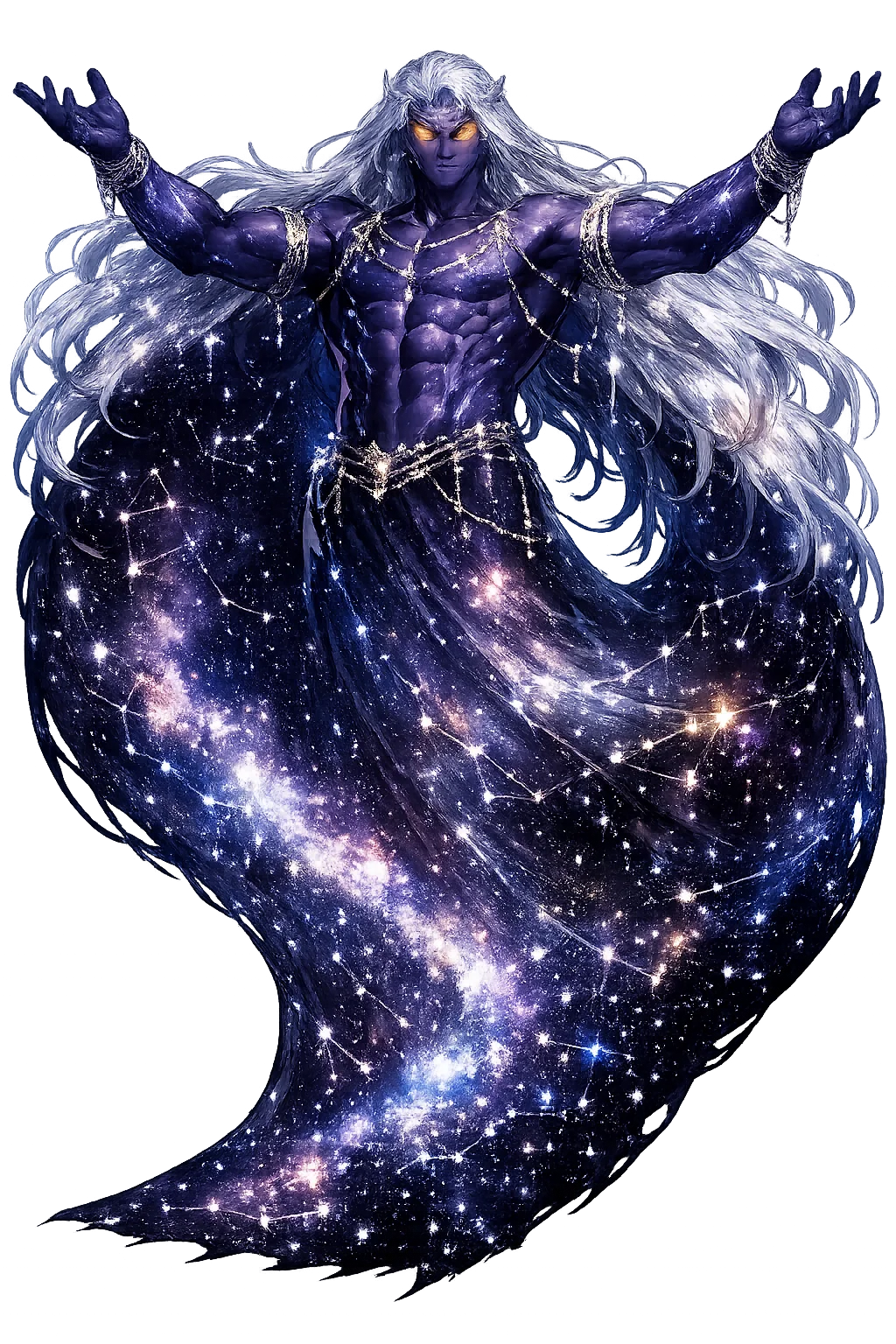
Why Ouranós is spelled that way — and what it costs to get it right
There is a version of this name the early internet had to settle for: ouranos. This is the file on how Ouranós replaced it.
Ouranós is the first tyrant of Greek cosmogony: a father who fears his children and is destroyed by one of them. His fall sets the pattern of divine succession that runs through Kronos and Zeus — each generation overthrowing the last.
At a Glance
- Restored name: Ouranós
- ASCII form: ouranos
- Meaning: "Heaven, sky"
- Domain of influence: Sky
- Pantheon: Greek
- Classification: Tier 1
- Original script: Οὐρανός
- Series: The Restoration Files, No. 372 of 546
The Name Before the Marks
The name is attested as Οὐρανός, in the attestation LSJ and Beekes, Etymological Dictionary of Greek give us. On the evidence, it means "Heaven, sky".
Strip Ouranós to ouranos and one piece of evidence vanishes:
- o → ó — Acute on o: the stress position the ASCII form cannot show.
A reader who knows the marks hears the name correctly on the first try. A reader who never sees them never gets the chance.
Spoken, the name runs `/oː.ra.nós/` — 'oo-rah-NOSS' — the first syllable is long and rounded, the final syllable pitched high.
The Temple That Stands Now
The restored name is not a plaque; it is an address. The temple of Ouranós lives at /ouranos/, with its mythology in the lore halls, its peer-reviewed record in the Scholarly Edition, and its place in the pattern atlas on the patterns floor.
Tier-1 is not a compliment; it is a measurement. This restoration keeps something the ASCII form provably loses, and the measurement is repeatable.
Where the Name Stood First
Ouranós was not worshipped in temples; his presence is cosmogonic and iconographic. Greek vase painters of the fifth century BCE depicted the castration with Gaia rising from the ground, the falling sickle, and the severed flesh — the earliest narrative art of a cosmic crime. In Roman art he survives as Caelus: the bearded sky-god spreading his starry mantle appears on sarcophagus fronts, altar reliefs, and the Augustan Belvedere Altar in the Vatican (Tellus between personifications of Air and Sea, with Caelus above). The planet Uranus, discovered by William Herschel in 1781 and named by Johann Bode, is his modern monument. The temple on the web is the newest of these addresses — the first one that fits in a pocket.
The Archetype at Work
The pattern atlas seats this temple in 4 industries, each match argued and weighted: Space, Astronomy & Celestial Science (heaven personified — and the planet Uranus keeps his name.); Aviation & Aerospace (heaven personified; the destination above the weather.); Ancestry & Heritage Services (father of Titans, Cyclopes, and Hundred-Handers; every Olympian pedigree opens with his line.). The Resonance File reads those seats through the myths themselves.
In the Sacred Texts
The Greek tradition is not a vibe; it is a library. The Sacred Texts collection holds Theogony, Homeric Hymns, and Works and Days — the primary sources the temple's scholarship is built on. The temple is the argument; the texts are the evidence.
The File Continues
The temple's founding dispatch tells the name's story; its Resonance File reads the myths into the industries; the blog index holds the whole archive.
Continue the series — previous file: Ouranía (read it here) · next file: Ọya (read it here).
The Restoration Files are written from the same canonical record as the temples themselves: the lexicon, the lore catalog, the pattern atlas, and the cited scholarly sources. If a file ever disagrees with its temple, the temple is right — tell us, and the file will be corrected.