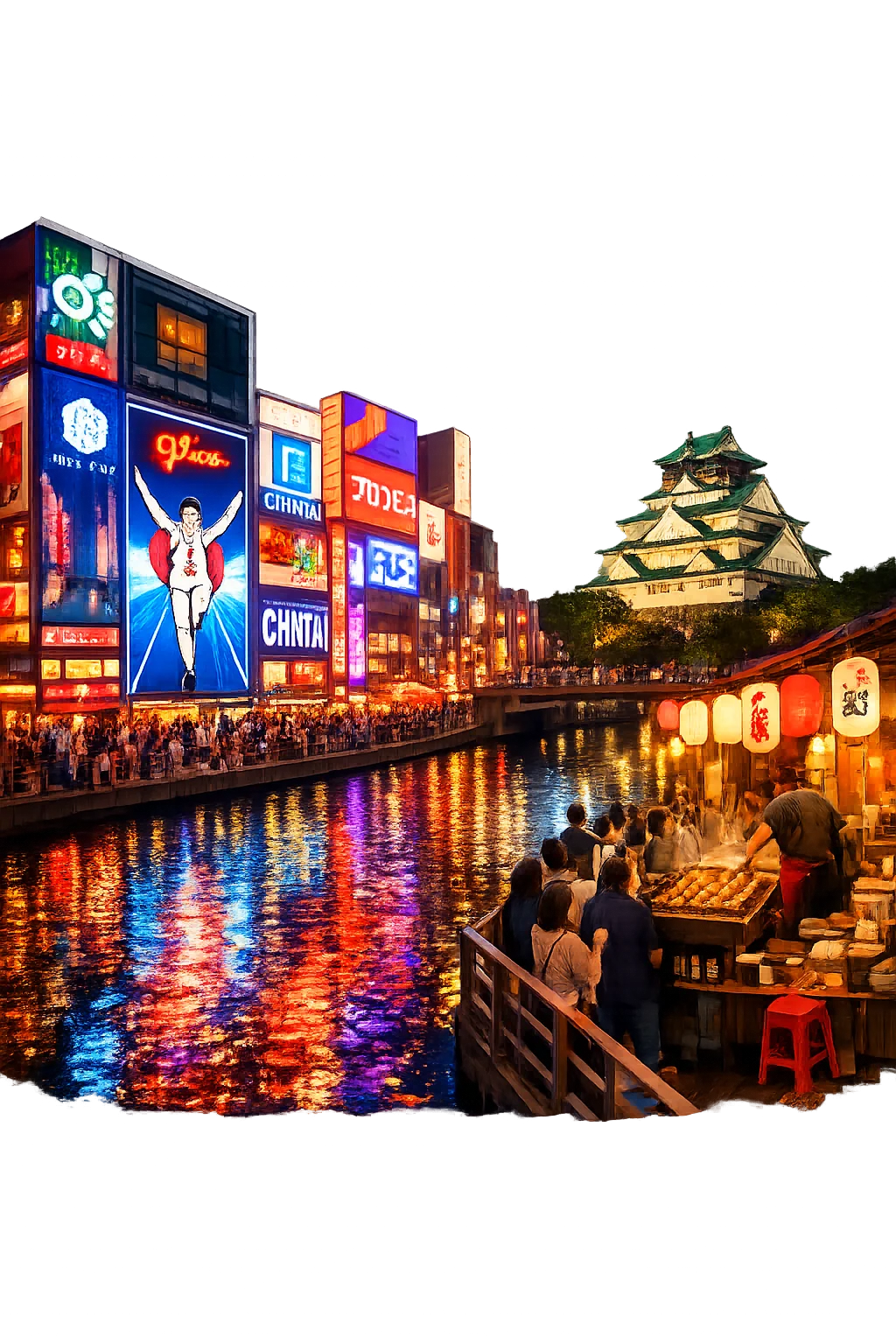
Stories of Ōsaka
Ōsaka began as the ancient port of Naniwa, gateway to the Asian continent and briefly an imperial capital. It later became the merchant city par excellence — the 'kitchen of the nation' — and the fortress from which Toyotomi Hideyoshi sought to rule a unified Japan. Its 'myths' are historical episodes, told here with the same reverence as legend.
Long before it was called Ōsaka, the delta at the mouth of the Yodo River was Naniwa — 難波, 'the rapids'. The Man'yōshū ('Collection of Ten Thousand Leaves', c. 759) preserves the city's oldest surviving poem: 'At Naniwa's ford these flowers bloomed, winter-bound, and now, with spring come, they bloom' (Man'yōshū 1.52), a courtly welcome staged at the port where envoys from Korea and China stepped ashore. South of the port the earth itself keeps royal memory: the Daisenryō Kofun of the Mozu cluster, traditionally attributed to Emperor Nintoku (r. early fifth century), is the largest tomb on earth, a keyhole-shaped island of forest nearly five hundred metres long. In 645 Emperor Kōtoku made Naniwa Nagara Toyosaki his capital — Japan's first planned imperial city — and Empress Saimei rebuilt the Naniwa palace in the 650s (Nihon Shoki). Ōsaka thus begins not as a town but as a doorway: everything continental — writing, Buddhism, metallurgy, ceramics — passed this threshold before it became Japanese.
In 593, tradition says, Prince Shōtoku founded Shitennō-ji, 'Temple of the Four Heavenly Kings', on Naniwa's ground, making Ōsaka one of the first places in Japan where Buddhism put down institutional roots. The temple was a political theology built in wood: the Four Kings were guardians of the state, and their temple announced that the new faith would defend the realm — a diplomatic as much as a devotional statement, aimed at the continental powers whose models Japan was adopting. Tradition credits Shōtoku's foundation with works of mercy alongside worship — relief for the poor, care for the sick, a pharmacy — so that the temple doubled as Japan's first public infrastructure. Shitennō-ji's five-storey pagoda still rises over the ward that bears its name. The episode fixes a pattern the city never lost: in Ōsaka, religion arrives as logistics — imported, organised, and immediately put to work at the waterfront.
In 1580, after a ten-year siege, Oda Nobunaga's armies destroyed the warrior-monks of Ishiyama Hongan-ji, the fortified cathedral whose walls had defied everything thrown at them. In 1583 Toyotomi Hideyoshi, the peasant-born general who completed Japan's unification, began on those ruins the castle that was to be the seat of a new order — walls of immense fitted stone, a donjon clad in gold, a city laid out as the capital of the realm he had made. Hideyoshi died in 1598; in 1614–1615 Tokugawa Ieyasu besieged the castle twice, and the Toyotomi line ended in the burning keep with Hideyoshi's son Hideyori and his mother Yodo-dono. The Tokugawa rebuilt the city, but as a merchant port, not a rival capital. The lesson Japan drew was architectural: the nation's strongest walls could not hold an inheritance, and Ōsaka's castle passed from monument of ambition to monument of warning — the fortress where Japan's second unifier built, and lost, everything.
Under the Tokugawa peace, Ōsaka became what Kyōto and Edo could not: a city of money. Rice from every domain flowed down the Yodo River to the Dōjima exchange, where from 1730 the shogunate licensed the trading of rice bills — deferred-delivery contracts that historians count among the world's first organised futures markets. The merchants' storehouses (kurayashiki) lined the canals; the city's brokers, weighers, and clerks ran an economy that no samurai fully understood. The surplus patronised art: in 1684 the chanter Takemoto Gidayū opened his puppet theatre in Dōjima, and the playwright Chikamatsu Monzaemon made the Ōsaka stage the voice of a merchant age, immortal in The Love Suicides at Sonezaki. Ōsaka earned its nickname tenka no daidokoro, 'the nation's kitchen', and its civic creed kuidaore — 'eat yourself bankrupt'. Where capitals keep monuments, this city keeps a market; its founding myth is a receipt.
Merchant Capital · Port of Naniwa · Castle Town
Ōsaka began as the ancient port of Naniwa, briefly an imperial capital, and grew into the merchant city par excellence of early modern Japan. Where Kyōto was aristocratic and Edo samurai, Ōsaka was the place where money, rice, and popular culture flowed together.
Hideyoshi's fortress rose on the ruins of the Ishiyama Hongan-ji and became the symbol of Toyotomi ambition.
The ancient harbour received envoys, Buddhism, and trade from Korea and China before the city was called Ōsaka.
Merchant patronage made Ōsaka a cradle of popular theatre, especially the puppet art of bunraku.
The Dōjima rice exchange and canal-side warehouses turned Ōsaka into Japan's financial and distribution hub.
From the original script to the living URL
大阪
The name in its original Japanese form. Ōsaka (大阪) is attested in the source tradition — “Large hill or slope”. Its original diacritics and script distinctions carry the full phonetic and orthographic weight of the source tradition.
osaka
Reduced to plain osaka, the name loses everything that made it specific: original diacritics and script distinctions. What remains is an ASCII string that machines can parse but that no longer speaks with its original voice.
Ōsaka
The Unicode restoration recovers what ASCII flattened. Ōsaka restores original diacritics and script distinctions, returning the name to its original written dignity. The domain encodes to Punycode, but the browser displays the truth.
Ōsaka.com → xn--saka-k3a.com
The non-ASCII characters in Ōsaka are encoded while the ASCII remains visible. To the DNS, it is Punycode. To humanity, it is Ōsaka.
Owned, ideal, and ASCII forms of Ōsaka
Ōsaka
Restores 大阪. The live temple domain — ōsaka.com.
osaka
Flattens 大阪. The plain ASCII fallback — what DNS and legacy systems see.
How Ōsaka was spoken
How Ōsaka travels from ancient script to the modern URL
Japanese 大阪 Ōsaka; from 大 ō “great" + 阪 saka “slope, hill"; the mercantile hub of western Japan.
Merchant City, Kansai
The Unicode restoration Ōsaka preserves the Hepburn macron; the kanji form is not registrable in .com.
The lore you have read is the living myth. Extended Lore opens the scholarly vault beneath it: the cult and its material remains, a history of the image, the name after antiquity, a meditation on what the name still means, and the full scholarly apparatus — etymology, orthography, sources.
Enter Extended Lore