PuniCodex

Extended Lore

大阪 Ōsaka

Etymology · Orthography · Cult · Iconography · Reception · Sources

Tier 1 Ōsaka.com
Ōsaka — Merchant City, Kansai
01

Quick Facts

Essential information about Ōsaka, Merchant City, Kansai

Original Script大阪
Unicode RestorationŌsaka
Reconstructed Pronunciation/oːsaka/
PantheonJapanese
DomainMerchant City, Kansai
MeaningLarge hill or slope
ClassificationTier 1
Primary DomainŌsaka.com
Sacred SymbolsCastle tower, Bunraku puppet, Merchant's scale, Glico running man, Kuidaore Taro
02

Etymology & Word Family

From original script to Unicode restoration

Proto-sino-tibetan 大阪 large + slope, hill
Original Script 大阪 Ōsaka — "Large hill or slope"
Unicode Restoration Ōsaka Restored stress, length, and script
Modern ASCII osaka Plain-ASCII fallback

From Japanese 大阪 "large hill"; ancient commercial capital.

03

Unicode Character Breakdown

Character-by-character philological analysis

CharacterUnicodeNameBlockPhonetic Role
ŌU+014CLatin Capital Letter O with MacronLatin Extended-AMacron: long vowel
sU+0073Latin Small Letter SBasic LatinSame
aU+0061Latin Small Letter ABasic LatinSame
kU+006BLatin Small Letter KBasic LatinSame
aU+0061Latin Small Letter ABasic LatinSame

The Tier 1 classification reflects how much of the original phonology this restoration preserves — stress and vowel length for Greek names, distinctive letters and diacritics for every other tradition.

04

Cult & Worship

How the sacred was kept — rites, sanctuaries, remains

The Cult

Ōsaka’s sacred calendar is a merchant’s calendar, and its great rites map the city’s ages. Sumiyoshi Taisha, traditionally founded in the third century and among Japan’s oldest shrines, keeps the Otaue Shinji each 14 June — rice-planting maidens in the god’s own fields, one of the last great agricultural liturgies of a city that was rice before it was money. Shitennō-ji, Prince Shōtoku’s foundation of 593, burned and was reborn so often that its present halls are a 1963 ferroconcrete reconstruction; every 14 January its precinct stages the Dōya-dōya, young men in loincloths scrambling for lucky sticks — an old temple rite with the city’s noise turned up. Osaka Tenmangū, raised in 949 to the deified scholar Sugawara no Michizane, sends its river procession and fireworks over the Dōjima waters on 24–25 July: the Tenjin Matsuri, counted among Japan’s three great festivals, born when the merchant city adopted a scholar’s plague-god as patron. Tradition counts Ikukunitama’s summer festival the oldest in town, and each January the shops of Imamiya Ebisu buy the year’s luck with bamboo branches — the cult of commerce, openly practised.

In the Earth

Naniwa Palace Ruins Park preserves the Daigokuden audience hall, warehouse complexes, and wharf remains of Emperor Kōtoku's capital. The Mozu-Furuichi Kofun Group, including the Daisenryō Kofun attributed to Emperor Nintoku, dominates the southern plain. Excavated Toyotomi stone walls, granite ramparts, and the reconstructed donjon of Ōsaka Castle document the city's transformation from port to mortuary landscape to fortress.

05

Iconography

How Ōsaka was imaged across the ages

The Image

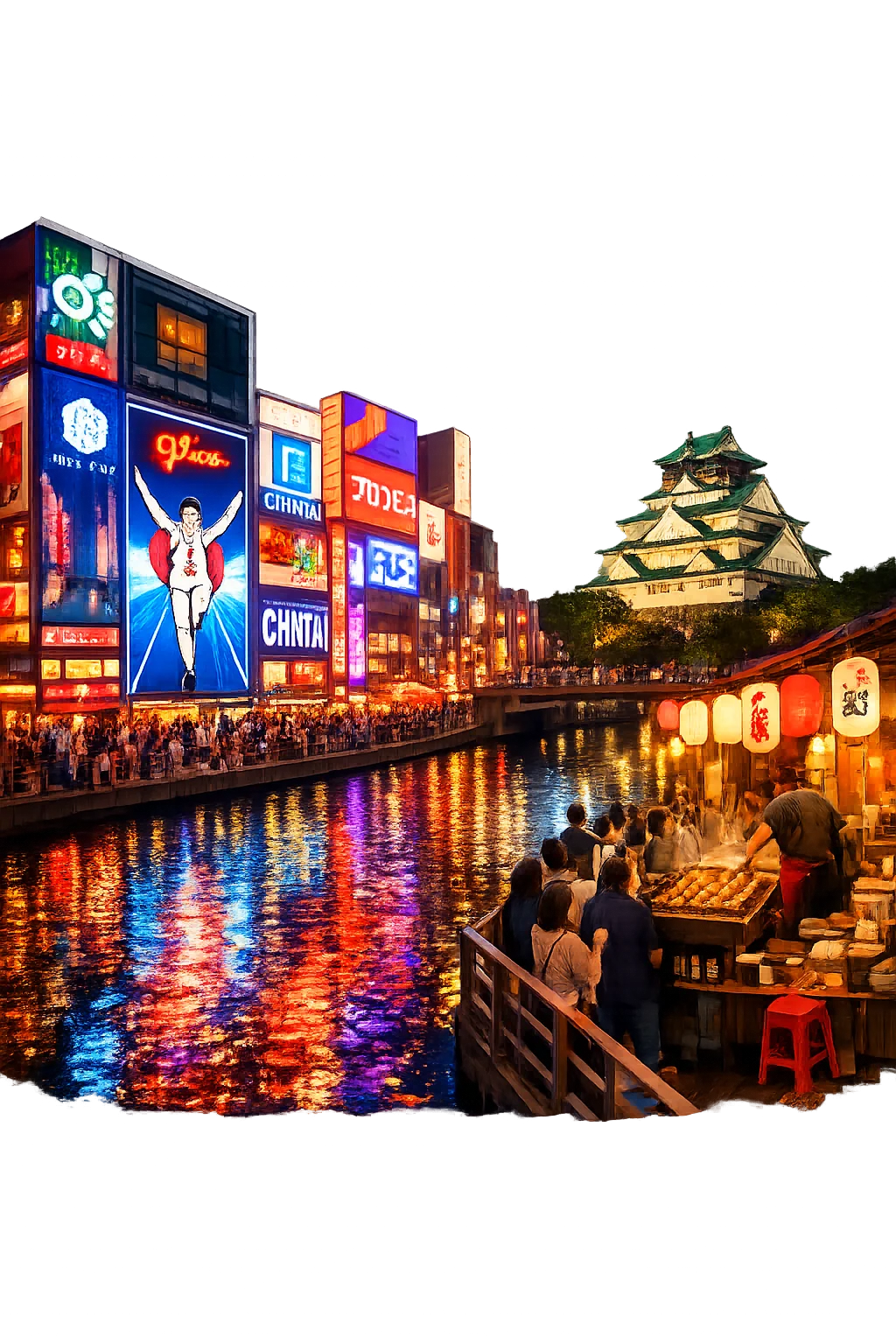
Ōsaka was imaged first as heaven’s gateway, then as itself — and the second portrait is the famous one. For a thousand years the city scarcely had a face in art: Naniwa appears in the Man’yōshū as a ford of flowers, and medieval imagination spent itself on the haniwa-guarded mounds of the southern plain rather than on any skyline. The print revolution gave the merchant city its likeness: the Ōsaka sōzu — bird’s-eye woodblock views of the whole town, canals, bridges and theatre districts — circulated from the late seventeenth century, and Akisato Ritō’s Settsu meisho zue (1796–98) fixed its celebrated places in the illustrated-guide tradition that taught Japan what was worth seeing. The nineteenth century added the emblem that now outshines all: Ōsaka Castle’s donjon on its stone sea, rebuilt in concrete in 1931 and again — gilded, moated, floodlit — as the logo of the modern city. The most honest portrait of Ōsaka, though, remains the oldest kind: a map you can live by, drawn in canals.

06

Reception & Transformation

The name after its own age — transmission, translation, survival

Afterlives

The city’s transmission runs on two rails — the name, and the image. The name changed hands across the centuries: Naniwa, the “rapids” of the Man’yōshū, yielded to Ōsaka — “great slope”, attested around the medieval temple-and-castle quarter — and the characters were officially rewritten in early Meiji, 1868, from 大坂 to 大阪, as if the old town could be rebranded with a stroke. The image travelled as guide and warning: Edo Japan learned Ōsaka through the meisho-zue picture-books as the place where money moves; the Meiji port, opened to foreign trade in 1868, taught the world the same lesson, and the city incorporated in 1889 among Japan’s first municipalities.

Twice destroyed and twice rebuilt — the Toyotomi fire and the air raids of 1945 razed the merchant quarters — Ōsaka re-imaged itself for the age of mass media with Expo ’70, the first world’s fair in Asia, Tarō Okamoto’s Tower of the Sun its brash new emblem, and UNESCO’s 2019 listing of the Mozu-Furuichi kofun returned the city’s oldest sacred geography to the world map. The nation’s kitchen now exports its self-portrait the way it once exported rice: in bulk, seasoned, and slightly immodest.

Identifications Across Traditions

Ōsaka's identity was forged by mixing sacred and commercial cultures.

Prince Shōtoku's Shitennō-ji made it one of Japan's earliest Buddhist centres, while the port received continental technologies, Chinese learning, and Korean crafts. In the Edo period the city became a meeting ground for samurai, merchants, and entertainers; its comedy, food, and theatre borrowed from Kyōto, Edo, and the immigrant communities of Nankinmachi. Modern Ōsaka remains Japan's most openly mercantile major city, proud of its dialect, its food, and its history of making deals across boundaries.

Modern Legacy

Ōsaka is the city that taught Japan to laugh, eat, and trade.

Its merchant culture produced bunraku, manzai comedy, and the regional cuisine celebrated in takoyaki, okonomiyaki, and kushi-katsu. The Dōjima rice exchange pioneered futures markets, and the city's canals and warehouses shaped the physical landscape of Kansai. Today Ōsaka is a global business hub, the gateway to the Kansai region, and a rival to Tōkyō in sports, food, and popular culture. It represents the Japan of merchants and migrants as much as the Japan of emperors and samurai.

07

The Meditation

What Ōsaka means — beyond the dictionary

Every country has a capital of power and a capital of something else. Japan's official story runs through Kyōto and Edo; its unofficial story runs through Ōsaka — the city that fed the capitals, financed them, and laughed at them. The restored macron in Ōsaka is a small act of philological justice for the least aristocratic of Japan's great cities: it preserves the long vowel the market itself would have pronounced flatly and quickly, between deals. There is a lesson in a sacred-mountain lexicon making room for a kitchen: myth is not only what nations believe about gods, but what they believe about themselves. Ōsaka's belief is that value is made, not inherited — rice into wealth, wealth into theatre, theatre into a civic personality sturdy enough to survive losing a castle, a war, and its status twice. The 'nation's kitchen' is Japan's other founding temple, and its liturgy is lunch.

08

Frequently Asked Questions

Common questions about Ōsaka, Merchant City, Kansai, and Unicode restoration

01How do you pronounce Ōsaka?

In reconstructed pronunciation, Ōsaka is /oːsaka/ — approximately 'OH-sah-kah' — the first vowel is long; the following syllables are short and level in pitch.

02What does Ōsaka mean?

Ōsaka means Large hill or slope in the japanese tradition.

03What are the symbols of Ōsaka?

Ōsaka is associated with Castle tower (The reconstructed donjon of Ōsaka Castle, icon of the city's warrior and merchant history), Bunraku puppet (The articulated puppet of the National Bunraku Theatre, symbol of Ōsaka's popular arts), Merchant's scale (The balance of the Dōjima rice exchange, where futures trading first took shape in Japan), Glico running man (The neon athlete glowing above Dōtonbori since 1935 — Ōsaka's most photographed sign and emblem of its merchant showmanship), Kuidaore Taro (The clown drummer of Dōtonbori in his striped costume, mascot of the eat-yourself-bankrupt creed).

04Why restore Ōsaka in Unicode?

Plain ASCII osaka strips the stress, length, and script that make the name specific. Unicode restoration returns the name to its original written dignity.

05What is the most important myth about Ōsaka?

“Naniwa, the First Imperial Port” — the Origins story that anchors the mythology of Ōsaka, told in full on the lore page.

09

Scholarly Sources

The philological foundations of this restoration

Every claim on this page is grounded in established scholarship. The orthographic restorations follow disciplinary convention. The etymological chain follows the best available reference works. This is not invention — it is resurrection through scholarship.

◈

Lexicography & Philology

  • Hepburn
◎

Primary Texts

  • Kojiki
  • Nihon Shoki (Chronicles of Japan)
  • Kojiki (Records of Ancient Matters, 712 CE)
  • Man'yōshū 1.52 (Collection of Ten Thousand Leaves, ca. 759 CE)
◉

Archaeology & Art History

  • Material evidence — iconography, inscriptions, and temple archaeology — for Ōsaka and related cults.
✦

Religious Studies

  • Osaka Museum of History, Naniwa Palace Ruins Park documentation
  • Ōsaka City official historical overview
Return

The Surface Awaits

You have traced the name from its earliest attestation to its Unicode restoration. Now return to the myth. The story is where the name lives.

Back to Lore
Ōsaka mascot