The Living Myth
Wisdom, Divination, Ifá · Heaven knows who will succeed
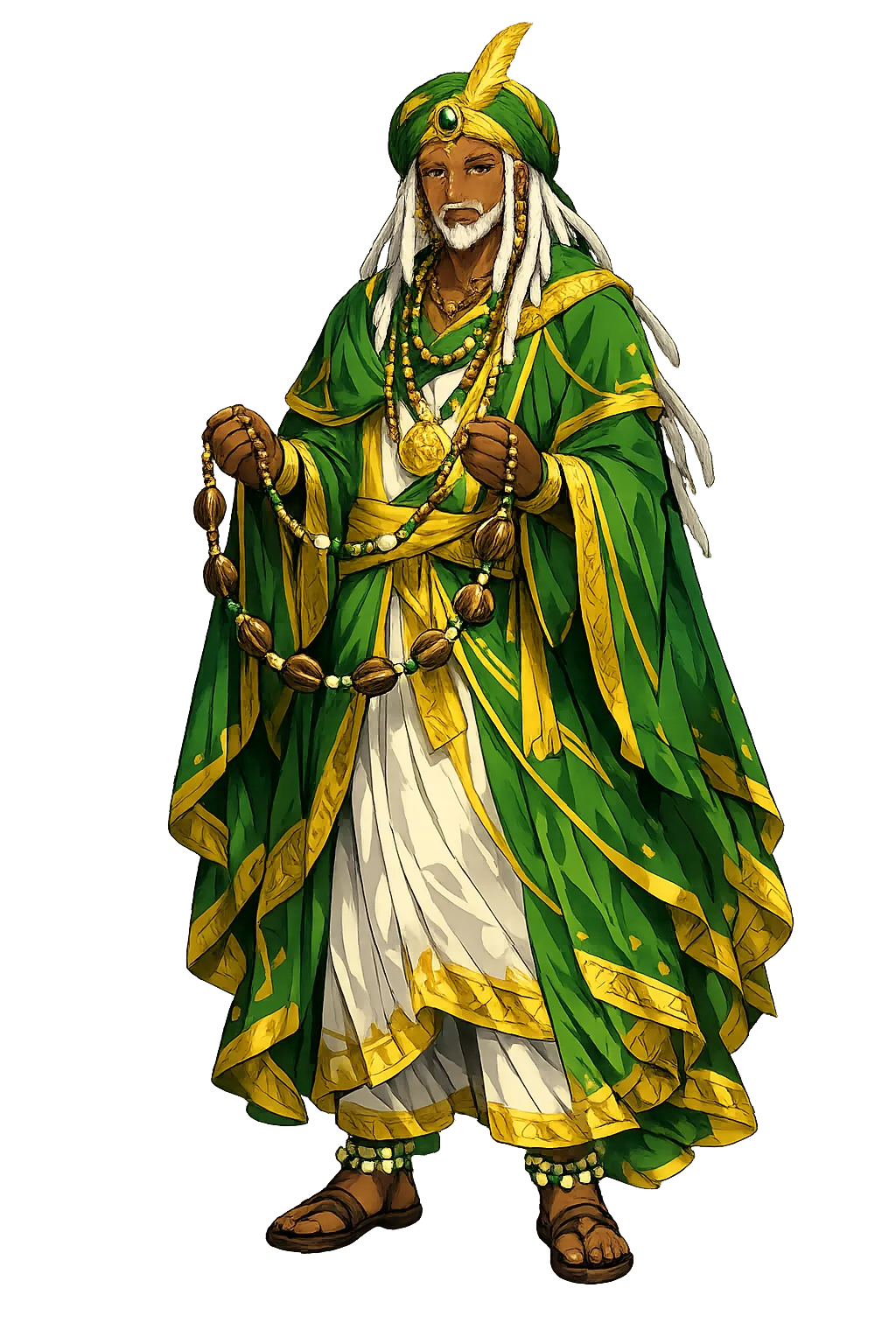
Stories of Ọrúnmìlà
Ọrúnmìlà's mythology lives in the thousands of Ifá verses (òdù Ifá) that record his journeys, judgments, and interventions — wisdom's biography told as scripture.
According to Ifá tradition, Ọrúnmìlà was the only orixá present when Olódùmarè created the earth. He observed the placing of the rivers, the rising of the mountains, and the distribution of destinies, and the corpus never stops drawing authority from that attendance (Abimbola, Ifá: An Exposition of Ifá Literary Corpus, 1976; Bascom, Ifa Divination, 1969). The other orishas received domains; Ọrúnmìlà received the memory of everything. Because he witnessed the beginning, he can trace any present trouble back to its origin and prescribe the sacrifice that will set it right. The Ifá verses return to this scene whenever authority is questioned, and it has silenced sceptics for centuries. The myth defines knowledge as witnessing rather than power: the one who watched the world being made became the one to whom the world turns when it forgets what it is for.
Before descending to earth, Ọrúnmìlà received from Olódùmarè the gift called àgbọnnìrègún — the sixteen sacred palm nuts and the science of reading them, glossed in the corpus as 'the medicine that never fails' (Bascom 1969; Idowu, 1962). The myth has a practical moral: the other orishas came down with powers over fire, water, and iron, but Ọrúnmìlà came down with a method. Wherever he travelled — and the verses send him wandering through every kind of settlement — he could answer any question put to him by casting the nuts and reciting the odù that fell. That is why the nuts are addressed with the respect due a founder, and why their loss ends a priest's career. The story makes divination a deliberate endowment, not an improvisation: heaven equipped its witness with the one tool the world would never stop needing.
A celebrated òdù narrative tells of a man who, before birth, knelt impatiently in heaven and seized the first head Àjàlá the potter offered — a cracked, ill-fired orí. On earth his life collapsed: his farms failed, his wives left, his name soured. At last he consulted Ifá, performed the prescribed sacrifice, and in a dream journey returned to the house of Àjàlá, where he exchanged the ruined head for a sound one; he woke on earth a different man (Abimbola 1976; the Orí cycle of narratives). The story is the corpus's most beloved parable of hope: destiny chosen cannot be unchosen, but heaven keeps a pottery, and sacrifice is the road back to it. Ọrúnmìlà's role is never to mock the careless chooser — only to chart the road back.
Countless òdù verses end the same way: a person consults Ifá, receives a precise prescription — offer this, avoid that — and ignores it; ruin follows exactly as the odù said it would (Bascom 1969 catalogues the motif). Sometimes the refuser is a king who will not humble himself, sometimes a trader who counts the ẹbọ too dear. Ọrúnmìlà never punishes; the ignored counsel simply unfolds, the way an unread letter still contains its bad news. The motif is the corpus's pedagogy of practice: divination is not knowledge for its own sake but knowledge tied to an act. A verse unperformed is a door left shut, and a sacrifice owed is a debt the world always collects. The god of wisdom measures understanding the way a doctor measures recovery — not by what you heard, but by what you did.
Wisdom, Divination, and the Ifá Corpus
Ọrúnmìlà is the orixá of wisdom and the patron of Ifá, the divination system that reads human destiny against the patterns of the cosmos. Present at creation, he alone remembers how the world was founded. Kings consult him before they act; his priests, the babalawos, speak for him through sixteen palm nuts.
Sixteen palm nuts and the divination chain reveal the odù that governs a situation.
He remembers the verses, medicines, and sacrifices that restore cosmic balance.
Only he saw the world being made; therefore only he can interpret its deepest laws.
The father of secrets — the title of the priests who speak for him in divination.
From the original script to the living URL
Ọ̀rúnmìlà
The name in its original Yoruba form. Ọrúnmìlà (Ọ̀rúnmìlà) is attested in the source tradition — “Heaven knows who will succeed”. Its acute stress marks carry the full phonetic and orthographic weight of the source tradition.
orunmila
Reduced to plain orunmila, the name loses everything that made it specific: acute stress marks. What remains is an ASCII string that machines can parse but that no longer speaks with its original voice.
Ọrúnmìlà
The Unicode restoration recovers what ASCII flattened. Ọrúnmìlà restores acute stress marks, returning the name to its original written dignity. The domain encodes to Punycode, but the browser displays the truth.
Ọrúnmìlà.com → xn--rnml-3na4exes761a.com
The non-ASCII characters in Ọrúnmìlà are encoded while the ASCII remains visible. To the DNS, it is Punycode. To humanity, it is Ọrúnmìlà.
Owned, ideal, and ASCII forms of Ọrúnmìlà
Ọrúnmìlà
Restores Ọ̀rúnmìlà. The live temple domain — ọrúnmìlà.com.
orunmila
Flattens Ọ̀rúnmìlà. The plain ASCII fallback — what DNS and legacy systems see.
How Ọrúnmìlà was spoken
How Ọrúnmìlà travels from ancient script to the modern URL
Yoruba theonym of the orisha of wisdom and divination, master of Ifá (often etymologized from ọ̀rún ní màyè, heaven knows the way).
Wisdom, divination, destiny, Ifá; the witness of fate.
The owned form Ọrúnmìlà keeps the underdot and three of four tones; the initial low tone is documented in the variants.
The lore you have read is the living myth. Extended Lore opens the scholarly vault beneath it: the cult and its material remains, a history of the image, the name after antiquity, a meditation on what the name still means, and the full scholarly apparatus — etymology, orthography, sources.
Enter Extended Lore