PuniCodex

Extended Lore

Ọ̀rúnmìlà Ọrúnmìlà

Etymology · Orthography · Cult · Iconography · Reception · Sources

Tier 1 Ọrúnmìlà.com
Ọrúnmìlà — Wisdom, Divination, Ifá
01

Quick Facts

Essential information about Ọrúnmìlà, Wisdom, Divination, Ifá

Original ScriptỌ̀rúnmìlà
Unicode RestorationỌrúnmìlà
Reconstructed Pronunciation/ɔ̀.rúɱ.mì.là/
PantheonYoruba
DomainWisdom, Divination, Ifá
MeaningHeaven knows who will succeed
ClassificationTier 1
Primary DomainỌrúnmìlà.com
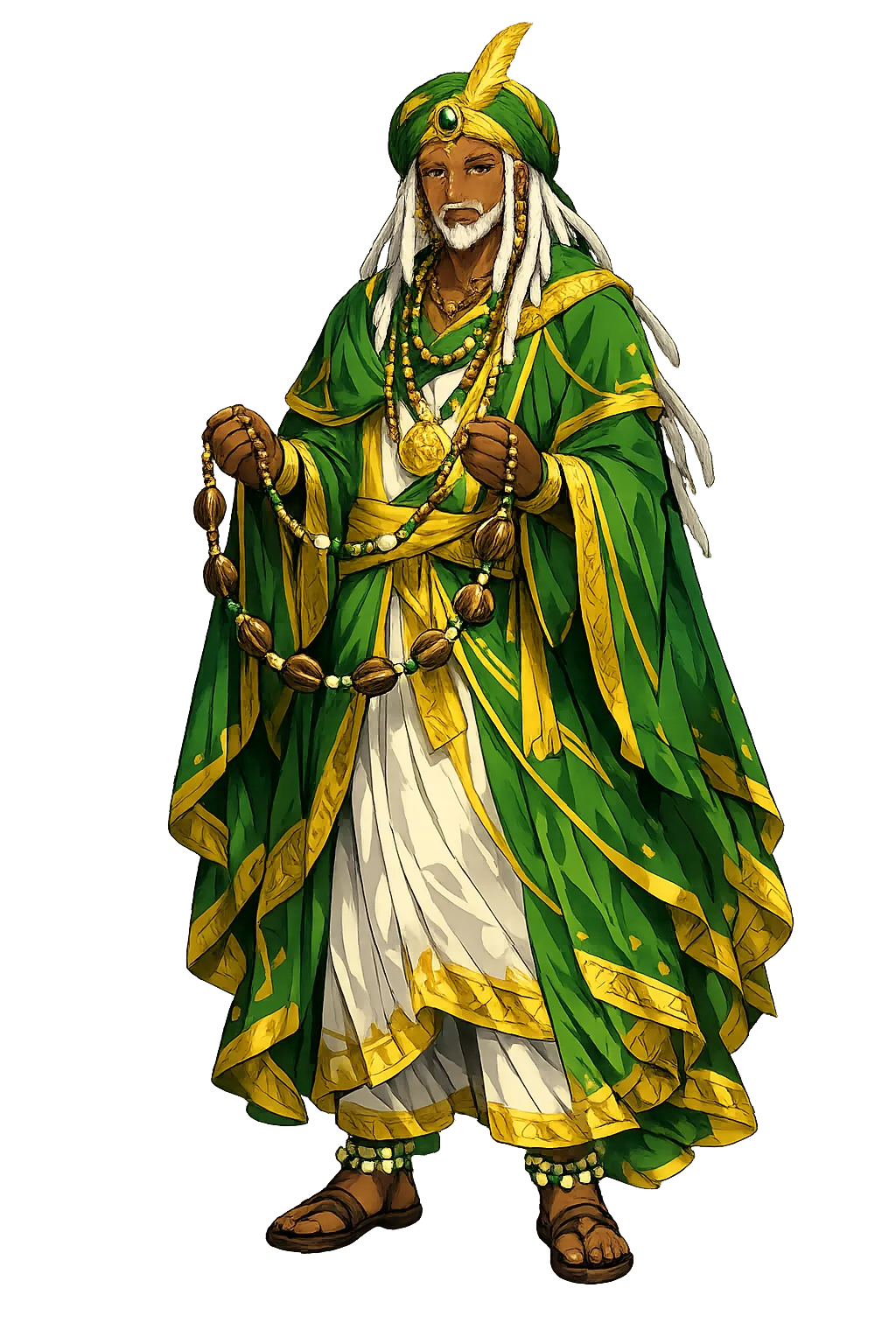
Sacred SymbolsIkin palm nuts, Ọpẹ̀lẹ̀ divination chain, Green and yellow beads, Staff of wisdom
02

Etymology & Word Family

From original script to Unicode restoration

Original Script Ọ̀rúnmìlà Ọrúnmìlà — "Heaven knows who will succeed"
Unicode Restoration Ọrúnmìlà Restored stress, length, and script
Modern ASCII orunmila Plain-ASCII fallback

The name Ọrúnmìlà carries the orthographic signature of the yoruba tradition: Ọ̀rúnmìlà. Unicode restoration recovers what ASCII flattens.

03

Unicode Character Breakdown

Character-by-character philological analysis

CharacterUnicodeNameBlockPhonetic Role
ỌU+1ECCLatin Capital Letter O with Dot BelowUnknownSpecial character
rU+0072Latin Small Letter RBasic LatinSame
úU+00FALatin Small Letter U with AcuteLatin-1 SupplementStress on u
nU+006ELatin Small Letter NBasic LatinSame
mU+006DLatin Small Letter MBasic LatinSame
ìU+00ECLatin Small Letter I with GraveLatin-1 SupplementStress on i
lU+006CLatin Small Letter LBasic LatinSame
àU+00E0Latin Small Letter A with GraveLatin-1 SupplementStress on a

The Tier 1 classification reflects how much of the original phonology this restoration preserves — stress and vowel length for Greek names, distinctive letters and diacritics for every other tradition.

04

Cult & Worship

How the sacred was kept — rites, sanctuaries, remains

The Cult

Ọrúnmìlà’s cult is the practice of his priests, and his priests are his temple. There is no shrine-building that houses the god: the working centre of his worship is the babalawo — “father of secrets” — an initiated priesthood whose members apprentice for years to memorize the corpus, and the consecrated shrine each one keeps: the divination tray, the sixteen ikin palm-nuts sealed in their beaded sheath, the ọpẹ̀lẹ̀ chain. Consultation is the ritual: a client comes with a question, the nuts are cast or the chain thrown, the odù that falls summons its verses, and the prescribed sacrifice — ẹbọ — is the act that closes the rite. Kings in Yorubaland consulted Ifá before war and succession; today the babalawo initiates new priests in the itẹfá ceremony and presides over the religion’s households from Lagos to Havana. The evidence is not archaeological but living and continuous — a priesthood that has transmitted the same instruments and verses for centuries, with UNESCO’s recognition of the Ifá divination system recording, not creating, its standing.

In the Earth

The Ifá corpus is preserved orally and in manuscript form across Yoruba-speaking regions, with material evidence in the divination kit itself: carved palm nuts (ikin), brass ọpẹ̀lẹ̀ chains, and wooden divination trays (ọpọ́n Ifá) whose rims bear the face of Ẹṣù. Bascom's mid-century recordings and Abimbola's transcriptions fixed tens of thousands of verses in writing for the first time. Diaspora collections hold beaded necklaces, iron staffs, and the palm-nut pouches of working babalawos in Havana and Bahia — instruments of a scripture whose primary medium remains the trained and consecrated memory.

05

Iconography

How Ọrúnmìlà was imaged across the ages

The Image

Ọrúnmìlà is imaged through his instruments, and that is a deliberate theology of the unseen. Yoruba sculpture lavishes skill on other orishas — Eshu at the gate, Shango’s dancing staffs — but the god of wisdom leaves no shrine figure: no museum holds a canonical image of him, and surviving Yoruba wood sculpture of any kind rarely predates the nineteenth century. His likeness, where one is needed, is the toolkit itself: the round divination tray with its rim of carved faces, the sixteen ikin nuts, the brass ọpẹ̀lẹ̀ chain of eight half-shells. The visual rhetoric is the point — the sage is what the sage uses. Only in the twentieth century did diaspora art give him a body: Cuban and Brazilian religious painting and beadwork image Orunmilá as an elder in green and yellow, often holding the palm nuts, and contemporary Yoruba artists now paint Ọrúnmìlà among the orishas in the bright flat style of the new sacred posters. The god who watched creation is still easiest to recognize by what he holds.

06

Reception & Transformation

The name after its own age — transmission, translation, survival

Afterlives

The transmission of Ọrúnmìlà is the transmission of an oral scripture into print, and it took the whole twentieth century. The corpus lived in the consecrated memory of the babalawos — verses in archaic Yoruba that scholars judge old by their language — until missionary linguistics gave Yoruba an alphabet in the nineteenth century and curiosity followed trade up the coast. Leo Frobenius recorded Ifá material during his Yorubaland expeditions of 1910–12, fixing chants in European print for the first time, however imperfectly; mid-century, Geoffrey Parrinder’s West African Religion (1949) placed the god in the comparative record. The decisive step came in the 1960s and 70s: William Bascom’s fieldwork produced Ifa Divination (1969), and Wande Abimbola — himself scholar and initiate — published the first large bilingual expositions of the corpus (Ifá: An Exposition of Ifá Literary Corpus, 1976, and the Odu Ifa volumes).

Since then Ifá has become a field of its own, taught on three continents, while the diaspora priesthoods kept the transmission unbroken in practice. The witness of creation ended up witnessing something quieter: an oral library crossing into writing without losing its voice.

Identifications Across Traditions

Ọrúnmìlà travelled to the Americas as the patron of Ifá and the apex of Santería's religious hierarchy. In Cuba, babalawos of the Regla de Ifá initiate through a ceremony that makes them 'godfathers' of the oracle itself, and Catholic syncretism sometimes pairs him with Saint Francis of Assisi, whose humility and poverty invited the identification. In Brazil he is Orunmilá, less publicly prominent than in Cuba but foundational to the Casas de Ifá that preserve the palm-nut casting beside the cowrie oracle. In both countries the figure who witnessed creation ended up witnessing another creation: a religion reassembled in exile, with himself as its librarian.

Modern Legacy

Ọrúnmìlà's legacy is the Ifá corpus itself — one of the largest bodies of African sacred poetry, inscribed by UNESCO on the Representative List of the Intangible Cultural Heritage of Humanity as the 'Ifa divination system'. His influence reaches into literature, psychology, and ethics: the idea that wisdom is not possession but practice, that destiny can be read but must be met with sacrifice, and that the future is a conversation rather than a sentence. Contemporary African philosophers and diaspora theologians return to him as a model of disciplined, compassionate knowledge — the sage whose authority rests entirely on having paid attention when the world was made.

07

The Meditation

What Ọrúnmìlà means — beyond the dictionary

Ọrúnmìlà is the god who knows that knowing is not enough. He possesses the memory of creation, yet his work is not to dazzle humans with that memory but to guide them through the small, repeated acts — casting nuts, reciting verses, making sacrifice — that restore alignment.

In an information-saturated age, Ọrúnmìlà offers a different model of wisdom. It is not the accumulation of facts but the patience to hear what a pattern means. The babalawo does not predict the future like a fortune-teller; he reads the shape of a life against the oldest stories and suggests the practical step that will turn the current. To approach Ọrúnmìlà is to admit that you do not know enough to act alone — and that this admission is the beginning of intelligence.

08

Frequently Asked Questions

Common questions about Ọrúnmìlà, Wisdom, Divination, Ifá, and Unicode restoration

01How do you pronounce Ọrúnmìlà?

In reconstructed pronunciation, Ọrúnmìlà is /ɔ̀.rúɱ.mì.là/ — approximately aw-ROON-mee-LAH — low 'aw', high 'ROON', then low 'mee-LAH'.

02What does Ọrúnmìlà mean?

Ọrúnmìlà means Heaven knows who will succeed in the yoruba tradition.

03What are the symbols of Ọrúnmìlà?

Ọrúnmìlà is associated with Ikin palm nuts (The sixteen sacred nuts used in Ifá divination; they hold the signatures of the odù.), Ọpẹ̀lẹ̀ divination chain (The chain of eight half-shells that provides quicker access to Ifá wisdom.), Green and yellow beads (His sacred colours, associated with palm leaves, knowledge, and mature wisdom.), Staff of wisdom (The iron staff that grounds his authority and marks the babalawo in ceremony.).

04Why are there different spellings of Ọrúnmìlà?

Each form is a historically attested restoration rather than a mistake: Ọ̀rúnmìlà is the alt form (Fully tone-marked dictionary form with the initial low tone (Abraham). Written Yoruba routinely omits tone marks.). PUNICODEX registers the full set so the tradition is preserved under every defensible spelling.

05Why restore Ọrúnmìlà in Unicode?

Plain ASCII orunmila strips the stress, length, and script that make the name specific. Unicode restoration returns the name to its original written dignity.

06What is the most important myth about Ọrúnmìlà?

“The Witness at the Foundation of the World” — the Cosmogony story that anchors the mythology of Ọrúnmìlà, told in full on the lore page.

09

Scholarly Sources

The philological foundations of this restoration

Every claim on this page is grounded in established scholarship. The orthographic restorations follow disciplinary convention. The etymological chain follows the best available reference works. This is not invention — it is resurrection through scholarship.

◈

Lexicography & Philology

  • Bascom
  • Idowu
◎

Primary Texts

  • The Ifá divination corpus; ọ̀rọ̀ àṣà and oríkì traditions; Abraham’s Dictionary of Modern Yoruba.
◉

Archaeology & Art History

  • Material evidence — iconography, inscriptions, and temple archaeology — for Ọrúnmìlà and related cults.
✦

Religious Studies

  • Bascom, Ifa Divination: Communication Between Gods and Men in West Africa (1969)
  • Abimbola, Ifá: An Exposition of Ifá Literary Corpus (1976)
  • Idowu, Olódùmarè: God in Yoruba Belief (1962)
  • Abraham, Dictionary of Modern Yoruba (1958)
  • Mason, Four New World Yoruba Rituals
  • Verger, Notes sur le Culte des Orisa et Vodun (1981)
Return

The Surface Awaits

You have traced the name from its earliest attestation to its Unicode restoration. Now return to the myth. The story is where the name lives.

Back to Lore
Ọrúnmìlà mascot