Stories of Orpheús
Orpheús' myths are all about what music can and cannot do: it charms everything in nature, opens the underworld's doors, and saves nothing except itself. Epic, lyric, and Roman poetry, and finally the mystery-religion that took his name, turn one Thracian singer into the West's permanent anatomy of art, love, and loss.
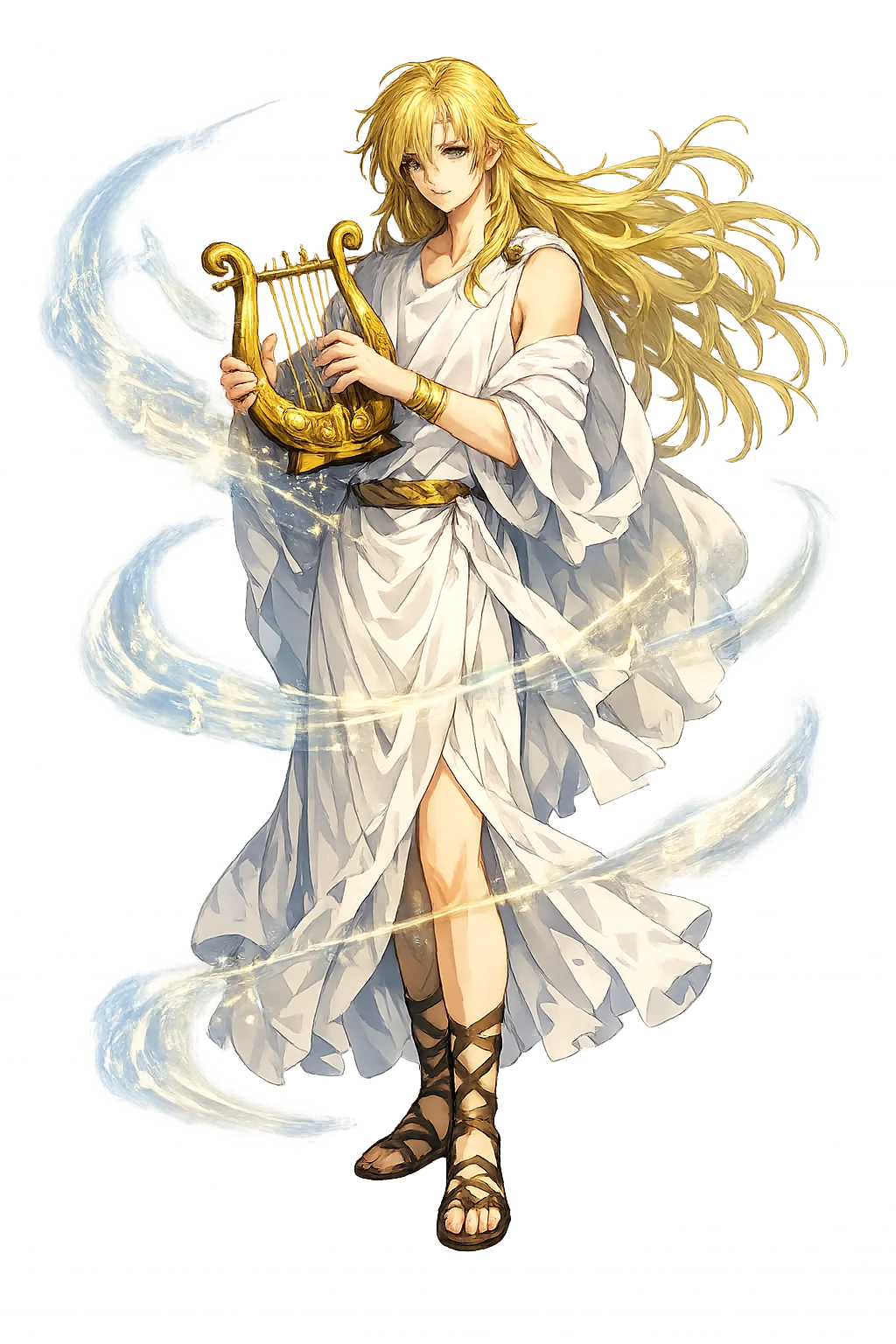
Genealogy made him art's aristocrat — son of Kalliopē, Muse of epic, by the Thracian king Oeagrus; or, in the version that flatters him more, by Apóllōn himself (Apollodorus 1.3.2). What he did with the inheritance became proverbial. When Orpheús played, the tradition insists, nature suspended its habits: trees unrooted and followed him down from Pieria, rivers halted mid-course, wild beasts lay down with sheep, and the oldest surviving witness, a line of Simonides (fr. 567 PMG), has 'the birds flying above him, the fishes leaping from the blue deep' — repeated almost verbatim by Apollonius Rhodius (Argonautica 1.23–34). The exaggeration is the point. No one claims Orpheús won a war; his was the one power the gods could not do better — harmony, which is to say the world persuaded rather than forced. Greek art never wrote a stronger claim for itself: song is not entertainment but government, over a jurisdiction that includes the stones.
Apollonius Rhodius gives the hero's gift its most practical use. On the Argo, Orpheús is not decoration: his lyre sets the rowers' time and stills the quarrels of heroes crowded on one deck (Argonautica 1.494–515, 1.540–546), and — at the passage of the Seirḗnes — his song saves the expedition outright, drowning the death-song in a nobler strain until the lethal shore is past (Argonautica 4.885–919). Pindar had already numbered him among the Argonauts (Pythian 4.176 ff.) as the one indispensable passenger who carried no weapon. The episode is the epic's quiet thesis: the most dangerous stretch of the most dangerous voyage in Greek legend is survived not by a blade but by a string, tuned. Every crew since — rowing, sailing, singing at the oars — has unknowingly rehearsed his passage, and every navy that still pipes its rowers keeps his discipline without his name.
Eurydíkē died of a viper's bite on their wedding day, and Orpheús answered with the act that defines him: he went down after her, alive. Katabasis was Odysseus' desperate errand and Herakles' labor; Orpheús went by the invitation of his own gift. His song stilled Charon's oar, silenced the triple throat of Cerberus, and stopped the whips of the Erinyes mid-stroke; the shades wept, and Hádēs himself relented — on one condition: she would follow behind him, and he must not turn to look until both stood in the upper light. The poets differ on the fatal instant — Virgil makes him 'conquered in mind' (Georgics 4.491), Ovid blames the forgetfulness of desperate love (Metamorphoses 10.56–57) — but all agree on the geography of the loss: the threshold. He looked. She fell back, already his, saying only 'farewell.' The West has been writing the sentence ever since: love almost defeats death — almost — and the whole distance between the two words is one glance.
The end matches the gift in strangeness. In Ovid's telling (Metamorphoses 10.78–11.66), Orpheús withdrew from all love after losing Eurydíkē — and the Thracian women, Maenads of Dionysos or jilted brides, the versions disagree, tore him apart on the banks of the Hebrus in a Bacchic frenzy. Even dismembered he kept singing: the head floated down the river, still calling 'Eurydíkē,' out into the sea and ashore at Lesbos, where for ages it prophesied from a cave until Apóllōn silenced it; and the lyre, set in the sky, became the constellation Lyra (Ovid, Metamorphoses 11.1–66). The Orphics, whose own god died in pieces, found their patron in him — a singer who preaches the soul's journey and is himself the journey's price. The myth's last mercy is exact: the song survives the singer, and what killed him is precisely what he would not stop doing.
Music, Poetry, the Descent, and the Lost Look Back
Orpheús is the archetype of art itself: the Thracian singer whose lyre moved stones and stopped rivers, who went down living into the underworld for his wife, and whose single look back is the West's permanent parable of love and loss.
His instrument: the gift of Apóllōn, the sound that made nature stop to listen.
His song steadied the Argo's crew past the Seirḗnes — art as navigation.
The katabasis for Eurydikē — the only route out of death that music ever opened.
The one forbidden glance, at the threshold — and the second, final loss.
From the original script to the living URL
Ὀρφεύς
The name in its original Greek form. Orpheús (Ὀρφεύς) is attested in the source tradition — “Darkness of the night”. Its aspirated consonants, diphthongs, and acute accents carry the full phonetic and orthographic weight of the source tradition.
orpheus
Reduced to plain orpheus, the name loses everything that made it specific: aspirated consonants, diphthongs, and acute accents. What remains is an ASCII string that machines can parse but that no longer speaks with its original voice.
Orpheús
The Unicode restoration recovers what ASCII flattened. Orpheús restores aspirated consonants, diphthongs, and acute accents, returning the name to its original written dignity. The domain encodes to Punycode, but the browser displays the truth.
Orpheús.com → xn--orphes-tya.com
The non-ASCII characters in Orpheús are encoded while the ASCII remains visible. To the DNS, it is Punycode. To humanity, it is Orpheús.
Owned, ideal, and ASCII forms of Orpheús
Orpheús
Restores Ὀρφεύς. The live temple domain — orpheús.com.
orpheus
Flattens Ὀρφεύς. The plain ASCII fallback — what DNS and legacy systems see.
How Orpheús was spoken
How Orpheús is preserved in writing
A bespoke provenance study for Orpheús is being prepared by the PUNICODEX scholarly team.
Contribute scholarly provenance →The lore you have read is the living myth. Extended Lore opens the scholarly vault beneath it: the cult and its material remains, a history of the image, the name after antiquity, a meditation on what the name still means, and the full scholarly apparatus — etymology, orthography, sources.
Enter Extended Lore