PuniCodex

Extended Lore

Ὀρφεύς Orpheús

Etymology · Orthography · Cult · Iconography · Reception · Sources

Tier 1 Orpheús.com
Orpheús — Poet, Musician, Underworld
01

Quick Facts

Essential information about Orpheús, Poet, Musician, Underworld

Original ScriptὈρφεύς
Unicode RestorationOrpheús
Reconstructed Pronunciation/or.pʰeús/
PantheonGreek
DomainPoet, Musician, Underworld
MeaningDarkness of the night
ClassificationTier 1
Primary DomainOrpheús.com
Sacred SymbolsThe lyre, The laurel, The nightingale, The river Hebrus, The constellation Lyra
02

Etymology & Word Family

From original script to Unicode restoration

Original Script Ὀρφεύς Orpheús — "Darkness of the night"
Unicode Restoration Orpheús Restored stress, length, and script
Modern ASCII orpheus Plain-ASCII fallback

The name Orpheús carries the orthographic signature of the greek tradition: Ὀρφεύς. Unicode restoration recovers what ASCII flattens.

03

Unicode Character Breakdown

Character-by-character philological analysis

CharacterUnicodeNameBlockPhonetic Role
OU+004FLatin Capital Letter OBasic LatinSame
rU+0072Latin Small Letter RBasic LatinSame
pU+0070Latin Small Letter PBasic LatinSame
hU+0068Latin Small Letter HBasic LatinSame
eU+0065Latin Small Letter EBasic LatinSame
úU+00FALatin Small Letter U with AcuteLatin-1 SupplementAcute on the final syllable
sU+0073Latin Small Letter SBasic LatinSame

The Tier 1 classification reflects how much of the original phonology this restoration preserves — stress and vowel length for Greek names, distinctive letters and diacritics for every other tradition.

04

Cult & Worship

How the sacred was kept — rites, sanctuaries, remains

The Cult

The Orphic movement left a material religion rather than a civic cult: thin gold tablets buried with initiates from Thessaly to South Italy give the dead passwords for the next world, and purity rules, vegetarianism, and initiation into secret rites shaped a network of private associations. No polis calendar lists a festival of Orpheús; his priesthoods were freelance initiators and poets. Modern pilgrims do not cluster at a single shrine, though ancient Thracian sites such as Dion occasionally market his name.

In the Earth

The Orphic gold tablets — thin gold leaves buried with initiates from Thessaly to South Italy, instructing the dead ('say: I am a child of Earth and starry Heaven') — are his cult's material archive. Vase-painting shows him in Thracian dress charming the Greeks, then charming the animals, then (a favorite Roman motif) playing to underworld figures; the Piraeus relief of Orpheús charming the animals (Piraeus Museum) and the singer-cult sites at Pangaion mark his geography. On Lesbos, the ancient tradition placed his head's landing at Antissa, where the oracle of the head was remembered into late antiquity.

05

Iconography

How Orpheús was imaged across the ages

The Image

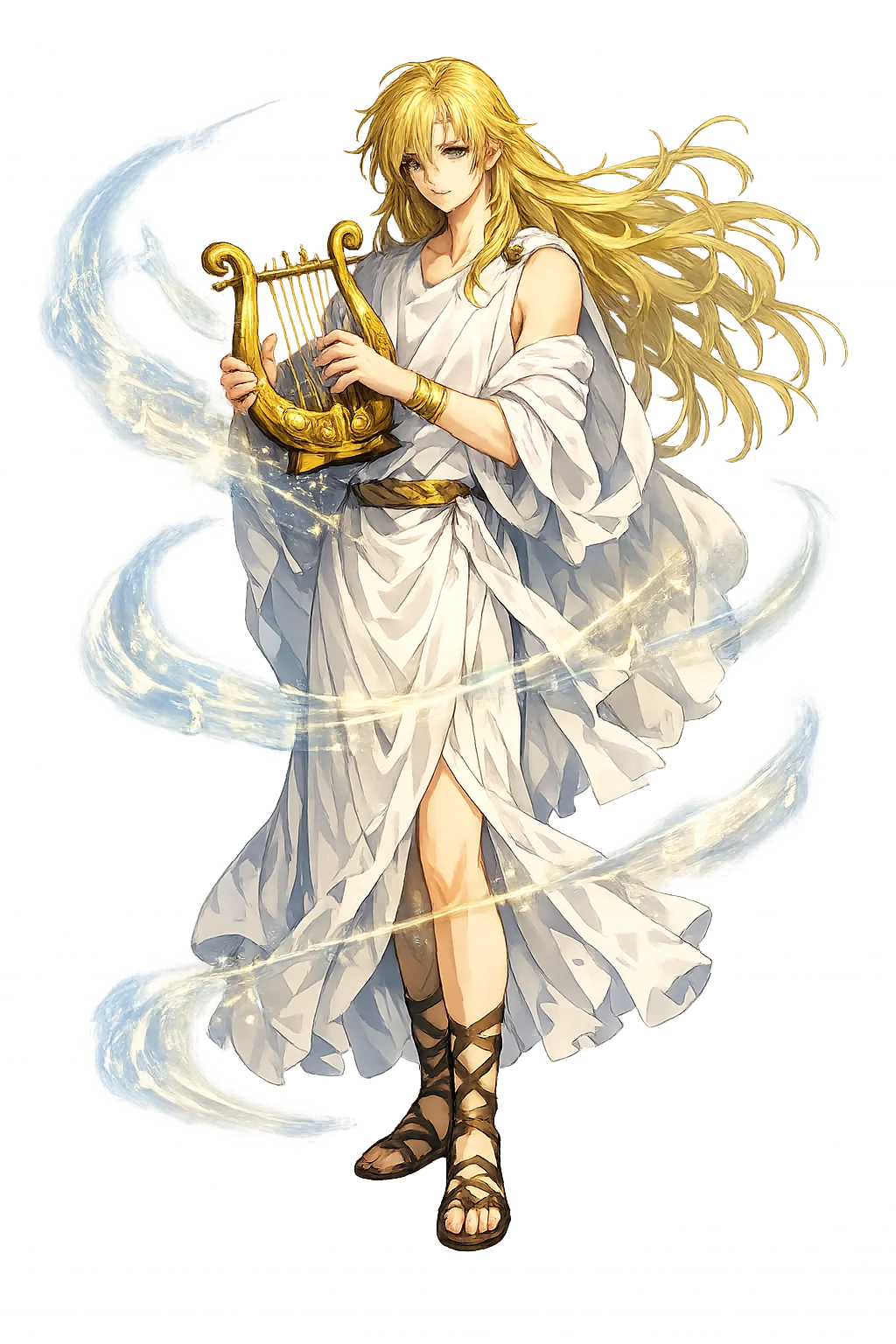
Vase-painters dressed him as a Thracian and showed the lyre charming first the Argonauts, then the beasts, and finally the powers of the underworld. The Piraeus relief gives a durable classical image of Orpheús in exotic costume among animals, while Roman sarcophagi repeatedly stage his fatal return from Hades. Manuscript illuminations and Renaissance mythographies preserve the same attributes: the Thracian cap, the kithara, and the descending path. In modern art he remains the archetype of the poet whose song outlasts death.

06

Reception & Transformation

The name after its own age — transmission, translation, survival

Afterlives

Orpheús became a vector for theological ideas long after his legendary lifetime: Platonic and Neoplatonic writers cited Orphic poems on the soul’s descent, and private groups across the Mediterranean borrowed his authority for initiation texts. The Renaissance rediscovered him through Poliziano’s dramatized Orfeo and through the earliest surviving opera, Monteverdi’s L’Orfeo (1607), which made the underworld journey a courtly spectacle. Later Romantic and modern artists—from Rilke’s sonnets to Cocteau’s film—used the failed rescue of Eurydice as a parable of art, memory, and loss. Meanwhile classical scholarship keeps debating which texts are genuinely Orphic and which are later attributions, so his afterlife is as much a critical problem as a cultural one. The gold tablets give initiation texts but no founder’s biography, so archaeology cannot settle the debate.

Identifications Across Traditions

The mystery-religion that took his name — Orphism — made him the patron of the soul's journey: the gold tablets, the cosmic egg, Phánēs, and the map of the afterlife all carry the Orphic brand, though the historical singer and the theology are centuries apart. Christianity read him as a type of Christ — the descent, the harrowing, the charming of the animals — and he appears in that role in early Christian art. The Renaissance made him the emblem of poetry itself, the divine Orpheus who tunes the world's discord into concord. And opera was effectively invented for him: Monteverdi's Orfeo (1607) is the first great opera, and the hundreds that followed — from Gluck to Offenbach — keep re-judging the look back, which is to say they keep re-trying the threshold.

Modern Legacy

'Orphic' is the word for haunting, entrancing beauty; the lyre constellation (Lyra) is his; and the look-back is literature's most quoted failure — from Virgil to Rilke's Sonnets to Orpheus to Cocteau's Orphée and on through film and musical after film and musical. Every artist who has tried to retrieve something from loss — and failed at the threshold of the work — is his descendant. Music's power to move the world is his biography; its limits are his lesson. Few figures who may never have lived have been so thoroughly employed: the West has used him, for twenty-five centuries, as its permanent rehearsal of the one question art cannot answer — whether the song was worth the wife.

07

The Meditation

What Orpheús means — beyond the dictionary

Orpheús is the patron of the almost. He retrieved her — almost. He sang the Erinyes to stillness — and still lost. His question is the one every artist and every lover knows: when the rule is 'do not look back,' and the one thing you possess is the looking, what are you willing to lose for a single glimpse of what you love?

The tradition has never decided whether the look was a failure or the final proof of love — Virgil convicts him, Ovid pities him, Rilke forgives him, because without the look there would be no song. Perhaps that is the myth's deepest economy: the loss of Eurydíkē is the price of everything Orphic that followed — the mysteries, the tablets, the poems, and the whole long culture of singing against the dark. The lyre, not the wife, reached the stars; and every artist since has suspected the trade was, somehow, the only one available.

08

Frequently Asked Questions

Common questions about Orpheús, Poet, Musician, Underworld, and Unicode restoration

01How do you pronounce Orpheús?

In reconstructed pronunciation, Orpheús is /or.pʰeús/ — approximately or-FEWS — the stress lands on the last syllable.

02What does Orpheús mean?

Orpheús means Darkness of the night in the greek tradition.

03What are the symbols of Orpheús?

Orpheús is associated with The lyre (Art as the measure of the world — the cosmos tuned to a string.), The laurel (The crown of his prophetic grove at Pieria, where trees learned to move.), The nightingale (Song persisting through darkness — the bird of his native Thrace.), The river Hebrus (The stream that carried his still-singing head down to the sea and ashore at Lesbos.), The constellation Lyra (His lyre set among the stars — the only instrument in the sky.).

04Why restore Orpheús in Unicode?

Plain ASCII orpheus strips the stress, length, and script that make the name specific. Unicode restoration returns the name to its original written dignity.

05What is the most important myth about Orpheús?

“The Song that Moves Stones” — the The Power story that anchors the mythology of Orpheús, told in full on the lore page.

09

Scholarly Sources

The philological foundations of this restoration

Every claim on this page is grounded in established scholarship. The orthographic restorations follow disciplinary convention. The etymological chain follows the best available reference works. This is not invention — it is resurrection through scholarship.

◈

Lexicography & Philology

  • Liddell, H. G., Scott, R., & Jones, H. S. A Greek-English Lexicon. Oxford: Clarendon Press, 9th ed. 1996.
  • Pape, W., & Benseler, G. E. Wörterbuch der griechischen Eigennamen. Braunschweig: Vieweg, 1884.
  • Beekes, R. S. P. Etymological Dictionary of Greek. Leiden: Brill, 2010.
◎

Primary Texts

  • Pindar, Pythian 4.176 ff.
  • Virgil, Georgics 4.453–527
  • Ovid, Metamorphoses 10.1–11.66
◉

Archaeology & Art History

  • Material evidence — iconography, inscriptions, and temple archaeology — for Orpheús and related cults.
✦

Religious Studies

  • Apollonius Rhodius, Argonautica 1, 4
  • Simonides, fr. 567 PMG
  • West, The Orphic Poems
Return

The Surface Awaits

You have traced the name from its earliest attestation to its Unicode restoration. Now return to the myth. The story is where the name lives.

Back to Lore
Orpheús mascot