
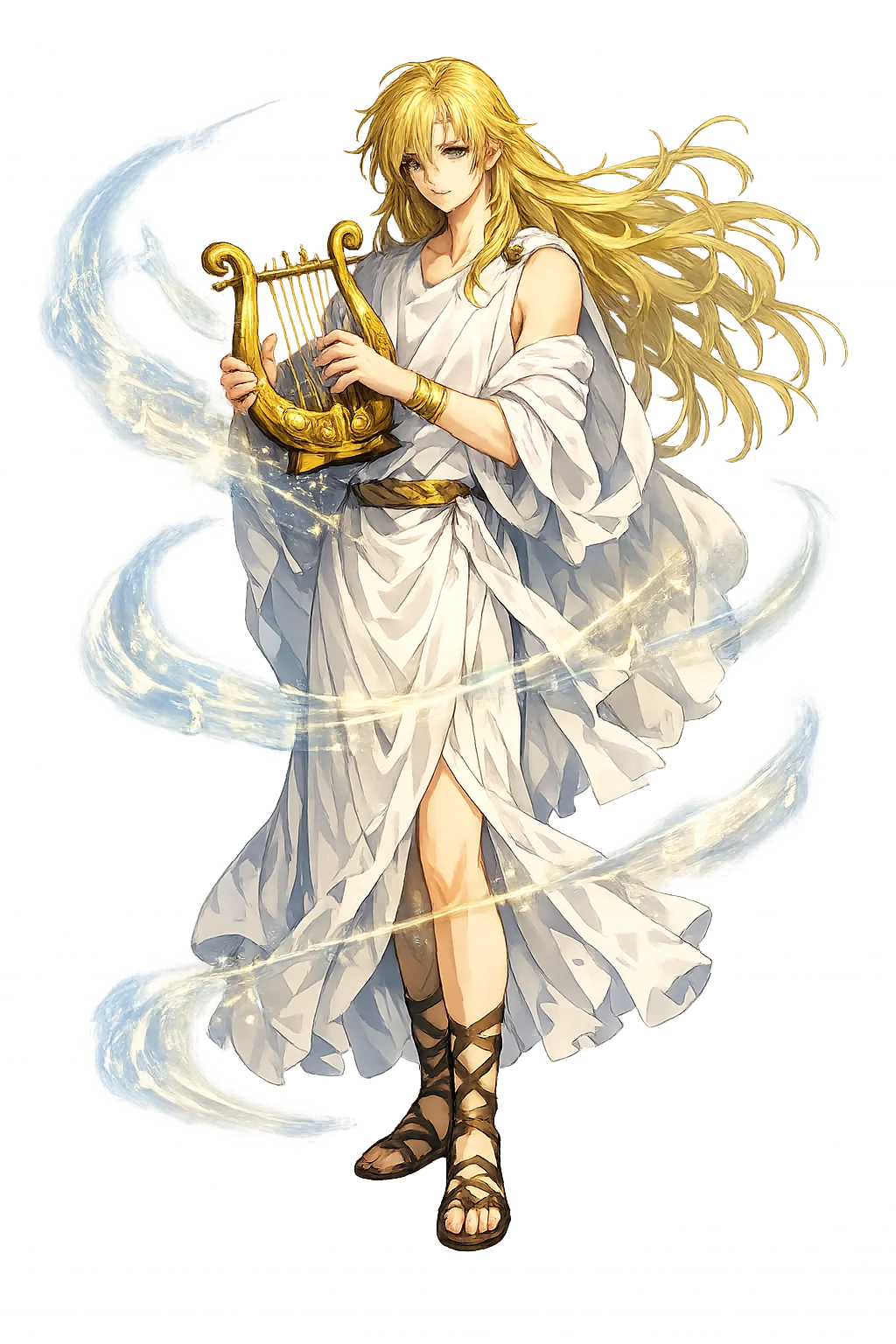
The provenance file on Orpheús
The provenance file for Orpheús. Nothing here is unsourced; that is what the file is for.
Provenance
1. The attestation. Ὀρφεύς — "Darkness of the night". On record: Apollonius Rhodius, Argonautica 1, 4, Pindar, Pythian 4.176 ff., Simonides, fr. 567 PMG, Virgil, Georgics 4.453–527.
2. The preserved evidence. u → ú (Acute on the final syllable) — absent from the ASCII form orpheus, present in the restoration, verifiable against the sources above.
3. The narrative record. The Song that Moves Stones — Genealogy made him art's aristocrat — son of Kalliopē, Muse of epic, by the Thracian king Oeagrus; or, in the version that flatters him more, by Apóllōn himself (Apollodorus 1. 3. The Singer on the Argo — Apollonius Rhodius gives the hero's gift its most practical use. On the Argo, Orpheús is not decoration: his lyre sets the rowers' time and stills the quarrels of heroes crowded on one deck (Argonautica 1.
4. The physical record. The Orphic gold tablets — thin gold leaves buried with initiates from Thessaly to South Italy, instructing the dead ('say: I am a child of Earth and starry Heaven') — are his cult's material archive. Vase-painting shows him in Thracian dress charming the Greeks, then charming the animals, then (a favorite Roman motif) playing to underworld figures; the Piraeus relief of Orpheús charming the animals (Piraeus Museum) and the singer-cult sites at Pangaion mark his geography. On Lesbos, the ancient tradition placed his head's landing at Antissa, where the oracle of the head was remembered into late antiquity.
5. The current holding. The temple at /orpheus/, classified Tier 1. Tier-1 is not a compliment; it is a measurement. This restoration keeps something the ASCII form provably loses, and the measurement is repeatable.
6. The documented resonances. Music, Arts & Performance, Love, Dating & Relationships, Astrology, Tarot & Esoteric Services — seats argued and weighted in the pattern atlas, read through the myths in this temple's Resonance File.
7. The primary sources. Theogony, Homeric Hymns, Works and Days — the library this file answers to, open at the Sacred Texts collection.
8. The continuing record. 'Orphic' is the word for haunting, entrancing beauty; the lyre constellation (Lyra) is his; and the look-back is literature's most quoted failure — from Virgil to Rilke's Sonnets to Orpheus to Cocteau's Orphée and on through film and musical after film and musical. Every artist who has tried to retrieve something from loss — and failed at the threshold of the work — is his descendant.
At a Glance
- Restored name: Orpheús
- ASCII form: orpheus
- Meaning: "Darkness of the night"
- Domain of influence: Poet, Musician, Underworld
- Pantheon: Greek
- Classification: Tier 1
- Original script: Ὀρφεύς
- Series: The Restoration Files, No. 366 of 546
The File Continues
Read the founding dispatch for the name's full story, the Resonance File for the archetype at work — or the whole archive in one sitting.
Continue the series — previous file: Óneiros (read it here) · next file: Ọrun (read it here).
The Restoration Files are written from the same canonical record as the temples themselves: the lexicon, the lore catalog, the pattern atlas, and the cited scholarly sources. If a file ever disagrees with its temple, the temple is right — tell us, and the file will be corrected.