PuniCodex

Extended Lore

ὀμφαλός Omphalós

Etymology · Orthography · Cult · Iconography · Reception · Sources

Tier 2 Omphalós.com
Omphalós — Navel, Center, Delphi
01

Quick Facts

Essential information about Omphalós, Navel, Center, Delphi

Original Scriptὀμφαλός
Unicode RestorationOmphalós
Reconstructed Pronunciation/om.pʰa.lós/
PantheonGreek
DomainNavel, Center, Delphi
MeaningNavel (of the earth); the stone at Delphi regarded as the centre of the world
ClassificationTier 2
Primary DomainOmphalós.com
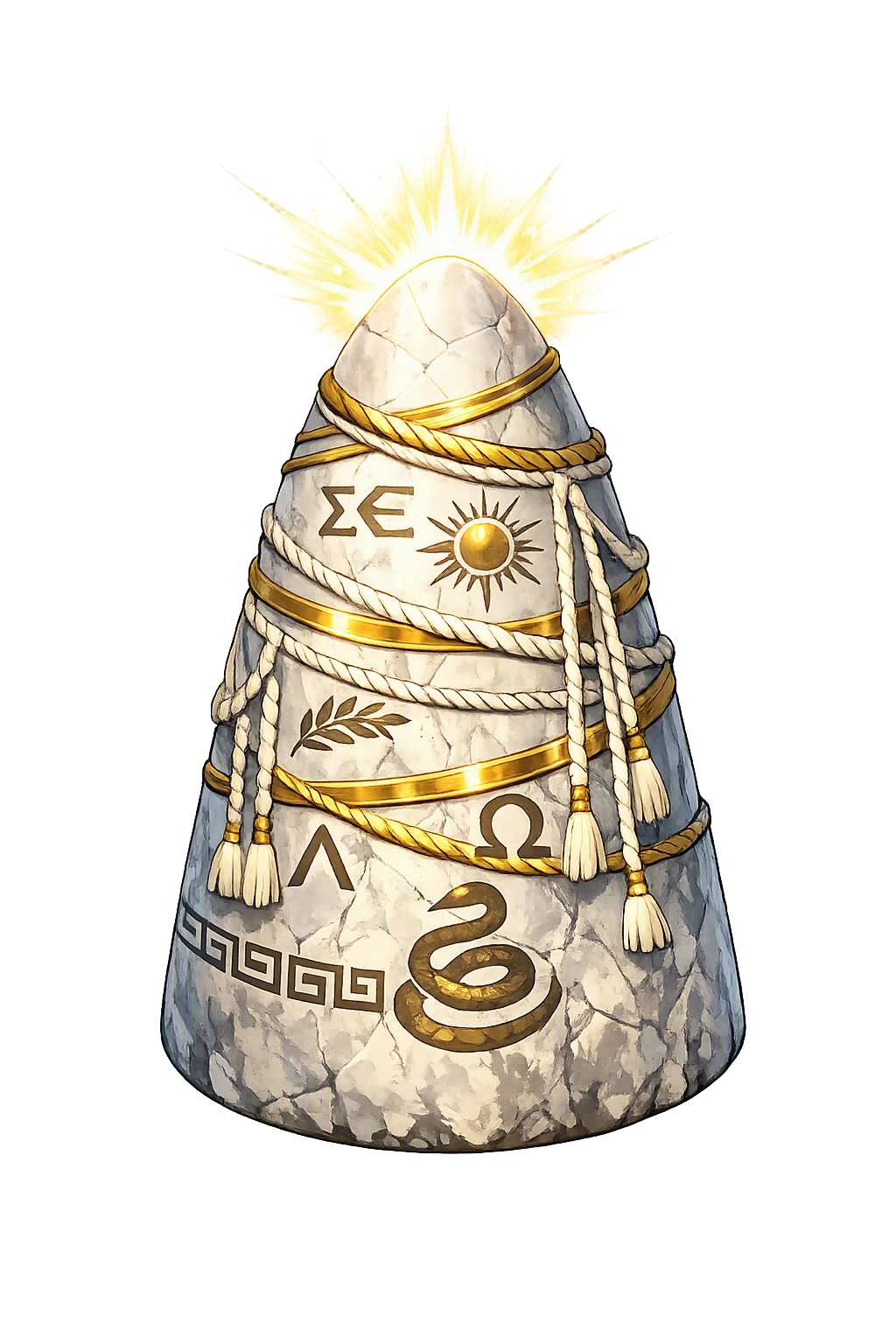
Sacred SymbolsThe net-covered stone, The two golden eagles, The navel of a newborn, The cleft of Delphi
02

Etymology & Word Family

From original script to Unicode restoration

Proto-indo-european *h₃mbʰ- navel
Original Script ὀμφαλός Omphalós — "Navel (of the earth); the stone at Delphi regarded as the centre of the world"
Unicode Restoration Omphalós Restored stress, length, and script
Modern ASCII omphalos Plain-ASCII fallback

Greek ὀμφαλός 'navel, boss, centre'; the Delphic omphalos marked the world's centre in archaic Greek geography.

03

Unicode Character Breakdown

Character-by-character philological analysis

CharacterUnicodeNameBlockPhonetic Role
OU+004FLatin Capital Letter OBasic LatinOmicron
mU+006DLatin Small Letter MBasic LatinMu
pU+0070Latin Small Letter PBasic LatinPi
hU+0068Latin Small Letter HBasic LatinEta aspiration (rough breathing marker in source)
aU+0061Latin Small Letter ABasic LatinAlpha
lU+006CLatin Small Letter LBasic LatinLambda
óU+00F3Latin Small Letter O with AcuteLatin-1 SupplementAcute on omicron
sU+0073Latin Small Letter SBasic LatinSigma

The Tier 2 classification reflects how much of the original phonology this restoration preserves — stress and vowel length for Greek names, distinctive letters and diacritics for every other tradition.

04

Cult & Worship

How the sacred was kept — rites, sanctuaries, remains

The Cult

The Omphalós was the ritual heart of Delphi. Pausanias saw the stone in the adyton of Apollo's temple, where it marked the "navel of the earth" and stood beside the Pythia's tripod. Pilgrims consulted the oracle in its presence, and the sanctuary received vast quantities of votive offerings from cities and individuals seeking Apollo's guidance. The stone thus functioned less as an object of worship in its own right than as the fixed point around which Delphic cult, prophecy, and Panhellenic consultation revolved.

In the Earth

The omphalos survives in the Delphi Archaeological Museum: a Hymettian-marble boss carved with a net pattern, a little over a meter high, found in the temple precinct and conventionally identified with the stone Pausanias saw in the adyton. The temple of Apollo — its fourth, stone, phase — still shows the foundations of the inner sanctuary where the stone and the Pythia's tripod stood. The form appears on imperial-period coins of Delphi, always with the net pattern and flanking eagles, and Roman copies of the omphalos type are known from the city of Rome itself. No inscription names the stone; its identification rests on the match between Pausanias's description and the carved marble found on site.

05

Iconography

How Omphalós was imaged across the ages

The Image

The most famous Omphalós is the Hymettian-marble boss, a little over a meter high, carved with an interlacing net pattern and displayed in the Delphi Archaeological Museum. Ancient vase paintings and coins of Delphi sometimes show the stone or the tripod beside it, while the temple's architectural remains still mark the inner sanctuary where it stood. Roman copies and small souvenir versions carried the form across the Mediterranean. The rounded, decorated boss became an instantly recognizable symbol of the earth's center and of Apollo's oracular authority.

06

Reception & Transformation

The name after its own age — transmission, translation, survival

Afterlives

Pausanias's description made the Omphalós a fixed landmark in the Greek traveler's imagination, and the stone survived in Christian and Byzantine accounts of Delphi. After the sanctuary's decline, the meaning of the "navel of the earth" passed into learned European discourse. The nineteenth-century French excavation of Delphi rediscovered the precinct and the carved stone, sparking renewed archaeological and mythological interest. Sigmund Freud later borrowed "omphalos" as a psychoanalytic term for the navel of the dream, while modern poets and essayists use it for any symbolic center. Today the museum specimen and the temple foundations remain one of Greece's most visited ancient sites, and the word itself has become a metaphor for any claimed center of the world. The stone therefore remains both an archaeological object and a continuing metaphor for centrality.

Identifications Across Traditions

Rome built its own navel: the Umbilicus Urbis Romae, a travertine marker in the Roman Forum, where the symbolic center of the empire was ritually defined, its rounded form echoing the Delphic original. In late antiquity and the Middle Ages the idea of a world-navel multiplied — Jerusalem, Constantinople, even Glastonbury in English legend each claimed a central, omphalic status — proof that the Greek idea had become a portable form of pride. The English language keeps the word as a learned synonym for the center of anything, and the modern mockery of self-absorption as 'navel-gazing' (omphaloskepsis) returns the word to its first, bodily meaning. The stone at Delphi thus survived its own religion: a pagan center-marker became the West's standing metaphor for wherever people believe the world's meaning is concentrated.

Modern Legacy

Delphi's omphalos made 'center' a claim any city could dream of. Roman emperors consulted the oracle and copied the stone; medieval mapmakers drew Jerusalem at the world's middle; and the modern phrase 'navel-gazing' preserves the Greek word in everyday speech. The archaeological site of Delphi, a UNESCO World Heritage site, still draws travelers to the temple foundations where the adyton — and the stone — once stood. In psychology, the Delphic 'know thyself' has been read together with the omphalos as an emblem of the inward journey to the center of the self, a reading popularized by Jung's school. The word also lives quietly in anatomy, where the umbilicus keeps the Greek root in every newborn's first scar. Few small stones have spread so far: a marble boss from a mountain sanctuary became the template for every claim, sacred or secular, to be the middle of things.

07

The Meditation

What Omphalós means — beyond the dictionary

Every culture draws its maps with a center. The Hebrews had Zion; the Romans had the Umbilicus; the medieval world chose Jerusalem; the modern mind, told there is no privileged point in space, has relocated the center inward. The omphalos is the Greek form of this universal habit — a stone that says: here, and not elsewhere, is where the world is anchored. What is remarkable about Delphi's version is its modesty. The center was not a throne or a temple tower but a carved marble lump, veiled in a fisherman's net and guarded by two eagles. The message seems to be that the middle of things is not a summit to be conquered but a place to be marked and then consulted — a still point, not a peak. Perhaps that is why the image survives: in an age of competing centers and vanishing middles, the omphalos reminds us that a center is something a community agrees upon, sets a stone upon, and returns to when it needs to ask where it is.

08

Frequently Asked Questions

Common questions about Omphalós, Navel, Center, Delphi, and Unicode restoration

01How do you pronounce Omphalós?

In reconstructed pronunciation, Omphalós is /om.pʰa.lós/ — approximately 'om-fah-LOSS' — the accent falls on the last syllable; classical phi is an aspirated p, not the modern f.

02What does Omphalós mean?

Omphalós means Navel (of the earth); the stone at Delphi regarded as the centre of the world in the greek tradition.

03What are the symbols of Omphalós?

Omphalós is associated with The net-covered stone (The omphalos itself, wrapped in the woolen agrenon net that veiled the world's center (Pausanias 10.16.3)), The two golden eagles (Zeus's birds, set one on either side of the stone as witnesses to the center-finding), The navel of a newborn (The body's own center — ὀμφαλός is the infant's navel, the mark where nourishment once entered), The cleft of Delphi (The rock fissure beneath the temple where Apollo's arrows struck Python and the prophetic power rose).

04Why restore Omphalós in Unicode?

Plain ASCII omphalos strips the stress, length, and script that make the name specific. Unicode restoration returns the name to its original written dignity.

05What is the most important myth about Omphalós?

“The Eagles of Zeus” — the The Center story that anchors the mythology of Omphalós, told in full on the lore page.

09

Scholarly Sources

The philological foundations of this restoration

Every claim on this page is grounded in established scholarship. The orthographic restorations follow disciplinary convention. The etymological chain follows the best available reference works. This is not invention — it is resurrection through scholarship.

◈

Lexicography & Philology

  • Liddell, H. G., Scott, R., & Jones, H. S. A Greek-English Lexicon. Oxford: Clarendon Press, 9th ed. 1996.
◎

Primary Texts

  • Pausanias
  • Pausanias 10.16.3; 10.24.6
  • Strabo 9.3.6
  • Hesiod, Theogony 485–497
  • Homeric Hymn to Apollo 300ff.
◉

Archaeology & Art History

  • Parke & Wormell, The Delphic Oracle (1956)
✦

Religious Studies

  • Beekes, Etymological Dictionary of Greek, s.v. ὀμφαλός
Return

The Surface Awaits

You have traced the name from its earliest attestation to its Unicode restoration. Now return to the myth. The story is where the name lives.

Back to Lore
Omphalós mascot