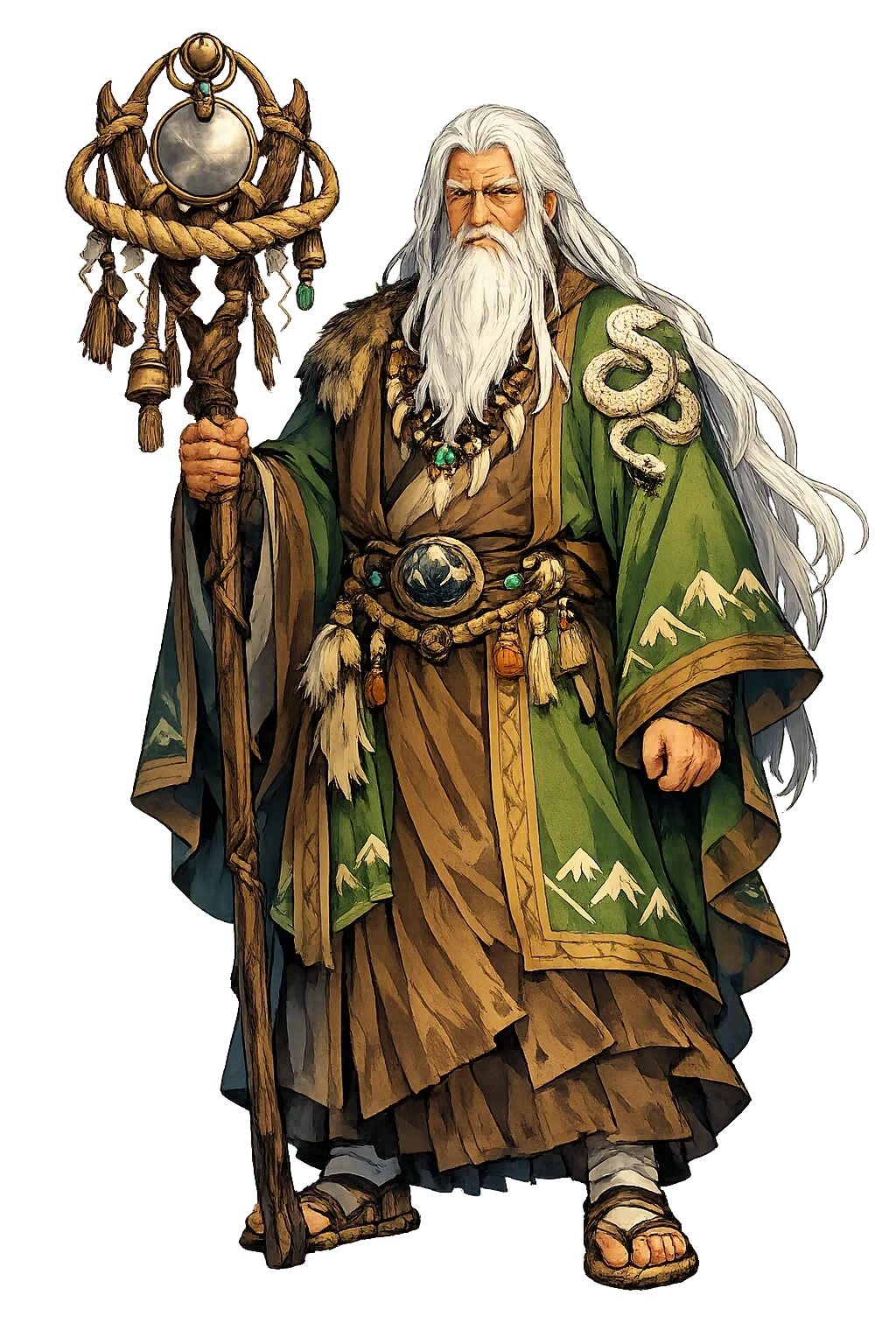
Stories of Omononushi
Ōmononushi's mythology is preserved in strange, archaic tales of snakes, possession, and oracles — the Kojiki's strangest marriage, the constitution of Japan's sovereignty, and a shrine with no god-house, because the mountain is the god.
A maiden named Ikutamayori was visited each night by a beautiful man who came unseen. When she bore his child, her parents demanded to know the father. She had him leave a needle threaded with red silk in the hem of his garment; in the morning she followed the thread, and it led to the foot of Mount Miwa and vanished into a cave — where the visitor declared himself: he was Ōmononushi, the great lord of the mountain, and he appeared in serpent form. The child of this union was Kotoshironushi, the god who would one day counsel the peaceful surrender of the land to the heavenly grandson (Kojiki; cf. Nihon Shoki, Aston's translation).
The tale binds three things into one knot — mountain, snake, and the Miwa priestly line, whose descent from the kami's human bride it exists to explain.
When the heavenly emissary Takemikazuchi descended to demand the land from the earthly god Ōnamuji (Ōkuninushi), Ōnamuji consulted his children. Kotoshironushi, away at Cape Miwa, answered that resistance to the heavenly grandson was hopeless — and then all eyes turned to the mountain. Ōmononushi was consulted, and his oracle settled the matter: 'Let the land be given over in peace,' he declared; the land was yielded, and he withdrew into a hidden realm, promising that his favor would attend his proper worship. The Nihon Shoki tells the same event differently, folding the mountain god into Ōnamuji himself: Ōnamuji, it says, is also called Ōmononushi (Kojiki; Nihon Shoki, tr. Aston, I).
Here the god is pure voice: sovereignty changes hands in Japan not by conquest but by consultation — and the mountain kami's consent is the constitution.
Ōmononushi took as wife Seyadatarahime, daughter of his own son Kotoshironushi by Ikutamayori — and their child was the princess Himetataraisuzuhime. She became the consort of Emperor Sujin and bore the future Emperor Suinin: the serpent-god of Mount Miwa thus entered the imperial genealogy itself, the god's line becoming grandmother to the next sovereign. The Kojiki's genealogy is compressed and the texts do not spell every step out plainly, but the dynastic point stands: the mountain married into the house that received the mountain's realm.
The marriage also sealed an alliance between the Miwa priestly house and the court — the god who gave the land away kept his blood beside the throne. The Kojiki records the whole sequence without wonder, as plain genealogy: which is how one knows the text was compiled on the winning side.
In Emperor Sujin's reign plague and disaster struck the land, and divination named the cause: the great kami of Mount Miwa, never yet given a shrine, was angry. The god made his will known by possessing a princess of his own line and speaking through her: worship me, he demanded, and I will cause the land to flourish. Sujin founded the rites; the pestilence lifted. The Nihon Shoki's parallel account likewise has the god speak through a human mouth, claim credit for guiding the cession of the land, and demand his due — the god of Miwa and the god of the land-transfer asserted as one and the same (Kojiki; Nihon Shoki, Aston I).
Myth here explains a liturgy: Ōmiwa's worship began, the texts insist, when the neglected mountain finally raised its voice.
Ōmiwa Shrine, at the foot of the mountain in Nara prefecture, is one of Japan's oldest shrines and one of the strangest: it has no honden, no inner sanctuary housing a divine image, because the god is not symbolized by anything — the god is Mount Miwa. Worshippers pray toward the peak across a unique three-pillared torii, the Miwa-torii; before the worship hall stand sacred sake casks, for Ōmononushi is patron of the brewers of Miwa, and his serpent form — a great snake said to coil in the mountain's caves — was traditionally offered sake. First listed among the great shrines in the Engishiki (927 CE), the site preserves a stratum of Japanese religion older than images: the mountain itself as shintai, the deity's body.
The absent statue is the theology: what has no face cannot be owned, and what cannot be owned cannot be conquered.
Mountain, Oracle, and Sacred Snake
Ōmononushi is the mysterious kami of Mount Miwa, one of the oldest and most enigmatic deities in Japan. He is associated with snakes, oracles, and the transfer of the land to Amaterasu's descendants. Unlike most kami, he had no image and was worshipped in the form of the mountain itself.
He is identified with Mount Miwa itself; Ōmiwa Shrine has no inner sanctuary because the peak is the kami's body.
He comes to Ikutamayori as a serpent in the Kojiki, and snake offerings of sake attend his Miwa cult.
His consent to the land-transfer was given by oracle — sovereignty in Japan changes hands by consultation, not conquest.
He is the voice that yields the land to the heavenly descendants, binding the Miwa line to the imperial house.
From the original script to the living URL
大物忌神
The name in its original Japanese form. Omononushi (大物忌神) is attested in the source tradition — “Great thing lord”. Its original diacritics and script distinctions carry the full phonetic and orthographic weight of the source tradition.
omononushi
The plain omononushi form is identical to the Unicode restoration. Because this name is already written in Latin letters, no diacritics, stress, or script information were lost — only capitalization differs.
Omononushi
The Unicode restoration does not need to recover lost marks for Omononushi. Its value is canonical spelling and consistent cataloguing, not the reconstruction of erased orthography. The domain is readable as-is to both DNS and humanity.
Omononushi.com
This restoration is written entirely in ASCII letters — no Punycode encoding stands between Omononushi and the DNS. The domain reads identically to machines and to human eyes.
Owned, ideal, and ASCII forms of Omononushi
Omononushi
Restores 大物忌神. The full Unicode restoration. omononushi.com is not in the PuniCodex collection — it is watched for release; if it drops, this temple upgrades to an owned flagship.
How Omononushi was spoken
How Omononushi is preserved in writing
A bespoke provenance study for Omononushi is being prepared by the PUNICODEX scholarly team.
Contribute scholarly provenance →The lore you have read is the living myth. Extended Lore opens the scholarly vault beneath it: the cult and its material remains, a history of the image, the name after antiquity, a meditation on what the name still means, and the full scholarly apparatus — etymology, orthography, sources.
Enter Extended Lore