Stories of Ògún
Ògún's myths are the Yoruba meditation on power: the strength that clears the way for everyone, and the rage that, unmastered, turns on its own town.
When the orisha first sought to descend from heaven to the unfinished earth, the primordial forest stood unbroken and no god could pass — not even the greatest among them, for all their wisdom. Ògún took his cutlass and cut the road through, and the gods followed him down (the tradition preserved by E. B. Idowu in Olódùmarè, 1962, and sung in the Ifá odù Ogunda, ‘Ògún creates’). The detail the storytellers never drop is the technology: where other cosmogonies begin with a word or a combat, the Yoruba world begins with a blade — creation as clearance, being as path. Yet ritual order keeps its own counsel: Èṣù-Ẹlẹ́gbá, not Ògún, is propitiated first in every rite, for the road-opener opens ways that others must keep. The myth encodes an entire philosophy of work: civilisation is something hacked out of chaos, by someone, with a tool — and the hacker is owed his portion forever after.
Installed as king of Irè, Ògún came one festival day to find his people silent — the honours due him unperformed (the Irè tradition recorded by Idowu, Olódùmarè). In his rage he drew the sword and cut down his own townsfolk, and the slaughter ended only when he saw his own son among the fallen. Coming to himself, he declared that he would walk no more among men, and sank into the earth — remaining, as the praise-songs say, in the iron itself. Every Ògún festival at Irè replays the king’s coming and going: the worshippers greet him with noise and honour precisely where the myth says silence once killed. The myth does not excuse the rage; it institutionalises the apology — a god whose festival is a town’s vow never again to repeat the silence that set him off.
Before he was king or smith, Ògún was the supreme hunter, lord of the deep forest where no farm grows and no town reaches. The hunters’ guilds sing his oríkì at the forest’s edge — ‘Ògún, the one who has water yet bathes in blood,’ ‘the one whose dog never tires’ — and hunters still pour the first palm wine of the season to him before the first hunt (hunters’ lore collected across Yorubaland; see Awolalu, Yoruba Beliefs and Sacrificial Rites, 1979). The forest is his because the road is his: every path into the bush is a cut he owns, every trap a loan from his forge. The tradition makes him the patron not of hunting’s glamour but of its discipline — the oath-bound guild, the shared kill, the rules that keep the forest from becoming mere wilderness. His hunters do not conquer the bush; they negotiate with it, in his name and under his law.
The corpus preserves, in several variants, the story of the dog. When Ògún had done the terrible thing at Irè and withdrew from men, the one creature that followed him into the wilderness was his dog; in some tellings the dog dies for him, in others it leads him back out of the bush when he is lost past return. The ethnography is plain: dogs are still the sacrifice his festivals accept — the one animal whose death honours rather than offends him (festival practice recorded by Pierre Verger, Orixás, 1981, and J. O. Awolalu, 1979; the black dog of the forge is a standing figure in Cuban patakís, Lydia Cabrera, El Monte, 1954). The sources do not fix one canonical version, and the honest reading keeps the variants side by side. The myth’s theology is of a piece with the rest of him: the god of the road keeps, as his emblem among living things, the one companion that will not leave the road’s end — loyalty itself, paid for in kind.
Ògún’s deepest alliance is with his brother-in-law, the archer Òchósi — and the founding story is a quarrel. Both laid claim to the same kill: Ògún had set the trap, but Òchósi’s arrow had struck the beast, and each argued the kill was his by craft. They took the dispute before the council of orisha, which ruled that the meat belonged to both — and bound them thereafter as partners in every hunt, the smith whose iron holds and the hunter whose aim decides (the tale survives in Yoruba hunters’ lore and in the Cuban patakís collected by Cabrera, El Monte). The myth is a treatise on technology: the trap without the arrow is a cage, the arrow without the trap is a shot in the dark. Yoruba religion enshrines the lesson in devotion itself — the two orisha are worshipped together to this day, and no serious hunter’s shrine to one lacks the other.
Iron, War, Labour, and the First Path through the Forest
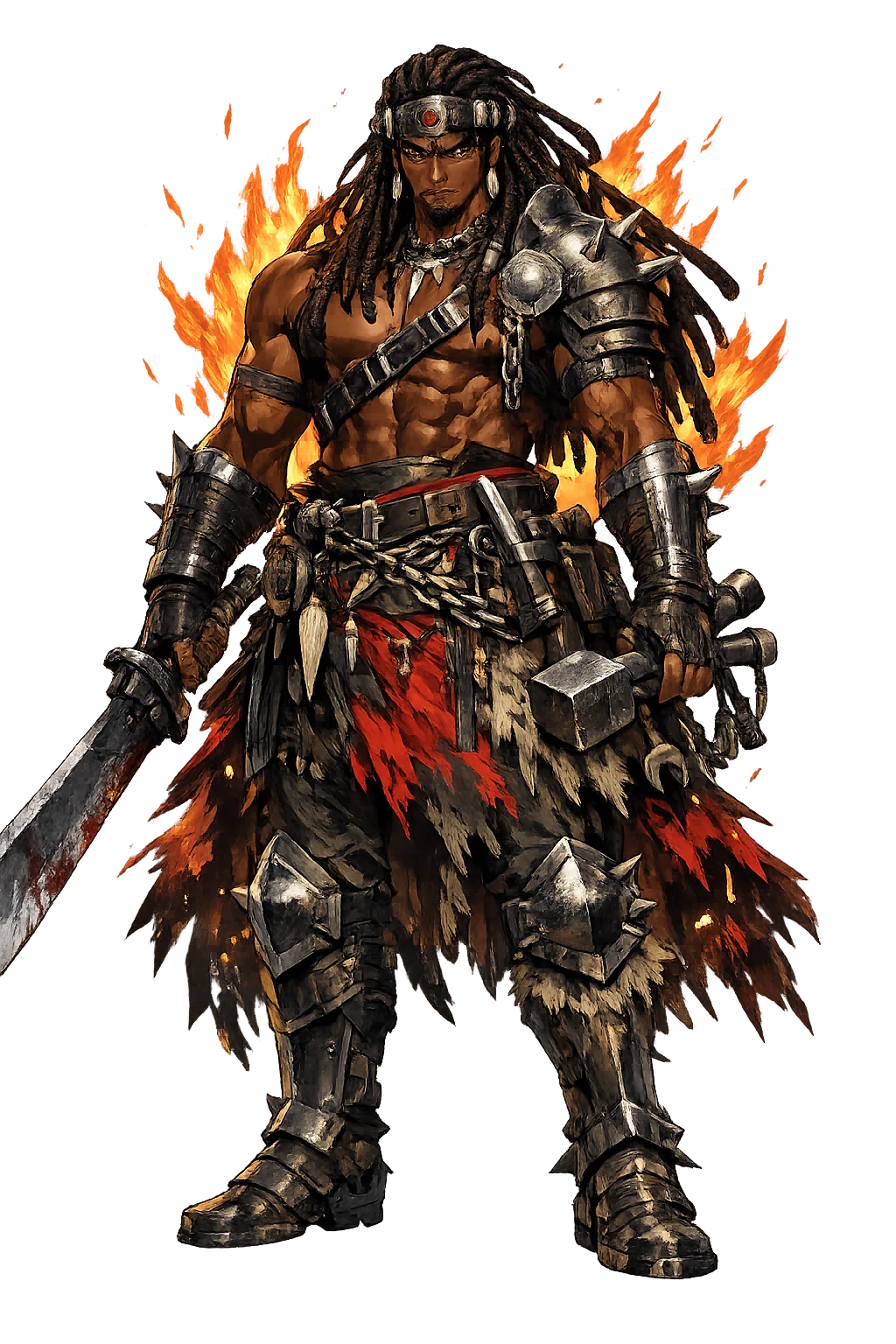
Ògún is the orisha of iron and of every road iron opens: the hunter who cleared the primordial forest so the gods could descend, the smith who arms the farmer and the warrior alike, and the patron of every worker who makes a living by metal — from the blacksmith to the surgeon to the driver.
His tool and emblem: the blade that clears the forest path — creation by cutting.
The smith's fire: iron is his body, and every smithy his shrine.
He hacked the road through the primal forest that let the orisha reach the earth.
His companion and sacrifice — the hunter's faithful one, honoured at his festivals.
From the original script to the living URL
Ògún
The name survives only in scholarly transliteration. Ògún is the standard Yoruba romanisation, documented in academic sources — “God of iron”. Its acute stress marks preserve distinctions lost in plain ASCII.
No indigenous writing system is securely attested for individual yoruba names. The form shown is a modern scholarly transliteration.
ogun
Reduced to plain ogun, the name loses everything that made it specific: acute stress marks. What remains is an ASCII string that machines can parse but that no longer speaks with its original voice.
Ògún
The Unicode restoration recovers what ASCII flattened. Ògún restores acute stress marks, returning the name to its original written dignity. The domain encodes to Punycode, but the browser displays the truth.
Ògún.com → xn--gn-1ja7a.com
The non-ASCII characters in Ògún are encoded while the ASCII remains visible. To the DNS, it is Punycode. To humanity, it is Ògún.
Owned, ideal, and ASCII forms of Ògún
Ògún
The live temple domain — ògún.com.
ogun
The plain ASCII fallback — what DNS and legacy systems see.
How Ògún was spoken
How Ògún is preserved in writing
No indigenous writing system is securely attested for individual yoruba names. The form shown is a modern scholarly transliteration.
Contribute scholarly provenance →The lore you have read is the living myth. Extended Lore opens the scholarly vault beneath it: the cult and its material remains, a history of the image, the name after antiquity, a meditation on what the name still means, and the full scholarly apparatus — etymology, orthography, sources.
Enter Extended Lore