PuniCodex

Extended Lore

Ògún — The Deeper Record

Etymology · Orthography · Cult · Iconography · Reception · Sources

Preserves stress Ògún.com
Ògún — Iron, War, Labour
01

At a Glance

Ògún — every fact links to its home

PantheonYoruba
DomainIron, War, Labour
Scholarly TransliterationÒgún →
Cited Works7 cited →
02

Etymology & Word Family

From attested form to canonical spelling — the full etymology page →

Scholarly Transliteration Ògún Ògún — "God of iron"
Unicode Restoration Ògún Restored stress, length, and script
Modern ASCII ogun Plain-ASCII fallback

The name Ògún carries the orthographic signature of the yoruba tradition. Unicode restoration recovers what ASCII flattens.

03

Unicode Character Breakdown

Character-by-character philological analysis

CharacterUnicodeNameBlockPhonetic Role
ÒU+00D2Latin Capital Letter O with GraveLatin-1 SupplementLow tone (Yoruba)
gU+0067Latin Small Letter GBasic LatinSame
úU+00FALatin Small Letter U with AcuteLatin-1 SupplementHigh tone (Yoruba)
nU+006ELatin Small Letter NBasic LatinSame

The restoration of Ògún preserves what it can of the original phonology — stress and vowel length for Greek names, distinctive letters and diacritics for every other tradition.

04

Cult & Worship

How the sacred was kept — rites, sanctuaries, remains

The Cult

Ògún's cult is rooted in the forge and the furnace. Yoruba blacksmith guilds treat the anvil as his shrine, and the first iron smelted from a new furnace is offered to him with prayers and palm wine. The great festivals of Ire and Ọndó preserve masquerades, processions, and the sacrifice of a dog, the animal associated with his work and his army. Hunters, drivers, surgeons, and soldiers also claim him, since iron tools of every kind belong to his domain. In the Ifá corpus his presence is encoded in the odù Ogunda, 'Ogun creates,' one of the sixteen principal patterns of divination. Wherever iron is worked, Ògún is venerated.

In the Earth

Yorubaland is one of Africa's oldest iron-working regions: the smelting furnaces of the Nsukka plateau (Lejja) date the craft back over two thousand years, and the guild-smithies of the forest belt kept the ritual side — the first iron of a furnace smelted with prayers to Ògún. His shrines are often the anvil itself; the great festivals of Ire and of Ọndó preserve the masquerades and the dog-sacrifice described in the earliest ethnographies, and the odù Ogunda verses are still divined daily by babaláwo across the Yoruba world.

05

Iconography

How Ògún was imaged across the ages

The Image

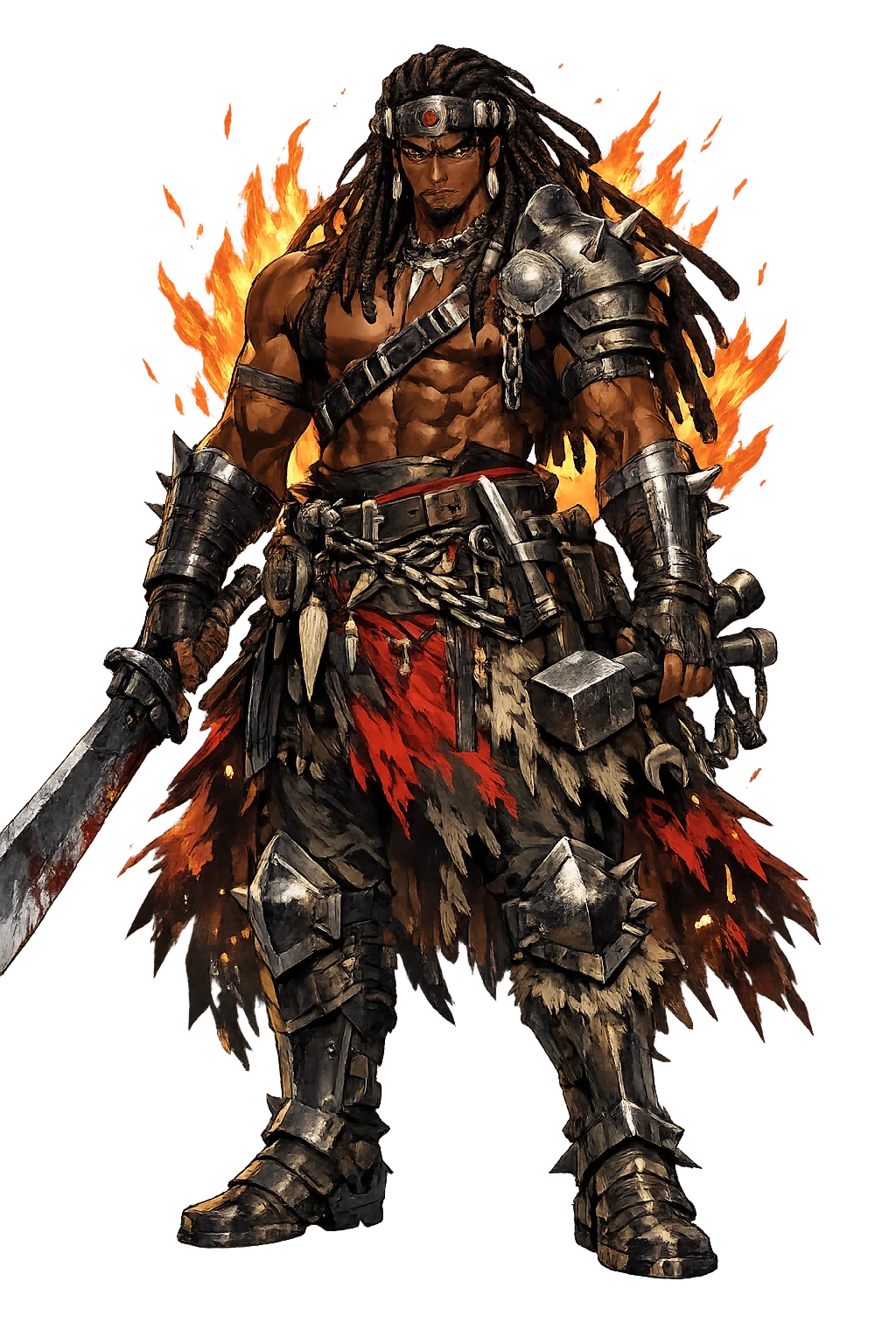
Ògún is rarely represented as a naturalistic statue; his image is his tools. The anvil, hammer, machete, hoe, chains, and iron implements are placed on an altar or wrapped in palm fronds, and the colors red and black announce him. A dog may appear as his messenger or sacrificial animal. In shrine settings he is sometimes embodied by a calabash filled with iron tools and medicinal substances, crowned with palm leaves. Unlike the polished marble gods of the Mediterranean, Ògún's iconography is deliberately rough, metallic, and functional: he is present wherever iron is.

06

Reception & Transformation

The name after its own age — transmission, translation, survival

Afterlives

Ògún crossed the Atlantic in the bodies and memories of enslaved Yoruba people, becoming Ogum in Brazilian Candomblé, Ogún in Cuban Santería/Lucumí, and Ogou in Haitian Vodou. In each diasporic setting he kept his association with iron, war, labor, and roads while adapting to new liturgical vocabularies. Twentieth-century scholars such as E. B. Idowu, William Bascom, and Pierre Verger documented his Yoruba cult and its American transformations, making him one of the best-studied African deities in the Americas. In contemporary Nigeria and the diaspora he has also become a symbol of labor, industry, and resistance, his reception shaped by both religious continuity and modern political identity.

Identifications Across Traditions

The Middle Passage carried him across the Atlantic, where the iron god found new irons: in Cuban Santería he is Oggún, syncretized with Saint Peter (keeper of the keys — the metal of heaven's gate) or Saint George; in Brazilian Candomblé, Ògún is Saint George of the dragon-slaying spear; in Haitian Vodou he is Ogou Feray, the warrior-loa of the forge and the soldier's flag. The saints changed the face; the iron, the road, and the dog kept the god.

Modern Legacy

Nigeria's Nobel laureate Wole Soyinka is his most famous devotee: Ògún is the patron of Soyinka's art — the road-maker who is also the destroyer — and the essay "The Fourth Stage" and the novel The Road are his modern liturgy. Ògún state in Nigeria bears his name; his praise-names echo in the foundries and mechanics' yards of every Yoruba city, where a splash of palm wine on the anvil still opens the working day.

08

The Scholarly Transliteration Note

What the written record preserves — and what it does not

Scholarly Transliteration

Yoruba is written in Latin letters with tone marks — the orthography the restoration preserves: Ò (low tone) and ú (high tone) are the name as spoken. In the Ifá divination corpus his signs live in the odù Ogunda, "Ogun creates," one of the sixteen principal odù: the god written into the divination system itself.

09

The Meditation

What Ògún means — beyond the dictionary

Ògún is the god of the tool in the hand. Every technology is his: the blade that clears the road and the blade that clears the town are the same iron, and only the wielder's self-command decides which road it opens. He asks the maker's question, which is also the warrior's and the surgeon's: what does your strength serve — and who stands in the way when it slips?

Every driver who splashes gin on a bumper in Lagos, every mechanic who taps the anvil before the first weld, is keeping his liturgy without needing its name: tools are moral — they open roads or open wounds — and the hand must be steadier than the blade. Ògún's myth admits what no other war-god's does: that the rage is his own. The road-opener who cut down his own town is the honest patron of a technological age: the strength is real, the forest is real, and so is the apology owed when the blade turns.

Soyinka, his greatest modern devotee, calls him the god of the road and of transition — the patron of everyone who makes a path where none existed, and the warning that every path is cut through something. In the diaspora's forge-altars the lesson survives translation: iron does not apologize, but it must be answered for. The road-opener asks of every builder, coder, and driver the same question his own myth could not escape: when the forest is cleared, what will you plant — and whom did the clearing cost?

The anvil rings, the day's first iron is cut, and the road — his road — opens another meter. The forest always grows back; that is why the clearing is a daily act, and why the god of the cutlass is worshipped not once but every working morning.

10

Frequently Asked Questions

Deep-dives into the cult, attestation, reception, and sources of Ògún

01How do we know how Ògún was worshipped?

Yorubaland is one of Africa's oldest iron-working regions: the smelting furnaces of the Nsukka plateau (Lejja) date the craft back over two thousand years, and the guild-smithies of the forest belt kept the ritual side — the first iron of a furnace smelted with prayers to Ògún. The full cult record →

02Where do the earliest attestations of Ògún come from?

The record rests on E. B. Idowu, Olódùmarè: God in Yoruba Belief (1962), W. Bascom, Ifa Divination: Communication Between Gods and Men in West Africa (1969), J. O. Awolalu, Yoruba Beliefs and Sacrificial Rites (1979), among 6 cited works. The full source apparatus →

03How did later traditions reinterpret Ògún?

Ògún crossed the Atlantic in the bodies and memories of enslaved Yoruba people, becoming Ogum in Brazilian Candomblé, Ogún in Cuban Santería/Lucumí, and Ogou in Haitian Vodou. Reception & transformation →

04What do the surviving images of Ògún actually show?

Ògún is rarely represented as a naturalistic statue; his image is his tools. The iconography →

05What does the written record of Ògún actually preserve?

Yoruba is written in Latin letters with tone marks — the orthography the restoration preserves: Ò (low tone) and ú (high tone) are the name as spoken. The Scholarly Transliteration note →

11

Scholarly Sources

The philological foundations of this restoration

Every claim on this page is grounded in established scholarship. The orthographic restorations follow disciplinary convention. The etymological chain follows the best available reference works. This is not invention — it is resurrection through scholarship.

◈

Lexicography & Philology

  • Abraham
◎

Primary Texts

  • The Ifá divination corpus; ọ̀rọ̀ àṣà and oríkì traditions; Abraham’s Dictionary of Modern Yoruba.
◉

Archaeology & Art History

  • Willett, F. Ife in the History of West African Sculpture; Drewal, H. Yoruba: Nine Centuries of African Art and Thought.
✦

Religious Studies

  • E. B. Idowu, Olódùmarè: God in Yoruba Belief (1962)
  • W. Bascom, Ifa Divination: Communication Between Gods and Men in West Africa (1969)
  • J. O. Awolalu, Yoruba Beliefs and Sacrificial Rites (1979)
  • Pierre Verger, Orixás (1981)
  • Lydia Cabrera, El Monte (1954)
  • Wole Soyinka, 'The Fourth Stage' (1967)
Return

The Surface Awaits

You have traced the name from its earliest attestation to its Unicode restoration. Now return to the myth. The story is where the name lives.

Back to Lore
Ògún mascot