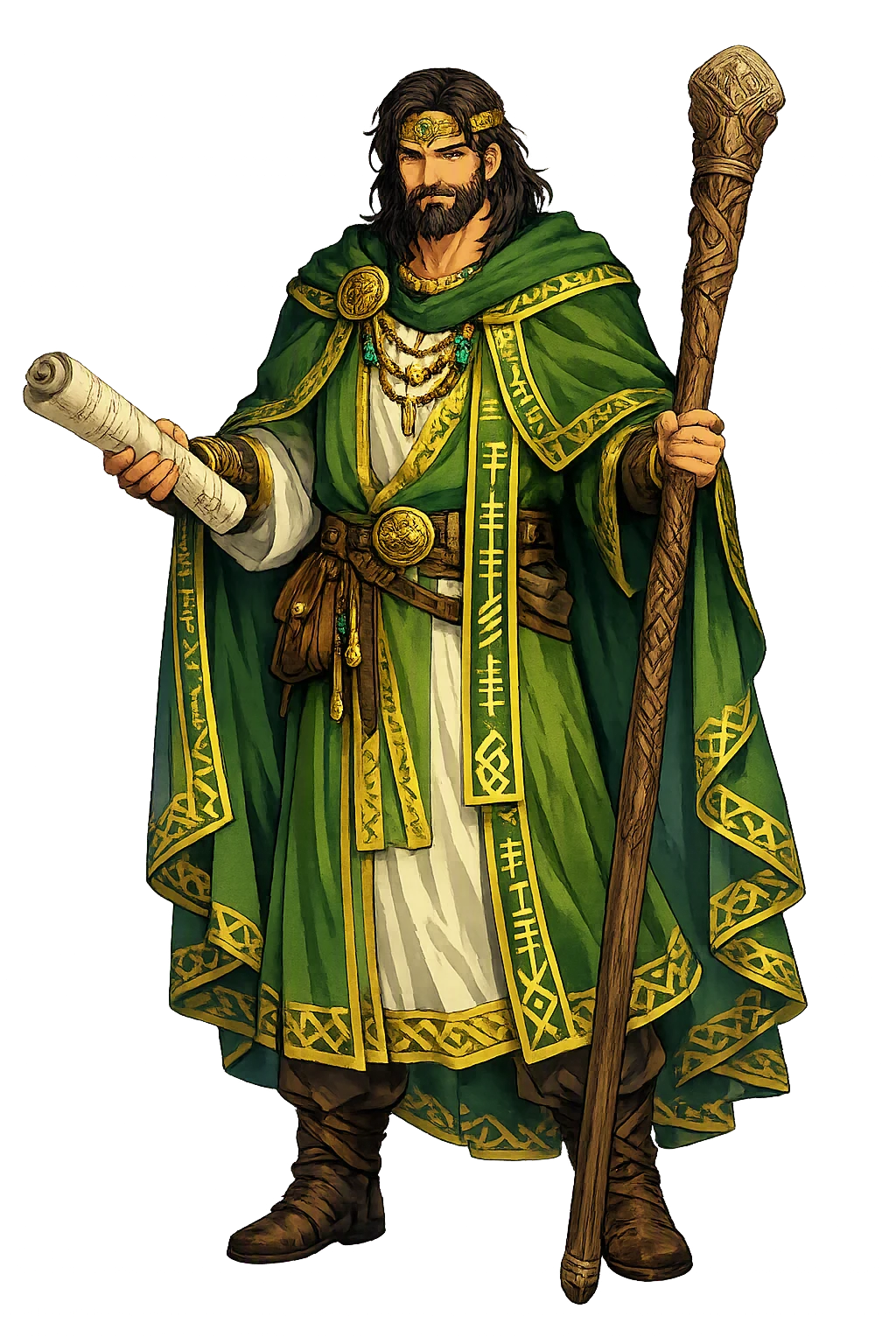
Stories of Ogma
Ogma's dossier is compact and exact: the Lebor Gabála gives his lineage, Cath Maige Tuired gives his deeds — the serf-labor under Bres, the flagstone test at Lugh's coming, the killing of the Fomorian king's son, and the talking sword — and the learned tradition gives him his strangest honor, the invention of the ogham.
The Lebor Gabála Érenn, Ireland's medieval book of invasions, writes Ogma into the divine genealogy: Ogma son of Elatha, of the line of Delbaeth, and so the brother of the Dagda himself. The surname carries a sting the saga does not hide — the same Elatha, the beautiful Fomorian prince who came as an arbiter to the Túatha Dé, is father of Bres by a Fomorian woman, which makes the champion of the gods the half-brother of the usurper who will set him hauling firewood. When the Túatha Dé Danann came to Ireland out of the four northern cities, Ogma came with them as the champion of the race — in trenfer, the strong man, the standing title the texts give him. His place in the pantheon is therefore double from the first mention: the arm of the Túatha Dé Danann, and the brother of their all-father, with the enemy's blood already in his own house.
When the half-Fomorian Bres was made king and laid the Túatha Dé Danann under tribute, the greatest of them were put to work like serfs — deliberately, for the tribute was calculated to break the mighty. The Dagda was set to building raths, and Ogma — the champion of the whole divine race — was set to hauling firewood for the fortress. The tale does not spare him: so weakened was he by hunger that the sea washed over him as he carried the fuel. The servitude did not blunt him; when the war came he killed the Fomorian king's son with his bare champion's art, and the firewood years became the measure of what was repaid. But the image stands as the tradition's sharpest statement of what Bres' kingship cost: the strong man of the gods, bent double under a usurper's faggots, with the tide at his knees.
When Lugh came to Tara before the battle, asking admission by his arts, it fell to Ogma to test the stranger's strength — the doorkeeper's office, and the champion's. Ogma hurled the great flagstone of the rath, a stone beyond the lifting of ordinary men, and Lugh answered by hurling it back through the rath to its own place. Ogma then challenged the newcomer to single combat, and Lugh declined: his arts, he said, would be tested soon enough against the Fomorians. The episode is the tradition's own changing of the guard, and it is conducted with a courtesy the Túatha Dé rarely manage elsewhere — a test, a verdict, and no feud. The old champion made way, stone by stone, for the many-skilled king who would lead the war, and the championship of Ireland passed hands without a blow struck in anger.
At the second battle of Mag Tuired the champion earned his title back. In the press of the fighting Ogma killed Indech, son of Dé Domnann, a king of the Fomorians — the same Indech whose blood the Mórrígan had promised the Dagda at the ford. And after the battle came the strangest prize in the Irish corpus: among the spoils Ogma found Orna, the sword of Tethra, king of the Fomorians. He unsheathed it and cleaned it, and the sword recounted all the deeds that had been done with it — for it was the custom of swords in those days, when drawn, to tell what they had done. The champion of the gods carried the only weapon in the world that could bear witness to itself: in Ogma's hand even the enemy's steel testified, because testimony is what this champion is for.
After the rout, the Fomorians had carried off the Dagda's harper, Uaithne, and the harp itself hung on the wall of the hall where Bres feasted. Three of the Túatha Dé Danann went in pursuit: Lugh, the Dagda, and Ogma — the king, the all-father, and the champion. The Dagda called the harp by its names, Daur Da Bláo and Coir Cethar Chuir, and it sprang from the wall to his hand, killing nine men in its path, and played the three strains of weeping, laughter, and sleep until the whole enemy host slept. Ogma walked out of that hall beside his brother and his king, through sleeping foes — the serf of the firewood years restored to the company of the gods' great deeds.
The Scholars' Primer — the Auraicept na n-Éces, the medieval Irish grammar of the poets — closes Ogma's dossier with the honor no other Irish god receives. Ogma, a man well skilled in speech and in poetry, invented the ogham for the speaking of Gaelic; and the tract fixes the paternity in a formula: the father of the ogham is Ogma, and the mother of the ogham is the hand or the knife of Ogma. Cormac's Glossary, compiled a generation before the Primer, already glosses the god's name from ogum, the ogham itself — in the Irish learned tradition, the alphabet and its father were one word. The glossarial tradition adds the epithet Grianainech, the Sun-faced. The champion who hauled firewood under a usurper is the same figure the learned tradition made the author of the alphabet itself — strength and letters, in Ireland, kept in one hand.
Eloquence, Writing
Ogma is the champion — in trenfer, the strong man — of the Túatha Dé Danann, and the Irish tradition made his strength and his speech one gift: the Auraicept na n-Éces calls him a man well skilled in speech and in poetry, and credits him with the invention of the ogham itself. His Gaulish cognate Ogmios, the old-man Herakles of Lucian's account, drags a willing crowd by golden chains fastened to his tongue: in the Celtic world, eloquence is what the strongest god is for.
The notched alphabet of early Ireland, carved along the edge of standing stones — of which the Scholars' Primer says: the father of the ogham is Ogma, the mother of the ogham is the hand or knife of Ogma.
The sword of Tethra, king of the Fomorians, found by Ogma after Mag Tuired — which recounted every deed that had been done with it, as swords did in those days.
The great stone Ogma hurled to test the stranger at the gate — which Lugh threw back through the rath to its own place, proving the stronger champion had arrived.
The champion's portion under the tyranny of Bres: hauling fuel for a usurper's fires, so weakened by hunger that the sea washed over him as he carried it.
From the original script to the living URL
Ogma
The name survives in scholarly transliteration. Ogma is the standard Celtic romanisation, documented in academic sources — “The grim one”. Because the spelling uses only Latin letters, the form is the same in both ASCII and Unicode.
No indigenous writing system is securely attested for individual celtic names. The form shown is a modern scholarly transliteration.
ogma
The plain ogma form is identical to the Unicode restoration. Because this name is already written in Latin letters, no diacritics, stress, or script information were lost — only capitalization differs.
Ogma
The Unicode restoration does not need to recover lost marks for Ogma. Its value is canonical spelling and consistent cataloguing, not the reconstruction of erased orthography. The domain is readable as-is to both DNS and humanity.
Ogma.com
This restoration is written entirely in ASCII letters — no Punycode encoding stands between Ogma and the DNS. The domain reads identically to machines and to human eyes.
Owned, ideal, and ASCII forms of Ogma
Ogma
The full Unicode restoration. ogma.com is not in the PuniCodex collection — it is watched for release; if it drops, this temple upgrades to an owned flagship.
How Ogma was spoken
How Ogma is preserved in writing
No indigenous writing system is securely attested for individual celtic names. The form shown is a modern scholarly transliteration.
Contribute scholarly provenance →The lore you have read is the living myth. Extended Lore opens the scholarly vault beneath it: the cult and its material remains, a history of the image, the name after antiquity, a meditation on what the name still means, and the full scholarly apparatus — etymology, orthography, sources.
Enter Extended Lore