PuniCodex

Extended Lore

Ogma — The Deeper Record

Etymology · Orthography · Cult · Iconography · Reception · Sources

ASCII-equivalent form Ogma
Ogma — Eloquence, Writing
01

At a Glance

Ogma — every fact links to its home

PantheonCeltic
DomainEloquence, Writing
Scholarly TransliterationOgma →
Cited Works12 cited →
02

Etymology & Word Family

From attested form to canonical spelling — the full etymology page →

Scholarly Transliteration Ogma Ogma — "The grim one"
Canonical Restoration Ogma Canonical scholarly spelling — ASCII-identical
Modern ASCII ogma Plain-ASCII fallback

The name Ogma reaches the modern world through scholarly transliteration of the celtic tradition. Because the conventional spelling uses only Latin letters, its canonical and ASCII forms coincide — the tradition it carries is in the name itself, not in diacritics.

03

Character breakdown

Character-by-character philological analysis

CharacterUnicodeNameBlockPhonetic Role
OU+004FLatin Capital Letter OBasic LatinSame, capitalized
gU+0067Latin Small Letter GBasic LatinSame
mU+006DLatin Small Letter MBasic LatinSame
aU+0061Latin Small Letter ABasic LatinSame

This restoration reflects fidelity to the attested tradition, not recovered diacritics: every character of Ogma already survives in ASCII. What the restoration preserves is the canonical spelling itself — the form scholarship standardised.

04

Cult & Worship

How the sacred was kept — rites, sanctuaries, remains

The Cult

No votary in ancient Ireland is known to have made an offering to Ogma. The medieval dossier — Cath Maige Tuired, the Lebor Gabála, the Auraicept — is learned literature, not cult record: no Irish sanctuary, festival, or priesthood is named for him anywhere in it, and of the some four hundred ogham stones that bear early Irish names, not one invokes the god the scholars fathered on the script. The continental evidence is slightly fuller. Lucian's second-century account presents the Gauls' image of Ogmios as a cult picture shown to a visitor, with a guide expounding its meaning — the behaviour of a god with a shrine, not of a story — and the theonym appears on a small number of Gaulish-language curse tablets, attesting a power people formally invoked, though no excavated sanctuary of Ogmios has ever been found. The Ogma honoured in modern Druid and pagan practice is a deliberate revival of this figure, two millennia removed from any ancient rite.

In the Earth

Ogma is a textual god: no ogham stone names him, no votive inscription invokes him, and the irony is the corpus's own — the script the medieval scholars fathered on him survives on some four hundred stones of roughly the fourth to seventh centuries, bearing personal names in formulaic genitives, none of them his. His manuscript witnesses are exact: Cath Maige Tuired survives uniquely in the sixteenth-century British Library MS Harley 5280, the basis of Gray's edition; the Lebor Gabála Érenn is preserved in the twelfth-century Book of Leinster and its sister codices; and the Auraicept na n-Éces, the tract that credits him with the alphabet, comes down in the great late-medieval compilations such as the Book of Ballymote. The nearest material witness to his figure is classical rather than Celtic: Lucian's second-century description of the Gaulish Ogmios, the old Herakles of eloquence, is the continental portrait of the god, and the Gaulish name is otherwise attested on a small number of defixiones (curse tablets) — comparative evidence, never identification.

05

Iconography

How Ogma was imaged across the ages

The Image

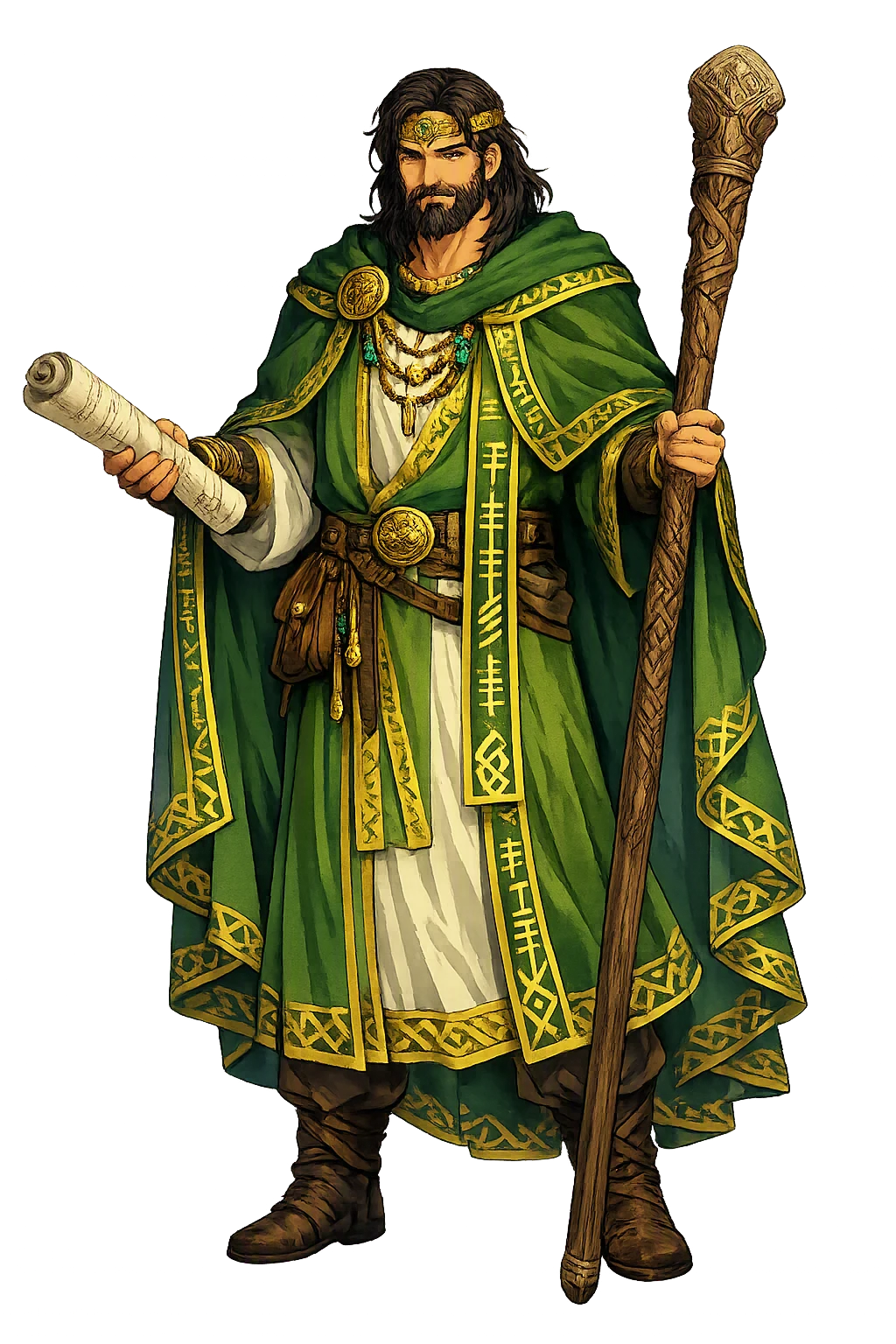
Ogma's only ancient portrait is made of words. Lucian's description is exact: a very old man, bald, wrinkled and sun-dark, Herakles in every respect save his age — but drawing after him a great crowd of men fastened by their ears to his tongue with slender chains of gold and amber, and they follow willingly. That is the complete iconographic dossier of antiquity: no Gaulish relief, coin or bronze is securely identified as Ogmios, and the proposed identifications remain contested. In Ireland the figure was never imaged at all — the great Insular codices illuminate scripture and genealogy, not the Túatha Dé, and no medieval artist drew the champion of the firewood years. What the tradition hands down is an attribute-system rather than a face: the gold-and-amber chains, the tongue as the strongest thing in the picture, the antique Herakles frame that makes eloquence, not youth, the mark of power. Every modern image of Ogma — and there are many, from nineteenth-century revival painting onward — descends from Lucian's three sentences.

06

Reception & Transformation

The name after its own age — transmission, translation, survival

Afterlives

Ogma travelled by two manuscript roads. In the West his dossier slept in Irish codices — the twelfth-century Book of Leinster, the sixteenth-century Harley 5280 that alone preserves Cath Maige Tuired, the Book of Ballymote's Auraicept — until the Celtic revival of the nineteenth century edited and translated it: Whitley Stokes published the battle-text in the Revue Celtique of 1891, George Calder's edition of the Scholars' Primer followed in 1917, and R. A. S. Macalister's Lebor Gabála (1938–56) fixed the genealogy for scholarship. In the East, Lucian's Herakles rode the Greek revival itself: Lucian was among the first Greek authors in print (1496), Erasmus and Thomas More translated him for the Latin-reading world, and the chained crowd became a fixture of every treatise on the ancient Celts from the Renaissance antiquarians onward. The name settled into the scholarly record through Vendryes' etymological lexicon and Proinsias Mac Cana's synthesis, while the ogham corpus that Ireland assigned to Ogma's paternity was catalogued by Victorian antiquaries and made a monument of the national past.

Identifications Across Traditions

Ogma has the strongest cross-border witness of any Irish god, and it is a classical author's eyewitness account. Lucian of Samosata, writing in the second century CE, describes a picture the Gauls showed him of their Herakles: not the young Greek athlete but a very old man, bald and wrinkled and sun-dark, drawing after him a great crowd of men — each one fastened by the ears to the god's tongue with slender chains of gold and amber, and following willingly, none struggling. The Gauls, Lucian's guide explains, do not give eloquence to Hermes as the Greeks do; they give it to Herakles, because he is the more powerful, and because the hero achieves everything by persuasion — his arrows are words. In the Gaulish tongue, the guide adds, Herakles is called Ogmios. The equation Ogmios = Ogma is the standard comparison of the handbooks — Vendryes' LEIA derives the Irish name from Proto-Celtic *Ogmios, and Mac Cana and Koch print the Lucian passage as the god's continental portrait. It remains comparison rather than identification: the Irish texts never call Ogma old or bald, and the ogham invention is Ireland's own learned myth. The Welsh corpus, meanwhile, is silent — the Mabinogi knows no counterpart, and no scholar has convincingly supplied one.

Modern Legacy

Ogma's afterlife runs on the two rails his name already laid down: strength and letters. Lady Gregory's Gods and Fighting Men (1904) carried Cath Maige Tuired into English and made the champion of the firewood years part of the revival's reading; the later romantic cycle, in Oidheadh Chloinne Tuireann, made him the father of Tuireann and so grandfather of the three sons whose blood-price Lugh exacted. His larger legacy is the script itself. The four hundred ogham stones of Ireland and Wales became the national patrimony of early Ireland, and with them Ogma's paternity: the medieval claim that the champion fathered the alphabet is quoted wherever the stones are studied. In the twentieth century Robert Graves's The White Goddess (1948) built a whole modern mythology on the ogham letters — a construction of Graves's own, not a medieval doctrine — and carried the script, and with it Ogma's fame, into modern esoteric and Druid practice, where he is honored as the god of eloquence, writing, and the poet's craft. The scholars, meanwhile, kept the older wonder alive: Lucian's chained crowd remains the most-quoted image of Celtic eloquence in the literature.

07

The Scholarly Transliteration Note

What the written record preserves — and what it does not

Scholarly Transliteration

The normalized Old Irish form is Ogma — already plain ASCII, with no diacritic or distinctive letter for the restoration to recover. Old Irish was written in the Insular Latin script of the great codices; the earlier monumental alphabet, ogham — the very script the medieval tradition credits Ogma with inventing — survives on some four hundred stones bearing personal names, but no attestation of this theonym has ever been read on any of them. Because the name is pure ASCII, its domain was registered decades ago in the ordinary way: ogma.com is held by a third party outside the PuniCodex collection and is watched for release — no form of the name is currently owned, and this temple claims none.

08

The Meditation

What Ogma means — beyond the dictionary

Ogma is the Celtic answer to a question every culture asks: what is strength for? The Irish texts could have left him a strong man — the champion who carries the wood, hurls the stone, and kills the Fomorian king's son, and nothing more. Instead the learned tradition took the same hand that dragged the firewood and made it the mother of the alphabet, and the Gauls, three centuries before the Irish manuscripts, had already painted the answer: the strongest god is the one whose victories need no chains, because men follow his tongue willingly. Even Ogma's weapon obeys the rule — Orna, the sword of the enemy king, becomes precious not for what it cut but for what it tells. The champion's whole dossier argues one proposition: the word is the deed that survives the doing. The stones of Ireland still stand along their stemlines, notched with the letters Ireland assigned to Ogma's paternity — the strongest kind of monument, because it is made of speech.

09

Frequently Asked Questions

Deep-dives into the cult, attestation, reception, and sources of Ogma

01How do we know how Ogma was worshipped?

Ogma is a textual god: no ogham stone names him, no votive inscription invokes him, and the irony is the corpus's own — the script the medieval scholars fathered on him survives on some four hundred stones of roughly the fourth to seventh centuries, bearing personal names in formulaic genitives, none of them his. The full cult record →

02Where do the earliest attestations of Ogma come from?

The record rests on Cath Maige Tuired (The Second Battle of Mag Tuired), ed. and trans. Elizabeth A. Gray, Irish Texts Society 52 (1982) — the firewood under Bres, the flagstone test, Indech slain, Orna the speaking sword, the recovery of the harp, Lebor Gabála Érenn, ed. and trans. R. A. S. Macalister (Irish Texts Society, 1938–56) — Ogma son of Elatha, brother of the Dagda, champion of the Túatha Dé Danann, Auraicept na n-Éces (The Scholars' Primer), ed. George Calder (1917) — Ogma, well skilled in speech and poetry, as inventor of the ogham; the father of the ogham is Ogma, the mother is his hand or knife, among 10 cited works. The full source apparatus →

03How did later traditions reinterpret Ogma?

Ogma travelled by two manuscript roads. Reception & transformation →

04What do the surviving images of Ogma actually show?

Ogma's only ancient portrait is made of words. The iconography →

05What does the written record of Ogma actually preserve?

The normalized Old Irish form is Ogma — already plain ASCII, with no diacritic or distinctive letter for the restoration to recover. The Scholarly Transliteration note →

10

Scholarly Sources

The philological foundations of the record

Every claim on this page is grounded in established scholarship. The orthographic restorations follow disciplinary convention. The etymological chain follows the best available reference works. This is not invention — it is resurrection through scholarship.

◈

Lexicography & Philology

  • Lebor Gabála
  • MacKillop
◎

Primary Texts

  • The Immram Brain (Voyage of Bran); Tochmarc Étaíne; Cóir Anmann; medieval Irish saga literature.
◉

Archaeology & Art History

  • Megaw, R., & Megaw, V. Celtic Art: From Its Beginnings to the Book of Kells; Green, M. The Gods of the Celts.
✦

Religious Studies

  • Cath Maige Tuired (The Second Battle of Mag Tuired), ed. and trans. Elizabeth A. Gray, Irish Texts Society 52 (1982) — the firewood under Bres, the flagstone test, Indech slain, Orna the speaking sword, the recovery of the harp
  • Lebor Gabála Érenn, ed. and trans. R. A. S. Macalister (Irish Texts Society, 1938–56) — Ogma son of Elatha, brother of the Dagda, champion of the Túatha Dé Danann
  • Auraicept na n-Éces (The Scholars' Primer), ed. George Calder (1917) — Ogma, well skilled in speech and poetry, as inventor of the ogham; the father of the ogham is Ogma, the mother is his hand or knife
  • Lucian of Samosata, Herakles (Prolalia) 1–6 — the Gaulish Ogmios, the old Herakles of eloquence with the chained and willing crowd
  • Sanas Cormaic (Cormac's Glossary), ed. Kuno Meyer (1912), s.v. Ogma — the gloss tying the name to ogum, i.e. ogham
  • Vendryes, Lexique étymologique de l'irlandais ancien, s.v. Ogma — from Proto-Celtic *Ogmios; the possible link with Greek ogmos, 'furrow, swath'
  • Mac Cana, Proinsias, Celtic Mythology (1970) — the champion and the Ogmios comparison
  • Koch, John T., ed., Celtic Culture: A Historical Encyclopedia (ABC-CLIO, 2006), s.vv. Ogma, Ogmios, ogham
  • McManus, Damian, A Guide to Ogam, Maynooth Monographs 4 (An Sagart, 1991) — the ogham corpus and its dating
  • MacKillop, James, Dictionary of Celtic Mythology (Oxford, 1998), s.v. Ogma
Return

The Surface Awaits

You have traced the name from its earliest attestation to its canonical restoration. Now return to the myth. The story is where the name lives.

Back to Lore
Ogma mascot