
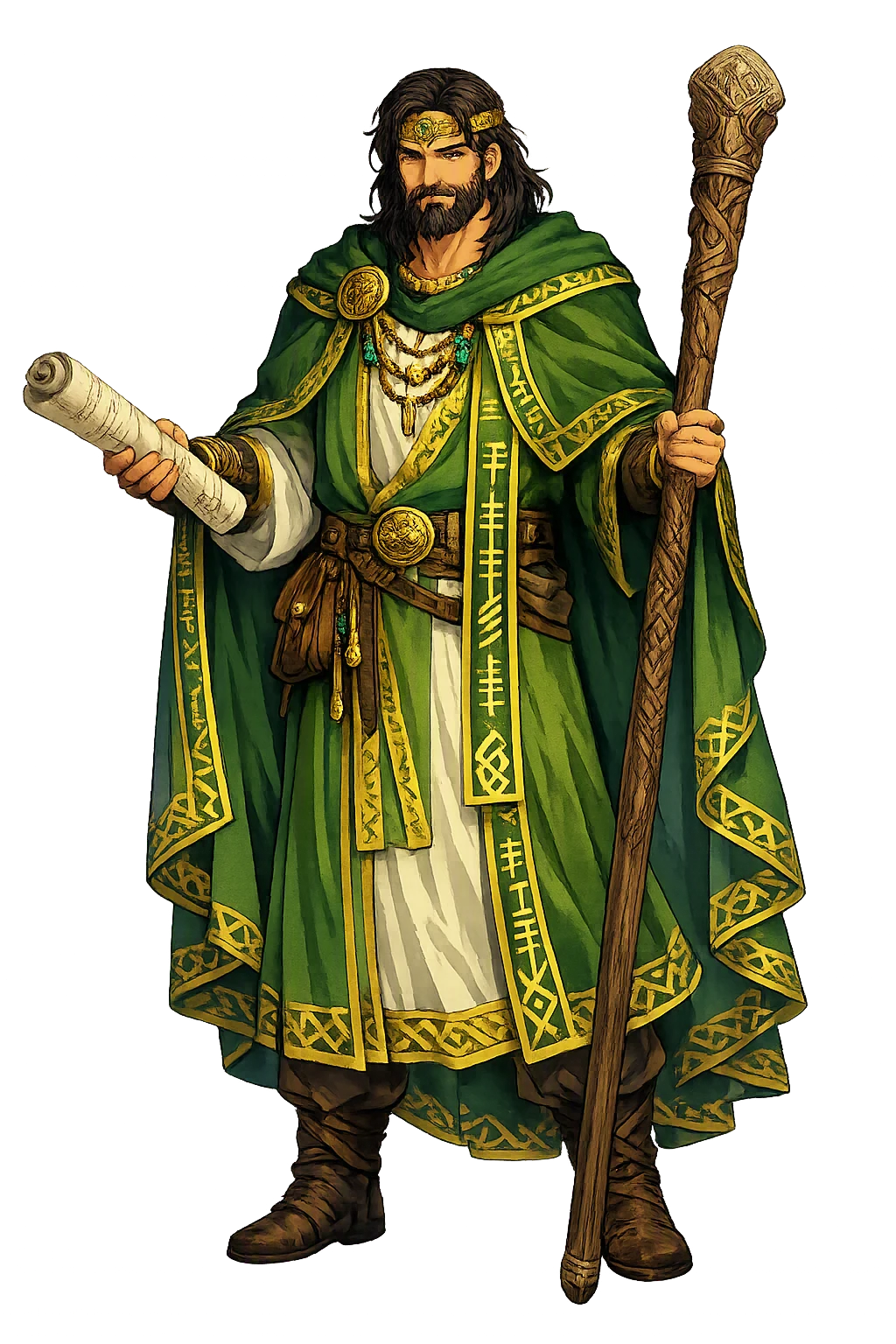
Ogma: canonical, contested, and the false forms on record
Evidence dossier 388 — Ogma. Every exhibit catalogued, every ruling stated with its grounds.
At a Glance
- Canonical form: Ogma
- Scholarly Transliteration: no original script securely attested — the romanized form is the primary record
- Pantheon: Celtic
- Convention: the tradition's scholarly romanization, kept exactly as recorded
- False forms on record: 0
- Contested forms: none attested
- Series: The Canonical Register, No. 388 of 597
The Evidence
Exhibit 1 — the attestation. The tradition's record preserves this name in its romanized scholarly form: Ogma — no older script survives to transcribe, so the canonical content is the exactness of the spelling itself.
Exhibit 2 — the flattened form. The plain form ogma differs from the canonical Ogma only by convention of display — case, not content. It is acceptable everywhere: in legacy systems, in plain-text citation, in the DNS itself. What is not acceptable is what follows in the register: respellings that change the letters, not just their case.
Exhibit 3 — the physical record. Ogma is a textual god: no ogham stone names him, no votive inscription invokes him, and the irony is the corpus's own — the script the medieval scholars fathered on him survives on some four hundred stones of roughly the fourth to seventh centuries, bearing personal names in formulaic genitives, none of them his. His manuscript witnesses are exact: Cath Maige Tuired survives uniquely in the sixteenth-century British Library MS Harley 5280, the basis of Gray's edition; the Lebor Gabála Érenn is preserved in the twelfth-century Book of Leinster and its sister codices; and the Auraicept na n-Éces, the tract that credits him with the alphabet, comes down in the great late-medieval compilations such as the Book of Ballymote. The nearest material witness to his figure is classical rather than Celtic: Lucian's second-century description of the Gaulish Ogmios, the old Herakles of eloquence, is the continental portrait of the god, and the Gaulish name is otherwise attested on a small number of defixiones (curse tablets) — comparative evidence, never identification.
Exhibit 4 — the continuing record. Ogma's afterlife runs on the two rails his name already laid down: strength and letters. Lady Gregory's Gods and Fighting Men (1904) carried Cath Maige Tuired into English and made the champion of the firewood years part of the revival's reading; the later romantic cycle, in Oidheadh Chloinne Tuireann, made him the father of Tuireann and so grandfather of the three sons whose blood-price Lugh exacted.
The Convention's Own History
The canonical spelling of Ogma rests on the tradition's own scholarly record, not on a marks convention: the name's forms are documented, compared, and one reference spelling is fixed so that citations agree across the temple, the lexicon, and this register. The principle that unifies every entry is the one the whole project stands on: a name is evidence, and evidence is not negotiable — not for keyboards, not for convenience, not for anyone.
The Address, Without an Encoding Detour
The canonical form Ogma already uses ordinary Latin letters, so the address bar needs no special encoding narrative. The digital temple can preserve the spelling exactly as the scholarly record presents it. That is the practical point here: consistency between the source, the citation, and the public address.
This does not make every romanization equally valid. A wrong letter remains wrong even when it is easy to type. Canonical status still depends on the attested convention, never on convenience or registrar inventory.
The Verdict
Case closed on Ogma: canonical, cited, and defended. The keyboard form ogma is the same name in another register of display — always acceptable. The register's files remain open: if a source surfaces that changes any line of this entry, the entry changes. Until then, the temple at /ogma/ holds the canonical form.
The docket for this ruling: no false forms on the docket; no contested forms attested; the attestation rests on 10 cited sources — Cath Maige Tuired (The Second Battle of Mag Tuired), ed. and trans. Elizabeth A. Gray, Irish Texts Society 52 (1982) — the firewood under Bres, the flagstone test, Indech slain, Orna the speaking sword, the recovery of the harp, Lebor Gabála Érenn, ed. and trans. R. A. S. Macalister (Irish Texts Society, 1938–56) — Ogma son of Elatha, brother of the Dagda, champion of the Túatha Dé Danann, Auraicept na n-Éces (The Scholars' Primer), ed. George Calder (1917) — Ogma, well skilled in speech and poetry, as inventor of the ogham; the father of the ogham is Ogma, the mother is his hand or knife.
The Register Continues
This is one of 597 entries in the Canonical Register — the authoritative reference for every flagship temple. The temple's founding dispatch tells the name's story; its Restoration File details the marks; its Resonance File reads the archetype into the industries. The blog index holds the whole archive, and the Rulebook states the convention this register enforces.
Continue the register — previous entry: Odysseús (read it) · next entry: Ògún (read it).
The Canonical Register is written from the same canonical record as the lexicon itself. If a false form is missing from this page, it is because the evidence does not support calling it false — or because we have not seen it yet. Show us, with a citation, and the register will answer.