PuniCodex

Extended Lore

Ogma

Etymology · Phonology · Orthography · Cultural Legacy · Primary Sources

Tier 2 Ogma
Ogma — Eloquence, Writing
01

Quick Facts

Essential information about Ogma, Eloquence, Writing

Scholarly TransliterationOgma
Unicode RestorationOgma
Reconstructed Pronunciation/ˈoɣ.ma/
PantheonCeltic
DomainEloquence, Writing
MeaningThe grim one
ClassificationTier 2
Primary DomainOgma
Sacred SymbolsThe ogham fews, Orna, Tethra's sword, The flagstone of Tara, The firewood bundle, The golden chains of Ogmios
02

Etymology & Word Family

From original script to Unicode restoration

Scholarly Transliteration Ogma Ogma — "The grim one"
Unicode Restoration Ogma Restored stress, length, and script
Modern ASCII ogma Plain-ASCII fallback

Ogma is Tier 2 by the mechanical rule: the normalized Old Irish form is already plain ASCII — there is no diacritic and no distinctive letter for the restoration to recover, and only the capital distinguishes the temple form from the input. The lexicon's traditional gloss is 'the grim one', but the etymology is genuinely unsettled: the standard scholarly line derives the name from Proto-Celtic *Ogmios (attested in Gaulish), with a possible further link to Greek ogmos, 'furrow, swath' — a derivation discussed since Vendryes and registered, not decided, by the handbooks (LEIA; Koch, s.v. Ogma).

03

Unicode Character Breakdown

Character-by-character philological analysis

CharacterUnicodeNameBlockPhonetic Role
OU+004FLatin Capital Letter OBasic LatinSame, capitalized
gU+0067Latin Small Letter GBasic LatinSame
mU+006DLatin Small Letter MBasic LatinSame
aU+0061Latin Small Letter ABasic LatinSame

The Tier 2 classification reflects how much of the original phonology this restoration preserves — stress and vowel length for Greek names, distinctive letters and diacritics for every other tradition.

04

Cultural Significance

From ancient cult to modern Unicode

Ancient Domain

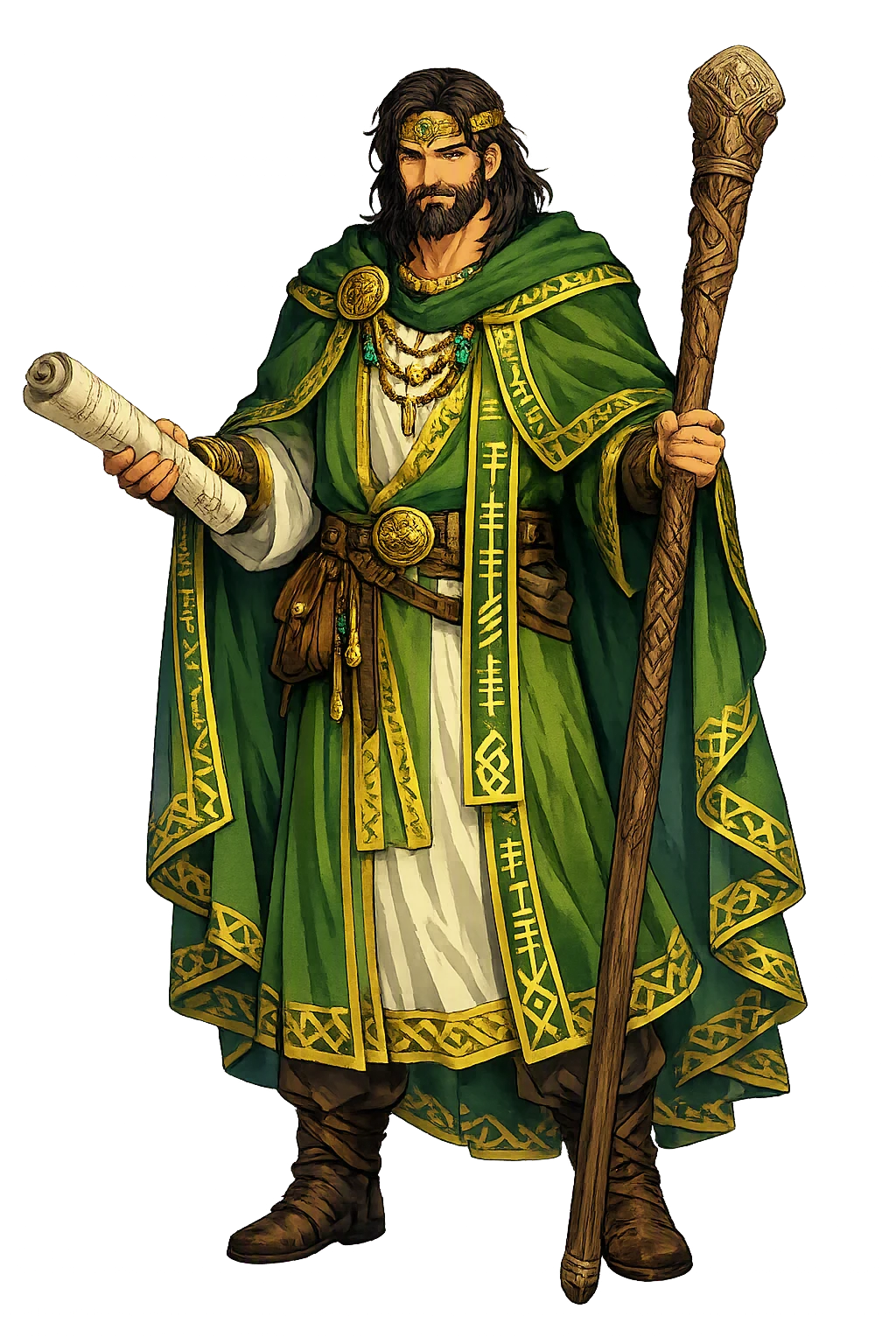
Ogma is the champion — in trenfer, the strong man — of the Túatha Dé Danann, and the Irish tradition made his strength and his speech one gift: the Auraicept na n-Éces calls him a man well skilled in speech and in poetry, and credits him with the invention of the ogham itself. His Gaulish cognate Ogmios, the old-man Herakles of Lucian's account, drags a willing crowd by golden chains fastened to his tongue: in the Celtic world, eloquence is what the strongest god is for.

Ogma in Later Traditions

Ogma has the strongest cross-border witness of any Irish god, and it is a classical author's eyewitness account. Lucian of Samosata, writing in the second century CE, describes a picture the Gauls showed him of their Herakles: not the young Greek athlete but a very old man, bald and wrinkled and sun-dark, drawing after him a great crowd of men — each one fastened by the ears to the god's tongue with slender chains of gold and amber, and following willingly, none struggling. The Gauls, Lucian's guide explains, do not give eloquence to Hermes as the Greeks do; they give it to Herakles, because he is the more powerful, and because the hero achieves everything by persuasion — his arrows are words. In the Gaulish tongue, the guide adds, Herakles is called Ogmios. The equation Ogmios = Ogma is the standard comparison of the handbooks — Vendryes' LEIA derives the Irish name from Proto-Celtic *Ogmios, and Mac Cana and Koch print the Lucian passage as the god's continental portrait. It remains comparison rather than identification: the Irish texts never call Ogma old or bald, and the ogham invention is Ireland's own learned myth. The Welsh corpus, meanwhile, is silent — the Mabinogi knows no counterpart, and no scholar has convincingly supplied one.

Modern Legacy

Ogma's afterlife runs on the two rails his name already laid down: strength and letters. Lady Gregory's Gods and Fighting Men (1904) carried Cath Maige Tuired into English and made the champion of the firewood years part of the revival's reading; the later romantic cycle, in Oidheadh Chloinne Tuireann, made him the father of Tuireann and so grandfather of the three sons whose blood-price Lugh exacted. His larger legacy is the script itself. The four hundred ogham stones of Ireland and Wales became the national patrimony of early Ireland, and with them Ogma's paternity: the medieval claim that the champion fathered the alphabet is quoted wherever the stones are studied. In the twentieth century Robert Graves's The White Goddess (1948) built a whole modern mythology on the ogham letters — a construction of Graves's own, not a medieval doctrine — and carried the script, and with it Ogma's fame, into modern esoteric and Druid practice, where he is honored as the god of eloquence, writing, and the poet's craft. The scholars, meanwhile, kept the older wonder alive: Lucian's chained crowd remains the most-quoted image of Celtic eloquence in the literature.

Unicode Restoration as Cultural Act

Restoring Ogma in a domain name is more than orthographic accuracy. It is a statement that the internet should recognize the full range of human writing — not only the ASCII keyboard.

05

Frequently Asked Questions

Common questions about Ogma, Eloquence, Writing, and Unicode restoration

01How do you pronounce Ogma?

In reconstructed pronunciation, Ogma is /ˈoɣ.ma/ — approximately 'OG-ma' — a short, closed 'o', the g melted toward a soft gargle before the m, stress firmly on the first syllable. The English habit of a hard g, as in 'dogma', is the one sound to avoid..

02What does Ogma mean?

Ogma means The grim one in the celtic tradition.

03What are the symbols of Ogma?

Ogma is associated with The ogham fews (The notched letters along the stemline — writing itself, fathered by the champion's hand), Orna, Tethra's sword (The weapon that tells its own deeds — even the champion's steel answers to speech), The flagstone of Tara (Strength as the doorkeeper's test — the stone only the worthiest arm can move), The firewood bundle (The strong man reduced to serf-labor — endurance under the usurper, repaid at Mag Tuired), The golden chains of Ogmios (Lucian's Gaulish image of eloquence: men led willingly, ear fastened to tongue).

04Why restore Ogma in Unicode?

Plain ASCII ogma strips the stress, length, and script that make the name specific. Unicode restoration returns the name to its original written dignity.

05What is the most important myth about Ogma?

The Lebor Gabála Érenn, Ireland's medieval book of invasions, writes Ogma into the divine genealogy: Ogma son of Elatha, of the line of Delbaeth, and brother of the Dagda himself. When the Túatha Dé Danann came to Ireland out of the four northern cities, Ogma came with them as the champion of the race — in trenfer, the strong man, the standing title the texts give him. His place in the pantheon is therefore double from the first mention: the arm of the Túatha Dé Danann, and the brother of their all-father.

06

Scholarly Sources

The philological foundations of this restoration

Every claim on this page is grounded in established scholarship. The orthographic restorations follow disciplinary convention. The etymological chain follows the best available reference works. This is not invention — it is resurrection through scholarship.

Lexicography & Philology

  • Lebor Gabála
  • MacKillop

Primary Texts

  • The Immram Brain (Voyage of Bran); Tochmarc Étaíne; Cóir Anmann; medieval Irish saga literature.

Archaeology & Art History

  • Material evidence — iconography, inscriptions, and temple archaeology — for Ogma and related cults.
  • Ogma is a textual god: no ogham stone names him, no votive inscription invokes him, and the irony is the corpus's own — the script the medieval scholars fathered on him survives on some four hundred stones of roughly the fourth to seventh centuries, bearing personal names in formulaic genitives, none of them his. His manuscript witnesses are exact: Cath Maige Tuired survives uniquely in the sixteenth-century British Library MS Harley 5280, the basis of Gray's edition; the Lebor Gabála Érenn is preserved in the twelfth-century Book of Leinster and its sister codices; and the Auraicept na n-Éces, the tract that credits him with the alphabet, comes down in the great late-medieval compilations such as the Book of Ballymote. The nearest material witness to his figure is classical rather than Celtic: Lucian's second-century description of the Gaulish Ogmios, the old Herakles of eloquence, is the continental portrait of the god, and the Gaulish name is otherwise attested on a small number of defixiones (curse tablets) — comparative evidence, never identification.

Religious Studies

  • Cath Maige Tuired (The Second Battle of Mag Tuired), ed. and trans. Elizabeth A. Gray, Irish Texts Society 52 (1982) — the firewood under Bres, the flagstone test, Indech slain, Orna the speaking sword, the recovery of the harp
  • Lebor Gabála Érenn, ed. and trans. R. A. S. Macalister (Irish Texts Society, 1938–56) — Ogma son of Elatha, brother of the Dagda, champion of the Túatha Dé Danann
  • Auraicept na n-Éces (The Scholars' Primer), ed. George Calder (1917) — Ogma, well skilled in speech and poetry, as inventor of the ogham; the father of the ogham is Ogma, the mother is his hand or knife
  • Lucian of Samosata, Herakles (Prolalia) 1–6 — the Gaulish Ogmios, the old Herakles of eloquence with the chained and willing crowd
  • Sanas Cormaic (Cormac's Glossary), ed. Kuno Meyer (1912), s.v. Ogma — the gloss tying the name to ogum, i.e. ogham
  • Vendryes, Lexique étymologique de l'irlandais ancien, s.v. Ogma — from Proto-Celtic *Ogmios; the possible link with Greek ogmos, 'furrow, swath'
  • Mac Cana, Proinsias, Celtic Mythology (1970) — the champion and the Ogmios comparison
  • Koch, John T., ed., Celtic Culture: A Historical Encyclopedia (ABC-CLIO, 2006), s.vv. Ogma, Ogmios, ogham
  • McManus, Damian, A Guide to Ogam, Maynooth Monographs 4 (An Sagart, 1991) — the ogham corpus and its dating
  • MacKillop, James, Dictionary of Celtic Mythology (Oxford, 1998), s.v. Ogma
Return

The Surface Awaits

You have traced the name from its earliest attestation to its Unicode restoration. Now return to the myth. The story is where the name lives.

Back to Lore
Ogma mascot