
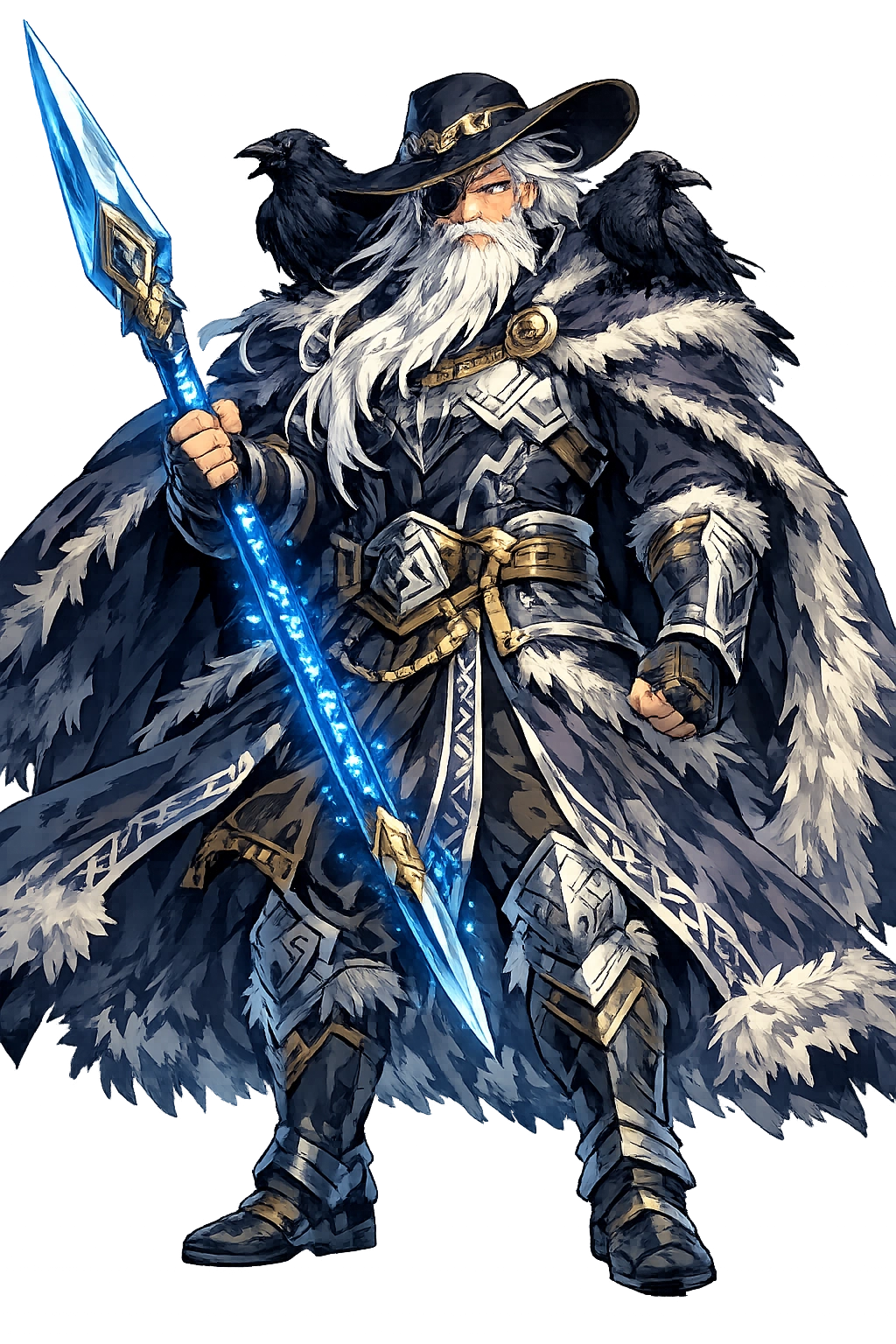
Óðinn: the stories first, then the spelling
Before the spelling, the story. Óðinn earns its restoration the old way — through what was actually told.
The Stories That Carry the Name
The Hanging on the Windy Tree. In Hávamál 138, Óðinn speaks of a sacrifice 'to myself, to myself': he hung nine nights on the windy tree — the stanza does not name it; later tradition identifies it with Yggdrasill — pierced by a spear, given neither bread nor drinking horn. From that ordeal he seized the runes, the letters of power that carry knowledge, healing, and sorcery through the worlds. The passage is one of the most striking shamanic initiations in European literature.
The Seeress's Vision. Óðinn summons a dead völva and compels her to answer his questions about the origins of the world and the coming doom. She tells him of the golden age of the gods, the murder of Ymir, the creation of dwarves, and finally of Ragnarǫk: the wolf Fenrir's release, the serpent's rising, the darkening of the sun, and the fall of the gods. The poem dramatizes Óðinn's defining obsession: he already knows much, yet he cannot stop seeking more.
The Eye in the Well of Mímir. Beneath one root of Yggdrasill lies Mímir's well, in which wisdom and understanding are hidden, and Mímir is its keeper. Óðinn came to the well and asked for a single drink; the price was an eye. He pledged it, and Mímir took the eye and cast it into the well, where it still lies — so Snorri tells in Gylfaginning 15 — and ever after Óðinn sees with one eye in this world while his other gazes into the water of hidden things.
And Here Is What the Spelling Preserves
The restoration keeps one feature the ASCII form odinn cannot show:
- o → Ó — Acute on O: where the voice peaks.
A storyteller pronouncing the name would restore every one of them by instinct. The file only writes down what the voice already knows.
At a Glance
- Restored name: Óðinn
- ASCII form: odinn
- Meaning: "Fury, possession (from *wōđanaz)"
- Domain of influence: Wisdom, War, Death, Poetry
- Pantheon: Norse
- Classification: Tier 1
- Original script: ᚢᚦᛁᚾ
- Series: The Restoration Files, No. 352 of 546
The Name Travels
Interpretatio romana named him Mercury: Tacitus (Germania 9) reports that Mercury is the chief god of the Germani, and the equation stuck — the dies Mercurii became Wednesday in English, Wodanstag in Dutch, and Óðinsdagr in Iceland. Anglo-Saxon royal houses claimed descent from Woden, and the genealogies of Wessex and Mercia trace their lines back to him — a pagan ancestor quietly retained by Christian kings.
The Address It Earned
The temple of Óðinn stands at /odinn/ — lore, scholars, patterns — because a name carrying this much story deserves more than a parking page. Tier-1 is not a compliment; it is a measurement. This restoration keeps something the ASCII form provably loses, and the measurement is repeatable.
The Sources Are Open
The myths above are retold from the temple's record; the primary voices are in the Sacred Texts: Poetic Edda and Prose Edda. Nothing in this file outranks them.
The File Continues
Read the founding dispatch for the name's full story, the Resonance File for the archetype at work — or the whole archive in one sitting.
Continue the series — previous file: Ọṣọọsì (read it here) · next file: Odùduwà (read it here).
The Restoration Files are written from the same canonical record as the temples themselves: the lexicon, the lore catalog, the pattern atlas, and the cited scholarly sources. If a file ever disagrees with its temple, the temple is right — tell us, and the file will be corrected.