The Living Myth
Wisdom, War, Death, Poetry · The Frenzied One · Lord of the Hanged
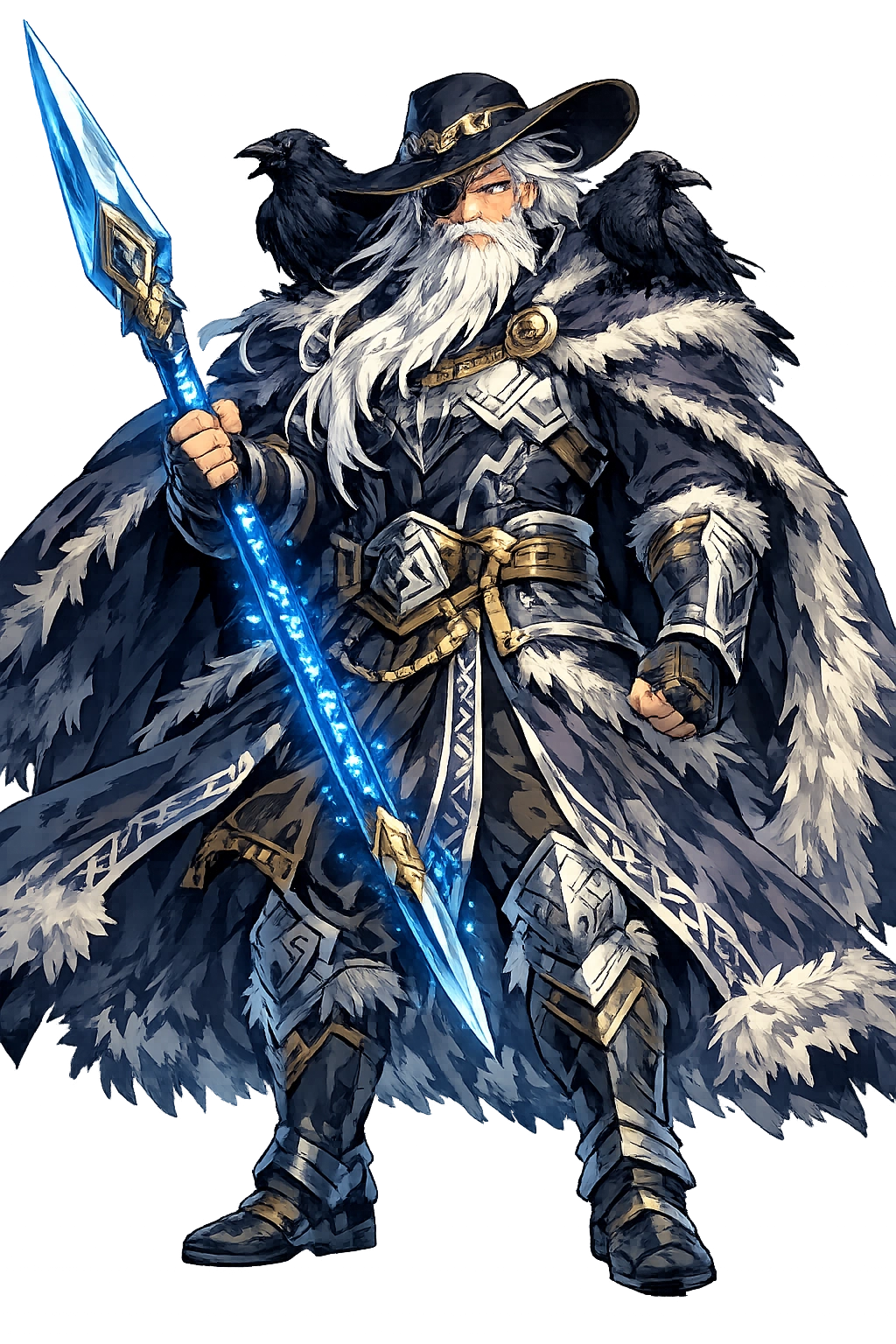
Stories of Óðinn
Óðinn is the most restless of the Æsir: a war-god who wins by wit, a poet who stole his art, a seeker who paid an eye and nine nights on a tree for wisdom the gods did not hand him. His myths are all bargains — with seeresses, giants, and his own body — and all of them end in knowledge, victory, or the foreknowledge of defeat.
In Hávamál 138, Óðinn speaks of a sacrifice 'to myself, to myself': he hung nine nights on the windy tree — the stanza does not name it; later tradition identifies it with Yggdrasill — pierced by a spear, given neither bread nor drinking horn. From that ordeal he seized the runes, the letters of power that carry knowledge, healing, and sorcery through the worlds.
The passage is one of the most striking shamanic initiations in European literature. Óðinn does not receive wisdom as a gift; he wins it by dying in a controlled way, suspended between worlds. The gallows and the spear become his ritual tools, and the tree becomes the axis along which the initiate ascends.
Óðinn summons a dead völva and compels her to answer his questions about the origins of the world and the coming doom. She tells him of the golden age of the gods, the murder of Ymir, the creation of dwarves, and finally of Ragnarǫk: the wolf Fenrir's release, the serpent's rising, the darkening of the sun, and the fall of the gods.
The poem dramatizes Óðinn's defining obsession: he already knows much, yet he cannot stop seeking more. Even foreknowledge does not grant escape. The myth presents him as a king who pays for wisdom with the anxiety of certainty, a god who knows precisely how his reign will end.
Beneath one root of Yggdrasill lies Mímir's well, in which wisdom and understanding are hidden, and Mímir is its keeper. Óðinn came to the well and asked for a single drink; the price was an eye. He pledged it, and Mímir took the eye and cast it into the well, where it still lies — so Snorri tells in Gylfaginning 15 — and ever after Óðinn sees with one eye in this world while his other gazes into the water of hidden things. The bargain outlived its broker: when the Vanir sent Mímir's severed head to the Æsir, Óðinn embalmed it with herbs and spoke charms over it until the head spoke and revealed what is hidden, and he consults it still.
The myth is the theology of Óðinn in miniature: vision is bought with vision, and the god's famous one-eyed gaze is the visible ledger of his trade. What Mímir's well sees, Óðinn need not guess — and what it cost him is written on his face.
Poetry in the Norse world had a body and a price. When the Æsir and Vanir made peace, they spat into a vat, and from the spittle they fashioned Kvasir, the wisest of beings — whom two dwarves murdered, whose blood they mixed with honey and brewed into the mead Óðrerir in three vessels, Óðrerir, Són, and Boðn. The giant Suttungr seized the mead and set his daughter Gunnlǫð to guard it inside a mountain. Óðinn bored into the rock as a snake, spent three nights with the giantess, drank all three vessels dry, and flew out as an eagle with Suttungr behind him in eagle form; he vomited the mead into the vats of the gods at Ásgarðr, losing a few drops backwards — Snorri's explanation, in Skáldskaparmál, for why bad poets exist.
The story makes poetry an intoxicant literally stolen from death: the mead is brewed from a murdered sage, carried in a god's belly, and decanted with some drops gone sour. Every skald who praised a king was drinking Óðrerir — and, as the myth insists, some of what reaches any poet is what fell backwards.
The domain of Óðinn
In the norse tradition, Óðinn is the Allfather: god of the battle-slain and of the mead of poetry, of wisdom bought at any price. Where Þórr defends the world with his hammer, Óðinn wanders it in a broad-brimmed hat and grey cloak, trading eyes, hanging on trees, and outwitting giants to know what is coming.
Óðinn hung nine nights on Yggdrasill, pierced by a spear, to seize the runes in an act of self-willed death.
He stole the fermented mead of inspiration from the giant Suttungr and carried it back to Ásgarðr in his belly.
His shield-maidens choose the slain and bear the worthy to Valhöll, the hall of the battle-dead.
Óðinn's ceaseless quest for wisdom drives him to summon dead seeresses, bargain with Mímir, and read fate itself.
From the original script to the living URL
ᚢᚦᛁᚾ
The name in its original Norse form. Óðinn (ᚢᚦᛁᚾ) is attested in the source tradition — “Fury, possession (from *wōđanaz)”. Its original diacritics and script distinctions carry the full phonetic and orthographic weight of the source tradition.
odinn
Reduced to plain odinn, the name loses everything that made it specific: original diacritics and script distinctions. What remains is an ASCII string that machines can parse but that no longer speaks with its original voice.
Óðinn
The Unicode restoration recovers what ASCII flattened. Óðinn restores original diacritics and script distinctions, returning the name to its original written dignity. The domain encodes to Punycode, but the browser displays the truth.
Óðinn.com → xn--inn-2mao.com
The non-ASCII characters in Óðinn are encoded while the ASCII remains visible. To the DNS, it is Punycode. To humanity, it is Óðinn.
Owned, ideal, and ASCII forms of Óðinn
Óðinn
Restores ᚢᚦᛁᚾ. The live temple domain — óðinn.com.
Oðinn
Restores ᚢᚦᛁᚾ. Eth variant: Oðinn (strict orthography). Not in the PuniCodex collection.
odinn
Flattens ᚢᚦᛁᚾ. The plain ASCII fallback — what DNS and legacy systems see.
How Óðinn was spoken
How Óðinn travels from ancient script to the modern URL
Old Norse Óðinn; from óðr “fury, inspiration, poetry" + the suffix -inn; the Allfather and god of wisdom and war.
Wisdom, War, Death, Poetry
The Unicode restoration Óðinn uses registrable Thorn and vowel accents; the runic form is not used because runic TLD support is impractical.
The lore you have read is the living myth. Extended Lore opens the scholarly vault beneath it: the cult and its material remains, a history of the image, the name after antiquity, a meditation on what the name still means, and the full scholarly apparatus — etymology, orthography, sources.
Enter Extended Lore