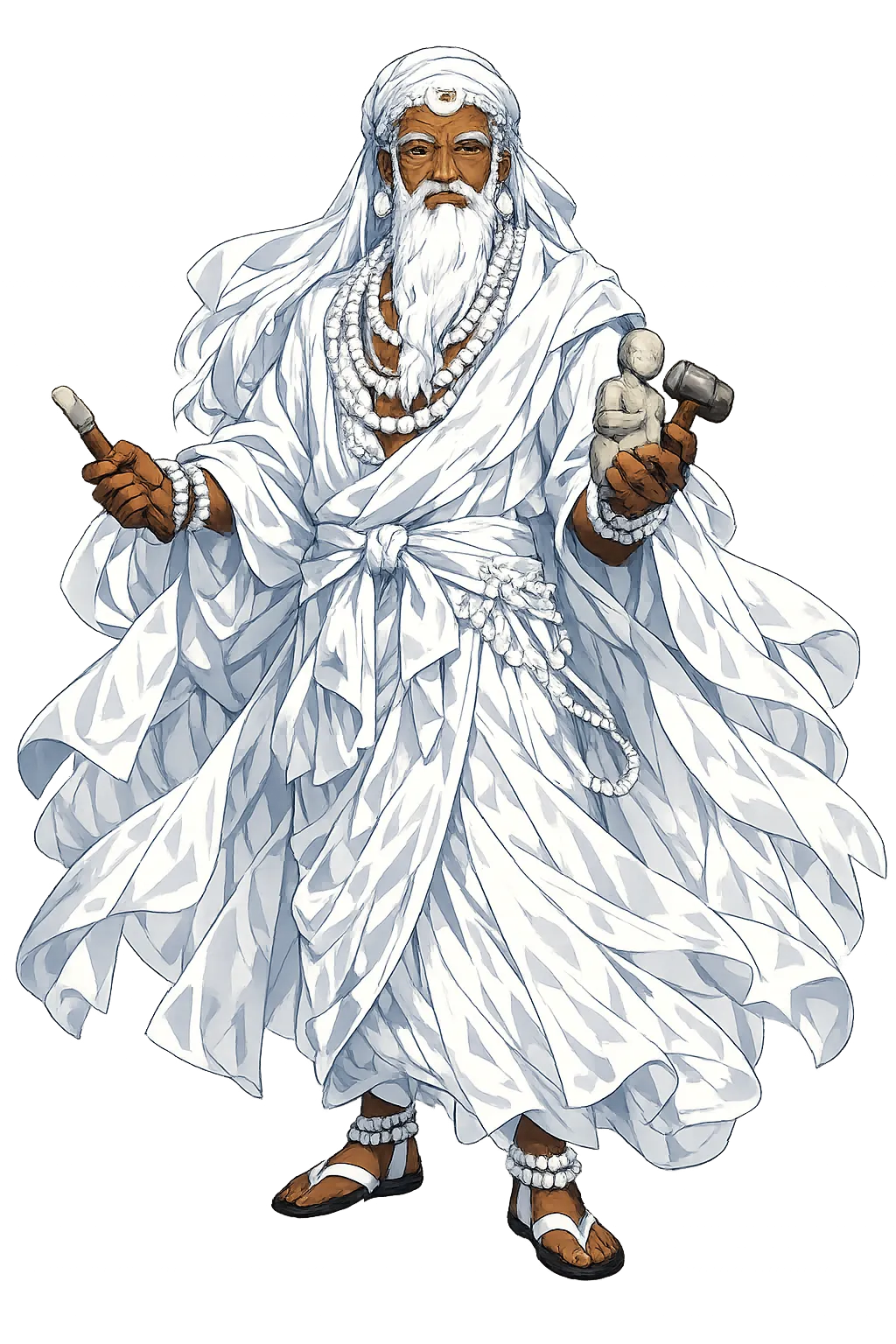
Stories of Ọbàtálá
Ọbàtálá's mythology turns on creation, sobriety, and the cost of pride — preserved in the corpus of Ifá divination poetry (odu), in the oral histories of Ilé-Ifẹ̀, and, across the Atlantic, in the liturgies of Candomblé and Santería, where the details shift with each retelling. He is the elder who knows that making life is more difficult than destroying it.
When Olódùmarè, the supreme God, resolved to people the earth, Ọbàtálá — also known as Ọ̀rìṣànlá, 'the great orisha' — took up the making of bodies. From clay given him by Olódùmarè he moulded each human form with care, and Olódùmarè breathed the emí, the living soul, into what his servant's hands had shaped. But one day, working, Ọbàtálá drank too much palm wine, and the figures he shaped that afternoon came out twisted, incomplete, unfinished. Olódùmarè gave them life anyway, and they remain among us — the disabled, the albino, the differently formed. From that day Ọbàtálá forbade palm wine to all who serve him and took these children of the drunken afternoon as his own, to be honored and never mocked. The myth is told across the Ifá corpus and the diaspora; its point is exact — even the maker's failure is gathered into the design, and the people the world calls broken are the ones heaven claims first.
Yoruba cosmogony tells that Olódùmarè once charged the orishas with creating solid earth from the primordial waters, giving them a chain, a hen, and a bag of sand for the work. The mission fell to Ọbàtálá, who climbed down the chain — but paused on the way, drank palm wine, fell into sleep, and dropped the bag of sand. Odùduwà, coming after, caught it, scattered the sand upon the waters, and set the hen to scratching: where the hen scratched, the first dry land rose, and on it Odùduwà founded Ilé-Ifẹ̀, the city of origin from which the Yoruba kingdoms descend. The sources disagree on details — some traditions name Ọbàtálá as the intended creator, others give the mission to Odùduwà from the first — and the rivalry between elder orisha and founding king became a standing theme of Ifá poetry. The myth encodes history as well as theology: Ifẹ̀'s supremacy is not brute primacy but a succession debated, remembered, and argued over in verse for a thousand years.
In many odu of Ifá, Ọbàtálá is the eldest of the orishas, the one who remembers the beginning of things. He takes no part in the thunder and river-drama of the younger powers; his authority rests on age, whiteness, and the fact that every human body was once clay in his hands. When kings fail and war-gods have exhausted themselves, the Ifá verses send the supplicant to Ọbàtálá — the orisha of the second chance, consulted when force has failed and only patience remains. His priesthood keeps among the strictest disciplines in Yoruba religion: white cloth, cool water, no palm wine, no raised voice. The mythology's quiet argument is that in a pantheon of spectacular powers, the eldest power is the unspectacular one — clarity, slowness, and the refusal to be provoked, worn like white cloth in a loud world.
Ọbàtálá's stories turn on arrogance and its correction. In one widely told narrative, a man mocked a cripple in the marketplace; Ọbàtálá, whose children the mocker had laughed at, afflicted him with confusion until he crawled to the orisha's shrine to beg pardon. In others the proud lose their speech or find their limbs frozen mid-gesture until restitution is made. The punishment always fits the offense with uncomfortable precision: those who mocked the imperfect are made imperfect; those who despised the slow are halted. His justice is cool, deliberate, and inescapable — the mythic face of the Yoruba ideal of ìtẹ̀lọ́rùn, the patient, cool heart, which counts calm as strength and impatience as a disease of character. The myth is a warning aimed at the able-bodied: the body's completeness is a loan, not a possession.
Carried across the Atlantic in the holds of slave ships, Ọbàtálá was reborn as Oxalá, the white-clad father of the Candomblé nations of Brazil, and as Obatalá of Cuban Santería. In diaspora cosmogony the creation story is retold with new economy: Oxalá descends to make the world, pauses to rest — and wakes to find the work done, or done wrongly, by another orisha; his white garments become the first light. Brazilian liturgy divides him into two paths of one power: the aged, endlessly patient Oxalá and the youthful, quick-tempered Oxaguiã. Cuban houses honor Obatalá with white beads and cool water on quiet altars, syncretised in Catholic imagery with the white-robed Christ. The myth's endurance across the Middle Passage is itself its meaning: a god of gentle hands survived the century that tried to break every hand that carried him.
Creation, Purity, and Peaceful Judgment
Ọbàtálá is the orixá who shapes humanity. While Olódùmarè breathes the soul into the body, Ọbàtálá is the sculptor who moulds the limbs, the one whose hands first pressed cool clay into human form. He is the eldest of the orishas in many accounts, the patron of white cloth, purity, peace, and the aged. His voice is soft, his judgments slow, and his anger terrible precisely because it is so rare.
He is also the guardian of those whom the world calls imperfect: the disabled, the deformed, the albino. In Yoruba thought, these are not mistakes; they are Ọbàtálá's own children, marked by his hand.
He moulds human form from earth; Olódùmarè alone gives it breath.
Spotless garments, white beads, and cool water mark his altars and his devotees.
He settles disputes with patience; his curses fall on the unjustly proud.
The disabled and the elderly are his special children; harming them offends him directly.
From the original script to the living URL
Ọbàtálá
The name in its original Yoruba form. Ọbàtálá (Ọbàtálá) is attested in the source tradition — “King of the white cloth”. Its acute stress marks carry the full phonetic and orthographic weight of the source tradition.
obatala
Reduced to plain obatala, the name loses everything that made it specific: acute stress marks. What remains is an ASCII string that machines can parse but that no longer speaks with its original voice.
Ọbàtálá
The Unicode restoration recovers what ASCII flattened. Ọbàtálá restores acute stress marks, returning the name to its original written dignity. The domain encodes to Punycode, but the browser displays the truth.
Ọbàtálá.com → xn--btl-9kagb8274c.com
The non-ASCII characters in Ọbàtálá are encoded while the ASCII remains visible. To the DNS, it is Punycode. To humanity, it is Ọbàtálá.
Owned, ideal, and ASCII forms of Ọbàtálá
Ọbàtálá
Restores Ọbàtálá. The live temple domain — ọbàtálá.com.
obatala
Flattens Ọbàtálá. The plain ASCII fallback — what DNS and legacy systems see.
How Ọbàtálá was spoken
How Ọbàtálá travels from ancient script to the modern URL
Yoruba theonym of the great white orisha, the molder of human bodies (from ọ̀bà àtàlá, often glossed as lord of the white cloth).
Creation, purity, peace, patience; the sky-white elder of the orisha.
The owned form Ọbatálá keeps the underdot and the two high tones; the low tone on ba is documented in the variants.
The lore you have read is the living myth. Extended Lore opens the scholarly vault beneath it: the cult and its material remains, a history of the image, the name after antiquity, a meditation on what the name still means, and the full scholarly apparatus — etymology, orthography, sources.
Enter Extended Lore