The Living Myth
River, Devotion, Sanctuary · The river orisha Ọba — co-wife of the thunder god, lady of the sacred waters
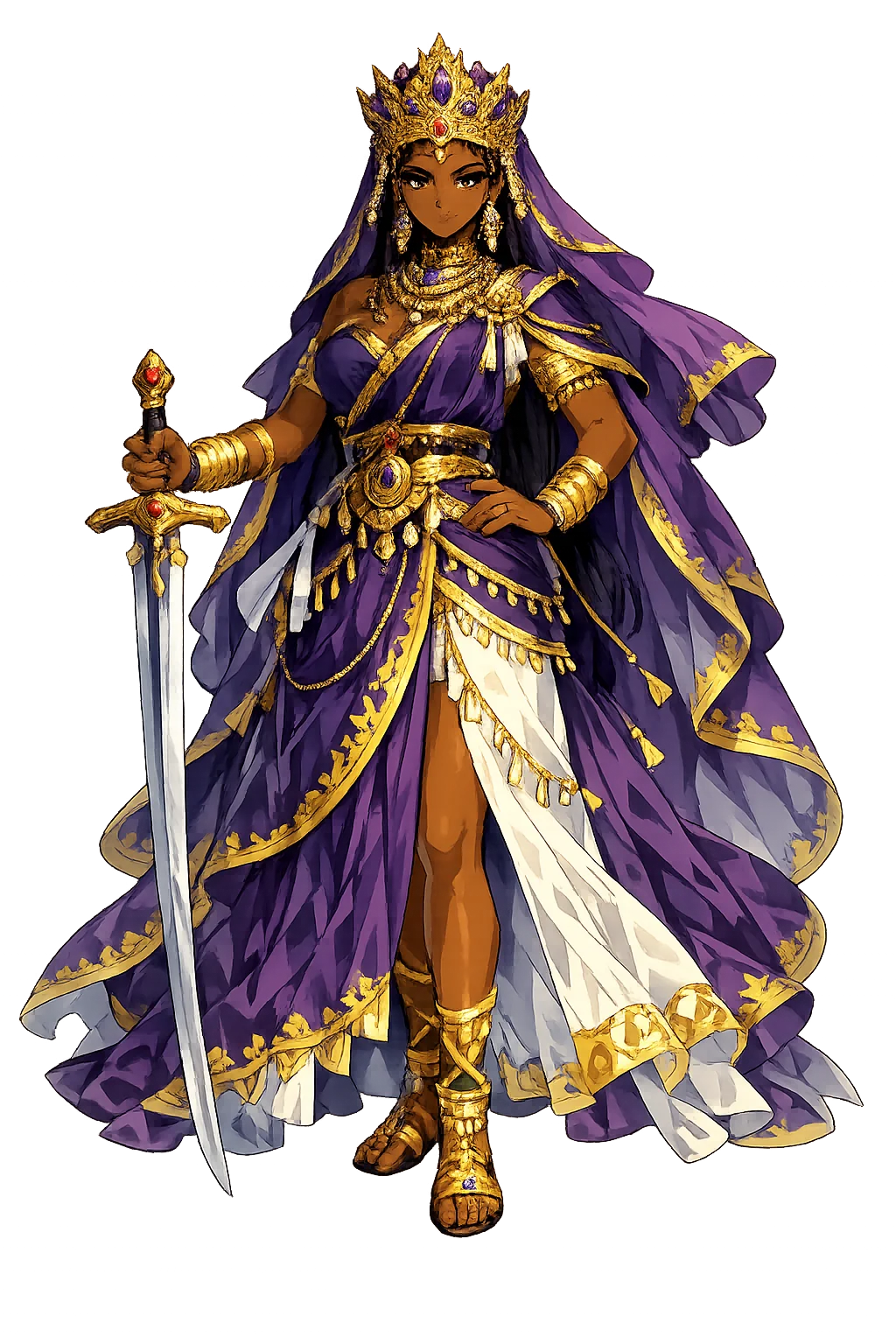
Stories of Ọbà
Ọba's myths are domestic tragedy told as hydrology: the co-wife's war that became a river and a lake. The cycle survives in Yoruba oral tradition — oríkì praise-poetry and the folktale corpus recorded by Bascom and others — and crossed the Atlantic to become the diaspora's parable of the polygamous household.
Ṣàngó, the thunder-king, took three river-wives: Ọba the senior, Ọṣun the beloved, and Ọya the storm-sharer. The cycle survives in the oríkì praise-poetry and the folktale corpus recorded by Yoruba specialists from the mid-twentieth century — Wande Abimbola's editions of Ifá verse, William Bascom's collections of tales — and in the diaspora the three wives became the standard cast of every household drama. The tellings agree on the shape: Ọba, the first wife, watched her husband's love flow downhill to Ọṣun, and love that is watched curdles into jealousy. In the fullest tellings Ọba schemed against Ọṣun — and Ọṣun, the shrewdest of the household, let the scheme come to her first and answered it with one that would end the rivalry. The seniority that should have protected Ọba is exactly what the story burns: in the thunder-king's house, the first wife is the last to be believed, and the household's peace is purchased with her humiliation.
The trap is the cycle's most famous scene, preserved in the folktale collections (Bascom, African Folktales) and endlessly retold in the diaspora. Ọṣun — in some tellings Ọya — let fall that the king loved, above all things, the taste of his beloved's ear in his soup. Ọba, desperate to be loved again, cut off her own ear and cooked it for him. When the bowl came before Ṣàngó and the trick stood revealed, his disgust and rage drove her from the palace; the co-wives laughed, and Ọba fled north weeping, her maimed head hidden under her crown and her hair. The sources disagree on which co-wife set the trap and on how much of the truth Ṣàngó ever learned — the oral tradition keeps the variants alive rather than settling them. What every telling keeps is the ear: the organ of obedience, cut off to buy a love that was never for sale. The myth is the Yoruba anatomy of jealousy — not the villain's punishment, but the victim's self-mutilation, and the crown she designed afterward to live with it.
Her tears became her realm. In the tellings, Ọba's flight ended in the water that still bears her name: the Ọba River of Yorubaland, and the lake of her worship, where her priests keep her cult and the faithful mourn with her on her appointed days. The geography is the theology — a goddess exiled from the palace takes the river as her palace, and the quiet water outlasts the thunder. The tradition preserves one firm ritual rule from the household war: Ọba and Ọya, the senior wife and the storm-sharer, can never be honored in the same shrine; some quarrels the orisha themselves decline to reconcile. But her people read the ending differently than the palace did: storms pass, the river stays. The senior wife outlasted the storm-god's louder wives by becoming the thing the storm cannot be — permanent, low, and always arriving.
The wives' cycle crossed the Middle Passage with the orisha, and in the Americas it acquired its second life. In Cuba's Santería she is Obá, syncretized with Santa Catalina de Alejandría — whose wheel she shares, and whose feast day, 25 November, became hers; her cult proved strongest in Matanzas province, where her initiates arrange the hair forward over the ears exactly as she arranged hers, the gesture intact across four hundred years and an ocean. In Brazil's Candomblé, Obá keeps her river and her covered ear, and the three-wives drama remains the standard parable told to explain the polygamous household's wars and survivors. Robert Farris Thompson documented how thoroughly the diaspora kept her iconography — the hidden ear is legible in Lucumí altars from Havana to Miami. The crossing is itself the last episode of the myth: the wife the palace expelled became the orisha the ocean could not drown, carried in the hair of women who had lost everything else and still arranged it, forward, covering, dignified.
Devotion, Jealousy, and the Lake of the Co-Wife
Ọba is the river orisha who loved and lost: the senior wife of Ṣàngó, whose jealousy cost her an ear and whose grief became a lake. She is the Yoruba study of endurance — the quiet river that outlasts the storm-god's louder wives, and whose crown was redesigned to hide, and honor, the wound at once.
Her water in Yorubaland — the stream that bears her name and her temperament, quiet where the storm-wives are loud.
The ear she lost to the co-wives' trick — hidden under her crown and her hair, which is why her images never show the ears.
The first wife of the thunder-king — and the last to be believed when the household turned cruel.
Her grief made geography: the lake where the faithful still mourn with her, season after season.
From the original script to the living URL
Ọbà
The name in its original Yoruba form. Ọbà (Ọbà) is attested in the source tradition — “The river orisha Ọba — co-wife of the thunder god, lady of the sacred waters”. Its original diacritics and script distinctions carry the full phonetic and orthographic weight of the source tradition.
oba
Reduced to plain oba, the name loses everything that made it specific: original diacritics and script distinctions. What remains is an ASCII string that machines can parse but that no longer speaks with its original voice.
Ọbà
The Unicode restoration recovers what ASCII flattened. Ọbà restores original diacritics and script distinctions, returning the name to its original written dignity. The domain encodes to Punycode, but the browser displays the truth.
Ọbà.com → xn--b-sfa590u.com
The non-ASCII characters in Ọbà are encoded while the ASCII remains visible. To the DNS, it is Punycode. To humanity, it is Ọbà.
Owned, ideal, and ASCII forms of Ọbà
Ọbà
Restores Ọbà. The live temple domain — ọbà.com.
oba
Flattens Ọbà. The plain ASCII fallback — what DNS and legacy systems see.
How Ọbà was spoken
How Ọbà travels from ancient script to the modern URL
Yoruba theonym of the river orisha Ọbà, wife of Ṣàngó, patron of devotion and sanctuary.
River, devotion, sanctuary, steadfast love; the senior wife of Ṣàngó.
The owned form Ọba keeps the underdot; the final low tone is documented in the variants.
The lore you have read is the living myth. Extended Lore opens the scholarly vault beneath it: the cult and its material remains, a history of the image, the name after antiquity, a meditation on what the name still means, and the full scholarly apparatus — etymology, orthography, sources.
Enter Extended Lore