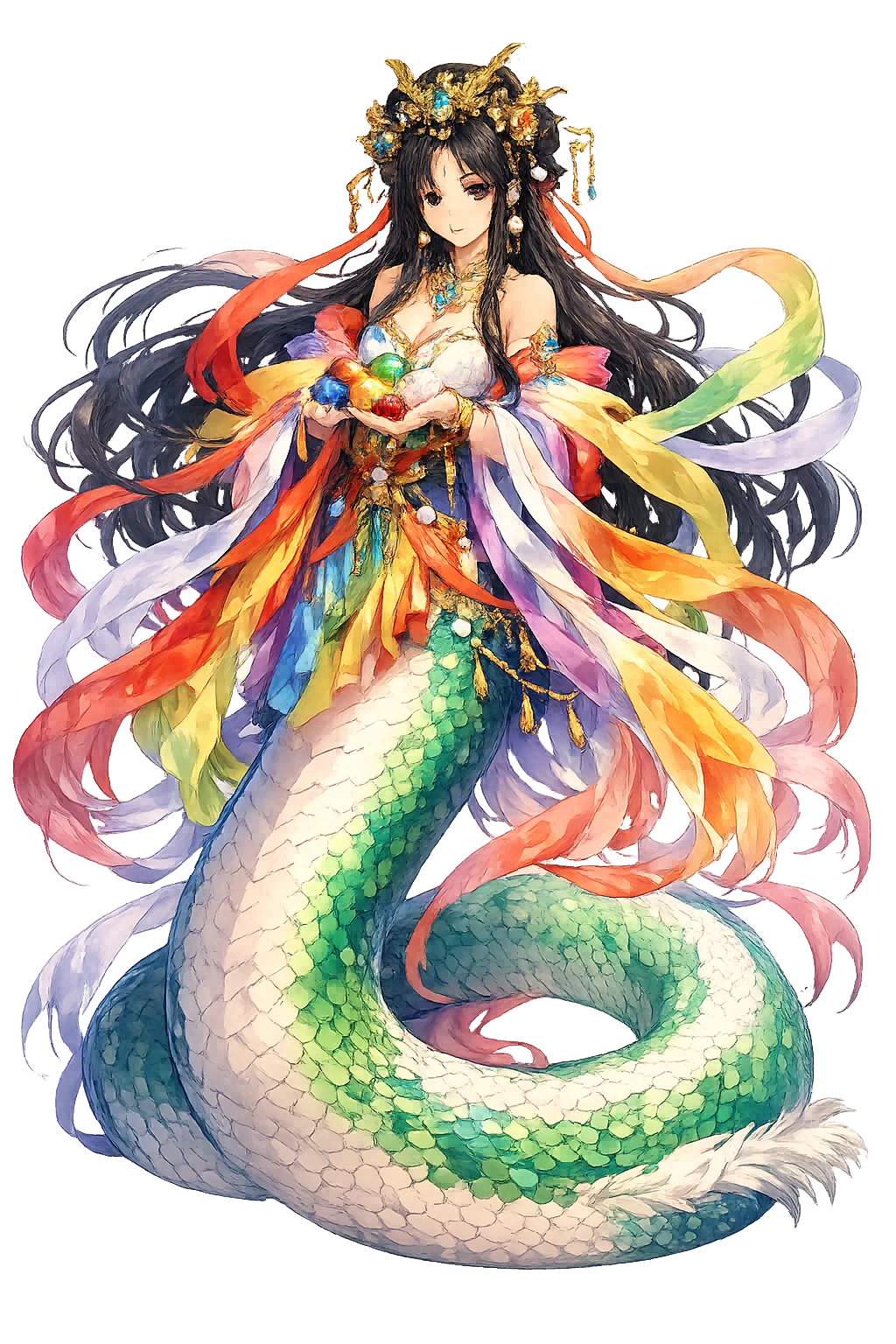
Stories of Nǚwā
Nǚwā's myths answer the two great questions — where people came from, and why the sky holds — and a third the tradition added later: what happens when the whole human race must begin again. They are told in the earliest strata of Chinese myth and never improved upon.
The Huáinánzǐ (ch. 6, the Lanming xun, c. 139 BCE) tells it in the grammar of catastrophe: in high antiquity the four pillars snapped and the nine provinces split; fire blazed unquenched, waters rose undrained; fierce beasts devoured the people and birds of prey seized the old and weak. Then Nǚwā acted, and the text lists her works like an engineer's report: she smelted stones of five colors to patch the azure sky; cut the legs from the great turtle to set the four pillars true; slew the black dragon to deliver Jì province; and heaped reed-ashes to dam the flooding waters. Then — and only then — 'the people of the four quarters could set foot on the land again', and the cunning beasts went quiet. Nothing in the passage is creation from nothing: heaven is mended with worked matter, propped with sacrifice, and drained with humble ash. The oldest Chinese creation story is a repair manual, and its author is a goddess with a craftsman's hands.
The gentler myth survives in quotation from Ying Shao's Fengsu Tongyi (c. 195 CE): when sky and earth had opened and there were not yet people, Nǚwā knelt by the Yellow River and shaped human beings from yellow clay. The work delighted but wearied her — so she trailed a rope through the mud and flung the drops loose, and the drops too became people. The handmade figures became the rich and noble; the rope-flung drops, the poor and common — China's oldest surviving reflection on how inequality began, set inside its tenderest creation story. Note what the myth refuses to do: it does not blame the poor for their fortune or flatter the rich for theirs. Both were made by the same hands in the same afternoon; the difference is only which instrument touched them. Two thousand years before the word existed, the tradition was teaching that class is an accident of the tool.
Having made people singly, she made them continuous. The Fengsu Tongyi continues: Nǚwā prayed at the shrine of the go-between, asking to become the divine matchmaker (Gāoméi), and so established marriage and its rites — so that humanity could reproduce itself without her kneeling by the river forever. The tradition therefore names her among the Three August Ones: progenitor, legislator, and engineer in one. Her strangest attestation is older still: the Shan Hai Jing ('Dahuang xijing') names ten spirits who dwell in the wilderness of Lìguǎng and calls them 'the intestines of Nǚwā, transformed into gods' — a fragment so archaic that the commentators have debated it for two millennia. Marriage and statecraft, clay and catastrophe, and one unglossable line about what a goddess leaves behind in the world: the sources give us a figure complete and still, after all this time, unexplained.
The tradition's later stratum sends the flood. When the waters drowned the world, only Fúxī and Nǚwā remained, brother and sister sheltering on Mount Kunlun — and the human race hung on their decision. They wished to marry and continue the line, but hesitated: were they not siblings? So they put the question to heaven itself. The fullest surviving version comes down through quotation from the Tang collection Duyi zhi (Li Rong, 9th century): each climbed a separate peak and kindled a fire, resolving that if the two smokes joined as one, the marriage was approved. The smokes mingled in the sky. They married, and Nǚwā bore — not children but a ball of flesh; ashamed, she cut it into pieces and scattered them, and the pieces became the peoples of the world. The myth is startling for its honesty: heaven's consent is asked, the body is divided to make the nations, and the founding marriage of humanity is a marriage that had to be permitted. Even the gods, it says, do not waive the need to ask.
The Five-Colored Stones, the Clay, and the First People
Nǚwā is the great repairer: the goddess who melted five-colored stones to patch the broken sky, cut off the giant turtle's legs to prop the corners of the world, and — on a quieter day — knelt by the Yellow River and made the first human beings out of mud.
Melted and poured into the sky's wound — the world's first and greatest repair, one stone left over (the seed of Dream of the Red Chamber).
Her form in Han art: human head, serpent body — earth's maker in earth's image, twined with Fúxī.
The rich she shaped by hand, the poor she flung from a rope — humanity's two fortunes, told without flinching.
She prayed to become the matchmaker and instituted marriage — society's first legislator, outsourcing creation to love.
From the original script to the living URL
女媧
The name in its original Chinese form. Nǚwā (女媧) is attested in the source tradition — “Woman wa”. Its macron-length vowels carry the full phonetic and orthographic weight of the source tradition.
nuwa
Reduced to plain nuwa, the name loses everything that made it specific: macron-length vowels. What remains is an ASCII string that machines can parse but that no longer speaks with its original voice.
Nǚwā
The Unicode restoration recovers what ASCII flattened. Nǚwā restores macron-length vowels, returning the name to its original written dignity. The domain encodes to Punycode, but the browser displays the truth.
Nǚwā.com → xn--nw-ela08f.com
The non-ASCII characters in Nǚwā are encoded while the ASCII remains visible. To the DNS, it is Punycode. To humanity, it is Nǚwā.
Owned, ideal, and ASCII forms of Nǚwā
Nǚwā
Restores 女媧. The live temple domain — nǚwā.com.
nuwa
Flattens 女媧. The plain ASCII fallback — what DNS and legacy systems see.
How Nǚwā was spoken
How Nǚwā is preserved in writing
A bespoke provenance study for Nǚwā is being prepared by the PUNICODEX scholarly team.
Contribute scholarly provenance →The lore you have read is the living myth. Extended Lore opens the scholarly vault beneath it: the cult and its material remains, a history of the image, the name after antiquity, a meditation on what the name still means, and the full scholarly apparatus — etymology, orthography, sources.
Enter Extended Lore