PuniCodex

Extended Lore

女媧 Nǚwā

Etymology · Orthography · Cult · Iconography · Reception · Sources

Tier 1 Nǚwā.com
Nǚwā — Creation, Mending Heaven
01

Quick Facts

Essential information about Nǚwā, Creation, Mending Heaven

Original Script女媧
Unicode RestorationNǚwā
Reconstructed Pronunciation/ny˨˩˦ wa˥/
PantheonChinese
DomainCreation, Mending Heaven
MeaningWoman wa
ClassificationTier 1
Primary DomainNǚwā.com
Sacred SymbolsThe five colors, The compass, The turtle's legs, The rope of mud, The stone she did not use
02

Etymology & Word Family

From original script to Unicode restoration

Original Script 女媧 Nǚwā — "Woman wa"
Unicode Restoration Nǚwā Restored stress, length, and script
Modern ASCII nuwa Plain-ASCII fallback

The name Nǚwā carries the orthographic signature of the chinese tradition: 女媧. Unicode restoration recovers what ASCII flattens.

03

Unicode Character Breakdown

Character-by-character philological analysis

CharacterUnicodeNameBlockPhonetic Role
NU+004ELatin Capital Letter NBasic LatinSame, capitalized
ǚU+01DALatin Small Letter U with Diaeresis and CaronLatin Extended-BStress on u
wU+0077Latin Small Letter WBasic LatinSame
āU+0101Latin Small Letter A with MacronLatin Extended-ALong vowel

The Tier 1 classification reflects how much of the original phonology this restoration preserves — stress and vowel length for Greek names, distinctive letters and diacritics for every other tradition.

04

Cult & Worship

How the sacred was kept — rites, sanctuaries, remains

The Cult

Nǚwā's cult is a late-built house on early foundations. The texts know her from at least the second century BCE — the Huáinánzǐ presumes every reader knows who mended the sky — but no Zhou or Han sanctuary of hers is attested; the textual archaeology is far richer than the ritual one. The standing cult crested in the medieval and Ming-Qing rebuilding age. Its capital is the Wāhuáng Palace at Shèxiàn, Hebei — pavilions chained to a red cliff above the Zhāng River, founded under the Northern Qi in the sixth century and rebuilt repeatedly — where she reigns as 'August Wa' and the spring crowds come to ask, above all, for children; her cliff is hung with the locks and ribbons of petitioners, and opera shares the fairground. Huaiyang's Ancestor Deities temple in Henan couples her altar with Fúxī's. The rite's logic follows her myths exactly: she who shaped the first people from riverside clay is the natural first address of every childless household — creation, in her case, did not stop at the world's beginning; it is re-contracted every spring at her cliff.

In the Earth

The Wahuang Palace at Shexian — pavilions chained to a cliff above the Zhang River, founded in the Northern Qi dynasty (6th century) — is her principal surviving sanctuary and one of China's architectural marvels. Han pictorial stones pair her with Fúxī from Shandong to Sichuan; the Astana cemetery silk banner carried the image to the Silk Road's far end. Her myth's textual strata are mapped from the Huáinánzǐ (139 BCE) backward into Warring States fragments and forward into the Tang flood-cycle accounts.

05

Iconography

How Nǚwā was imaged across the ages

The Image

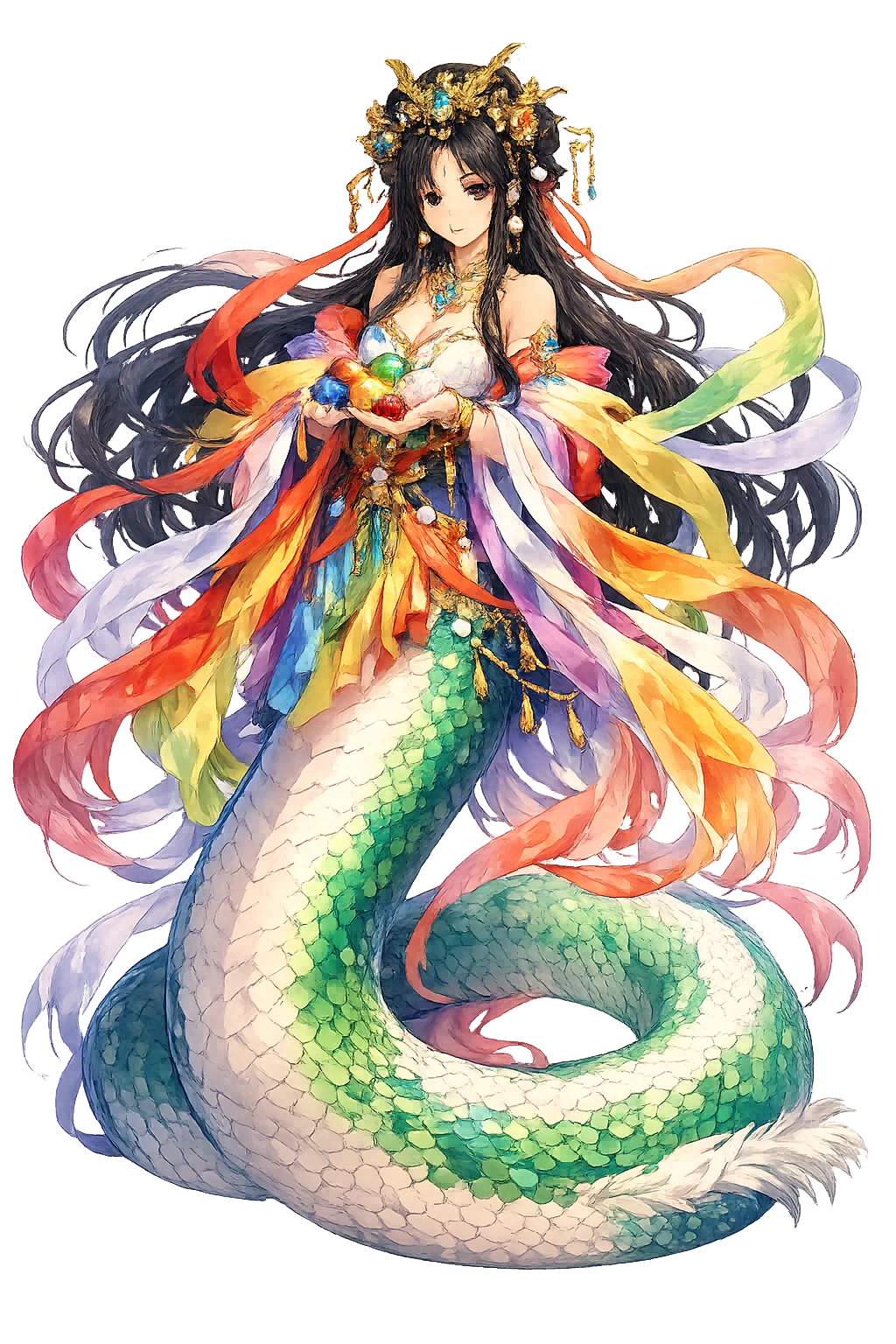
Nǚwā's first portraits are Han, and they chose the snake for her. The second-century pictorial stones — the Wu Liang shrine is the locus classicus — show the primal pair with human heads and braided serpent tails, Fúxī's square against her compass: earth's measure and heaven's in one image. Tang tomb banners from Astana carry the pair to the Silk Road's end, each deity crowned with its cosmic lamp, sun against moon. The iconography is strangely stable for so strange a body: three centuries of stones and silks repeat the same entwined silhouette, the same instruments. Then, as with Fúxī, the tail was shed. In later temple sculpture and New-Year prints she is wholly woman — a serpent's coil sometimes retained at the hem as a badge — and her tools become her story: five-colored stones in a crucible, a rope of mud, the great turtle's severed legs standing like columns. The Qing popular print tradition made her the most recognizable creatrix in Chinese folk art: a lady of court robes, calmly repairing a cracked sky.

06

Reception & Transformation

The name after its own age — transmission, translation, survival

Afterlives

Nǚwā's transmission begins in fragments and never stops being reassembled. The Huáinánzǐ of 139 BCE gave her the sky-mending in full; Ying Shao's Fēngsú Tōngyì, a century later, preserved the clay-creation from sources now lost; and Tang miscellanies kept the flood-marriage alive — each stratum quoted by the next, since almost everything about her survives in quotation. The Song antiquarians then matched text to image: the Wu Liang stones they walked and catalogued showed the serpent-bodied mender exactly as the classics described, and the Ming print trade fixed her portrait in every province's New-Year stock. The novel sealed her canonical afterlife: Cáo Xuěqín's Dream of the Red Chamber opens with the single stone she rejected, making her surplus the seed of China's greatest book — and 'Nǚwā mends the sky' the standing idiom for heroic repair, applied ever since to engineers, surgeons, and statesmen. The twentieth century re-read her twice over: the myth-historical school of Gù Jiégāng dissolved her into legend-layers, while archaeology made her the unofficial emblem of the Neolithic dawn, and feminist scholarship claimed the serpent-bodied mender as China's buried mother-goddess, restoring to her the priority the classical texts had always given her hands.

Identifications Across Traditions

She pairs with Fúxī as sister-wife in the Han synthesis — their intertwined serpent bodies, compass and square in hand, form the canonical image of cosmic order on tomb stones from Shandong to Sichuan — and she absorbs older creation figures as the myth spread south and north. Daoist tradition adopted her without difficulty: a goddess who mends heaven and authorizes marriage fits a canon of celestial bureaucracy. Modern readers note her kinship with every world-mother from Gaia to the Navajo Changing Woman, but the Chinese tradition keeps her distinct signature: she is not just a mother but a repairer, the goddess of maintenance. And the novel Dream of the Red Chamber completed her canonization in literature, making the one stone she rejected for the sky the seed of China's greatest book.

Modern Legacy

Her stones became literature: the great novel Dream of the Red Chamber (Hónglóu mèng) opens with the one stone Nǚwā rejected for the sky — the stone that becomes the hero's jade and the book itself. 'Nǚwā mends the sky' is the standing idiom for heroic repair; engineers, surgeons, and diplomats are all praised with it. Temples to her survive across North China — Shexian's cliff-hanging Wahuang Palace in Hebei is the grandest — where she is still prayed to for children. Her name entered the language twice over: as Wāhuáng, the August Wa, and in the everyday compliment of the mender of any broken thing.

07

The Meditation

What Nǚwā means — beyond the dictionary

Nǚwā is the goddess of the second day — the one after the catastrophe. Creation, in her myth, is not a single word but a continuous mending: sky patched, pillars reset, people shaped and taught. She asks the question every survivor, every parent, every civilization must answer: the world broke once; what, with your own two hands, have you repaired?

The rope and the handmade figures remain the tradition's quiet self-critique: some are shaped with care, some flung from a rope — and the goddess who made both is the one who mends the sky for all of them. Repair is her gospel and her rebuke: the world will break — pillars snap, heavens leak — and the measure of the maker is not the first creation but the mending. She is, for every restorer, nurse, and engineer of last resort, the patron of the second day.

08

Frequently Asked Questions

Common questions about Nǚwā, Creation, Mending Heaven, and Unicode restoration

01How do you pronounce Nǚwā?

In reconstructed pronunciation, Nǚwā is /ny˨˩˦ wa˥/ — approximately nyoo-wah, low-dipping tone on Nǚ, high level on Wā.

02What does Nǚwā mean?

Nǚwā means Woman wa in the chinese tradition.

03What are the symbols of Nǚwā?

Nǚwā is associated with The five colors (The five phases (wood, fire, earth, metal, water) — the sky rebuilt in cosmic order), The compass (Her emblem in Han art, paired with Fúxī's square — heaven's measure in her hand), The turtle's legs (The four pillars she cut and set — sacrifice repurposed as architecture), The rope of mud (Her tool of mass creation — and the myth's blunt explanation of why fortunes differ), The stone she did not use (The one stone left over after the mending — the stone that becomes the jade of Dream of the Red Chamber and the book itself).

04Why restore Nǚwā in Unicode?

Plain ASCII nuwa strips the stress, length, and script that make the name specific. Unicode restoration returns the name to its original written dignity.

05What is the most important myth about Nǚwā?

“The Mending of the Sky” — the The Catastrophe story that anchors the mythology of Nǚwā, told in full on the lore page.

09

Scholarly Sources

The philological foundations of this restoration

Every claim on this page is grounded in established scholarship. The orthographic restorations follow disciplinary convention. The etymological chain follows the best available reference works. This is not invention — it is resurrection through scholarship.

◈

Lexicography & Philology

  • Shan Hai Jing
  • Chinese classics
◎

Primary Texts

  • Primary sources in the chinese tradition for Nǚwā.
◉

Archaeology & Art History

  • Material evidence — iconography, inscriptions, and temple archaeology — for Nǚwā and related cults.
✦

Religious Studies

  • Huainanzi, ch. 6 (Lanming xun)
  • Shan Hai Jing, 'Dahuang xijing' (ch. 16)
  • Ying Shao, Fengsu Tongyi (c. 195 CE), preserved in quotation
  • Li Rong, Duyi zhi (Tang dynasty), fragmentary
  • Birrell, Anne, Chinese Mythology: An Introduction (1993)
  • Yuan Ke, Dragons and Dynasties: An Introduction to Chinese Mythology (1993)
Return

The Surface Awaits

You have traced the name from its earliest attestation to its Unicode restoration. Now return to the myth. The story is where the name lives.

Back to Lore
Nǚwā mascot