
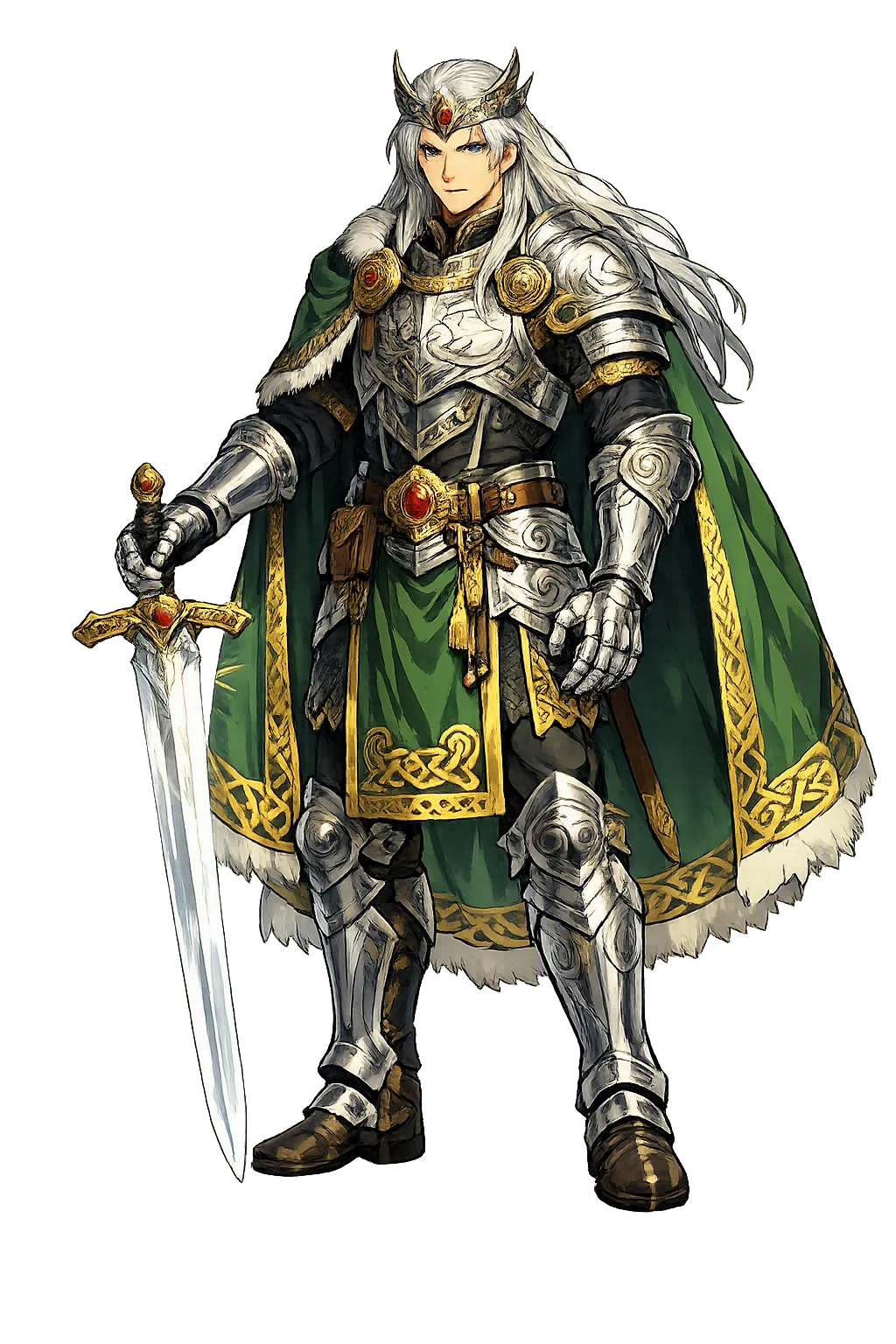
Why Nuada belongs in the scholarly record
A name can be complete without carrying a single diacritic. Nuada is a canonical scholarly spelling, not a damaged form waiting for decoration. This post follows the evidence behind that spelling: the scholarly record, the reconstructed sound, the myths, the material culture, and the reasons this particular romanization became the public reference. The plain ASCII letters already contain the whole form. The scholarly work is to prove their provenance, preserve their capitalization, and keep the name attached to its history.
At a Glance
- Canonical name: Nuada
- ASCII form: nuada
- Meaning: "Cloud-maker, hunter"
- Domain of influence: War, King of Tuatha
- Pantheon: Celtic
- Restoration: ASCII-equivalent form
Overview
Nuada (nuada) — War, King of Tuatha · Cloud-maker, hunter — belongs to the Celtic tradition, where it is catalogued under the domain "War, King of Tuatha". The name means "Cloud-maker, hunter".
Nuada Airgetlám is the first king of the Tuatha Dé Danann in Ireland — the ruler who lost his arm at the First Battle of Mag Tuired, lost his throne to the law that a blemished man cannot be king, and won both back through the physicians' craft: first the silver arm that named him, then the living arm that restored him. His sword from Findias was one of the Four Treasures of his people, and he died at the Second Battle of Mag Tuired at the hands of Balor of the Evil Eye.
PuniCodex records the canonical scholarly spelling Nuada and serves its temple at its temple. The displayed form is ASCII-equivalent — a description computed from the displayed form itself. The plain ASCII form nuada contains the same letters: no recovered diacritics or special encoding is claimed. The work here is consistent citation, capitalization, provenance, and cultural context.
The Name
No indigenous written attestation survives for this name; Nuada is a scholarly transliteration of the reconstructed spoken form. Etymologically the name means "Cloud-maker, hunter".
The canonical spelling Nuada matches the conventional scholarly romanization. The plain ASCII form nuada contains the same letters, so no lost diacritics or encoding transition is claimed. The editorial work is to fix one reviewed reference spelling, preserve capitalization and provenance, and keep the original evidence visible. The displayed form is ASCII-equivalent — a description computed from the displayed form itself.
The letter-by-letter transformation runs:
- n → N — Same, capitalized
- u → u — Same
- a → a — Same
- d → d — Same
- a → a — Same
The Original Script
No indigenous writing system is securely attested for individual celtic names. The form shown is a modern scholarly transliteration.
The form Nuada is therefore a scholarly transliteration rather than an attested ancient spelling; it encodes the reconstructed sound of the name for modern use, and no mark in it is decorative.
The attested Old Irish form is Nuadu (later Nuada), written by medieval Irish scribes in the Insular Latin bookhand of the great vellum codices; in the Ogham letter-row the name would have been notched ᚅᚒᚐᚇᚐ (N-U-A-D-A), though no Ogham stone yet found carries it. Because the name is already plain ASCII, its domain was registered decades ago in the ordinary way: nuada.com is held by a third party outside the PuniCodex collection and is watched for release — no form of the name is currently owned, and this temple claims none.
Pronunciation
The reconstructed pronunciation of the name is /ˈnuː.að.u/ — Old Irish Reconstruction.
Phoneme by phoneme:
- N- — Broad alveolar nasal [n̪ˠ], the plain 'n' of Old Irish initial position, unlenited.
- -uːa- — Long close back [uː] gliding into open [a]; the two vowels of Nuadu fall across a syllable boundary.
- -ð- — Lenited d, the voiced dental fricative [ð] — the soft 'th' of 'this', which medieval Irish scribes wrote simply as d.
- -u — Short back [u], the final vowel of the Old Irish nominative form Nuadu.
For the modern speaker, the closest approximation is: 'NOO-ah-oo' — stress the first syllable, hold the 'oo' long, soften the middle d toward the 'th' of 'breathe', and finish on a short 'oo'. Modern English speakers usually say 'NOO-uh-duh'.
Kindred and historical forms of the name:
- Old Irish — Nuadu (later Nuada), byname Airgetlám, 'Silver-hand'
- Middle Welsh — Nudd, and Lludd Llaw Eraint, 'Lludd of the Silver Hand', king of Britain in Lludd a Llefelys
- Gaulish — Nodens (also Nodons, Nudens), the god of the temple at Lydney Park in Gloucestershire
- Modern Irish — Nuadha, the living spelling of the name
Nuada is a plain restoration by the mechanical rule: the attested Old Irish form carries no diacritic and no distinctive letter, so plain ASCII loses nothing. The etymology is honestly uncertain: one proposal reads the name as 'cloud-maker', from a root behind Welsh nudd 'mist'; another, argued by Tolkien for the Gaulish Nodens, connects it to a root meaning 'to catch, acquire' — a fisher or hunter — which would suit the sea-and-hounds imagery of the Lydney temple. Neither is settled, and the temple says so.
Mythology
Nuada's story is the Irish tradition's great parable of kingship and the body: a ruler can be unmade by a single wound and remade by healing, and the law watches both. The record runs from the Lebor Gabála Érenn through the two battles of Mag Tuired, and his Welsh and Gaulish cognates carry the same silver-handed name across the Celtic world.
The First Battle of Mag Tuired (Lebor Gabála Érenn)
When the Tuatha Dé Danann came to Ireland, Nuada had been their king for seven years. They demanded the country from the Fir Bolg, and the two peoples met at Mag Tuired in Connacht. In the battle Nuada fought Sreng, champion of the Fir Bolg, and Sreng struck off his right arm at the shoulder — yet the Tuatha Dé Danann won the field, and the Fir Bolg king Eochaid mac Eirc was driven to his death. The victors then offered the defeated a quarter of Ireland, and the Fir Bolg chose Connacht, which their descendants held. The victory that made the Tuatha Dé Danann masters of Ireland thus cost their king the wholeness the kingship required: one champion's sword-stroke bought a kingdom and unmade its king in the same afternoon.
The Silver Hand and the Hand of Flesh (Lebor Gabála Érenn)
Because a blemished man could not hold the kingship, Nuada yielded the throne to Bres. The physician Dian Cécht, with Credne the brazier, made him a full arm of silver that moved in every joint — whence his byname Airgetlám, Silver-hand. But Dian Cécht's own son Miach went further: he set the severed arm to the stump and healed it 'joint to joint and vein to vein' in thrice nine days. Jealous that the son had outdone the father, Dian Cécht struck Miach dead; from the young healer's grave grew three hundred and sixty-five herbs, which his sister Airmed sorted by their virtues — and which Dian Cécht scattered, so that their full knowledge died with him. Healing, in this cycle, is never free of the wound of envy.
Bres, the Satire, and the Restoration (Lebor Gabála · Cath Maige Tuired)
Bres mac Elatha, half Fomorian by blood, ruled badly: the warriors of Ireland were set to menial labour, hospitality failed, and the poet Cairbre mac Étaíne composed against him what the tradition calls the first satire ever made in Ireland — and Bres's face broke out in blotches. Shamed and deposed, Bres fled to his Fomorian kin and came back at the head of the host that forced the Second Battle. The same law that had unseated Nuada now unseated Bres, for a blemished king could not stand; and with his arm made whole by Miach, Nuada took back the kingship and held it until the war came. The symmetry is exact: one king falls by the body's wound, the other by the wound of the word, and the same unforgiving law of wholeness judges them both.
The Second Battle and the King's Death (Cath Maige Tuired)
At Tara, on the eve of the war, a stranger came to Nuada's hall claiming every skill at once — harpist, warrior, smith, poet, healer — and Nuada, testing Lugh and finding him unmatched, gave the young god his own seat, the champion's seat, to lead the counsel of war. The Second Battle of Mag Tuired was fought against the Fomorians, and there Nuada Airgetlám and Macha his wife fell together at the hands of Balor of the Evil Eye. Balor's own death followed within the hour, Lugh's sling-stone through the destroying eye, and with the two kings' deaths the war ended and the tribute was lifted forever. The first king of the Tuatha Dé Danann in Ireland died in the victory that secured his people's rule; the sword of Findias passed into memory as the measure of a weapon that cannot be withstood.
Symbols & Iconography
The iconography associated with Nuada concentrates in a small set of recurring attributes, each a compressed statement about the name:
- The silver arm — Wholeness made by craft when nature failed — the prosthesis that kept a king king in all but law
- The sword of Nuada — The irresistible weapon from the city Findias, one of the Four Treasures brought to Ireland
- Tara (Temair) — The seat of the kingship of Ireland, which a blemished man could not lawfully hold
- The physician's craft — Dian Cécht's silver-work and Miach's flesh-work — healing as the instrument of sovereignty
- Dog and fisherman (as Nodens) — The hound figurines and sea imagery of the Lydney Park temple, where his Gaulish cognate was worshipped
Archaeology & Evidence
Nuada is textual in Ireland — no inscription names him there — but his Gaulish cognate has one of the best-excavated cult sites in Roman Britain. At Lydney Park, Gloucestershire, overlooking the Severn estuary, a temple complex of the late third and fourth centuries CE was dedicated to Nodens: the Wheelers' excavations (1928–29, published 1932 with Tolkien's philological appendix) uncovered mosaic floors, inscribed slabs reading DEVO NODENTI and D M NODONTI ('to the god Mars Nodens'), bronze dog figurines, a fisherman plaque, and pins and bracelets left as votives — the material of a healing-and-hunting cult. The famous curse tablet of Silvianus, asking Nodens to withhold health from whoever stole his ring until it was returned 'to the temple of Nodens', was found on the site; a gold ring inscribed SENICIANE VIVAS IN DEO, plausibly the very ring, surfaced at Silchester. On the Irish side, the texts are the evidence: the Second Battle of Mag Tuired survives in the sixteenth-century British Library Harley MS 5280, the First Battle in a single late vellum copy edited by Fraser, and the Lebor Gabála in its medieval recensions.
Realm & Domain
Nuada Airgetlám is the first king of the Tuatha Dé Danann in Ireland — the ruler who lost his arm at the First Battle of Mag Tuired, lost his throne to the law that a blemished man cannot be king, and won both back through the physicians' craft: first the silver arm that named him, then the living arm that restored him. His sword from Findias was one of the Four Treasures of his people, and he died at the Second Battle of Mag Tuired at the hands of Balor of the Evil Eye.
The Silver Hand
Dian Cécht's silver arm, made with Credne the brazier, moved in every joint — and gave the king his name, Airgetlám.
The Sword from Findias
One of the Four Treasures of the Tuatha Dé Danann; once it was drawn from its sheath, no one escaped it.
Mag Tuired
The plain of the two battles: against the Fir Bolg, where the arm was lost; against the Fomorians, where the king fell.
The Unblemished Throne
Irish kingship law held that no man with a blemish could rule; Nuada's wound cost him Tara, and his healing restored him.
Across Cultures
Nuada belongs to one of the clearest pan-Celtic name families. In Welsh he is Nudd and, in full form, Lludd Llaw Eraint — 'Lludd of the Silver Hand' — the king of Britain in Lludd a Llefelys, whose byname renders Airgetlám word for word (llaw 'hand', eraint 'silver'). In Gaulish he is Nodens (also Nodons, Nudens), worshipped at the great temple at Lydney Park in Gloucestershire, where Roman dedicants equated him with Mars and where the imagery — hounds, fishermen, the sea — suggests a healer and hunter as much as a warrior. The Romano-British curse tablet of Silvianus, asking 'Lord Nodens' to deny health to the thief of his ring, shows the god working as an enforcer of justice. Scholars (Mac Cana, Koch) reconstruct a Common Celtic Noudont- or Noudo- behind all three, though the root's meaning — 'cloud-maker' or 'catcher, fisher' — remains genuinely debated.
Within the Celtic tradition, closely related names in the corpus include Aengus, Annwn, Arawn, Badb, Balor, and Bedwyr.
Cultural Legacy
Nuada's afterlife runs through scholarship into fantasy. When R. E. M. and T. V. Wheeler published their excavation of the Nodens temple at Lydney Park in 1932, the young philologist J. R. R. Tolkien contributed the appendix 'The Name Nodens', tracing the god's name to a root of catching and acquiring — a fragment of Tolkien's scholarly life that fans of his fiction still chase. In modern Irish the name survives as Nuadha, and Maynooth University's old arms carried Nuada's sword. In popular culture the silver-handed king rides again as Prince Nuada Silverlance in Hellboy II: The Golden Army (2008), and the motif of the magical prosthetic hand — from A Song of Ice and Fire to Japanese fantasy — descends, knowingly or not, from Airgetlám. Modern Celtic pagans honour Nuada as a god of rightful rule, healing, and sovereignty restored.
The Scholarly Record
The account of Nuada given in this edition rests on the witnesses and reference works listed below. Lexica and etymological dictionaries secure the form and meaning of the name; the literary and religious texts supply the narrative evidence.
- Lebor Gabála Érenn (The Book of Invasions of Ireland), ed. and trans. R. A. S. Macalister, Irish Texts Society — the arrival, the First Battle, the silver arm, Miach's healing, and the kingship of Bres.
- Cath Maige Tuired (The Second Battle of Mag Tuired), ed. and trans. Elizabeth A. Gray, Irish Texts Society 52 (1982) — Lugh's coming to Tara and Nuada's death at Balor's hand.
- J. Fraser, 'The First Battle of Moytura', Ériu 8 (1916) — the sole-copy text of the battle against the Fir Bolg and Sreng's stroke.
- Lludd a Llefelys and Culhwch ac Olwen (Mabinogion corpus) — Nudd and Lludd Llaw Eraint, the Welsh silver-hand.
- Mac Cana, Proinsias, Celtic Mythology — the Nuada–Nudd–Nodens name family.
- Koch, John T. (ed.), Celtic Culture: A Historical Encyclopedia — entries on Nuadu, Nodens, and Lydney Park.
- Jackson, Kenneth Hurlstone, The Oldest Irish Tradition: A Window on the Iron Age — the social setting of the kingship and blemish law.
- Wheeler, R. E. M. and T. V., Report on the Excavation of the Prehistoric, Roman, and Post-Roman Site in Lydney Park, Gloucestershire (1932), with J. R. R. Tolkien's appendix 'The Name "Nodens"'.
A Meditation
Nuada is the king of the necessary surrender. The Irish law of the unblemished king looks cruel — a man maimed in his people's victory loses his throne — but the myth refuses both easy readings. It does not mock the law: Bres, who takes the throne, is judged by the same standard and falls to a blemish of the face raised by satire. And it does not abandon the wounded: the whole craft of the physician-gods bends itself to making Nuada whole, first in silver, then in flesh. What the cycle teaches is that sovereignty is not possession but fitness, and fitness can be lost and restored. The silver hand is the emblem of every function that has to be rebuilt after catastrophe: it moves in every joint, it does the work, and it is not the thing it replaces — until Miach's deeper healing shows that even that distinction can be overcome. The king who rules again is not the king who fell. He is the king who was remade.
The Canonical Spelling
Nuada is the canonical spelling used by this temple. The plain ASCII form nuada contains the same letters, so there are no lost diacritics to recover and no special encoding transition to explain. What the temple preserves is the reviewed reference form: capitalization, conventional romanization, original evidence, and a stable place to inspect them. The value here is not added decoration; it is fidelity to the attested record.
Why This Record Matters
Recording Nuada accurately is part of a larger effort to make the web more faithful to the names it carries. This spelling needs no recovered marks; it needs a defensible chain of evidence. The script, sound, myths, and material record converge on the same point: the canonical form is information, and information deserves an address of its own. The temple keeps that address connected to the scholarship that justifies it.
Explore Further
This post is one doorway into the temple. The home page carries the full character breakdown and the ambient canvas; the lore page tells the myths in long form; the Scholarly Edition preserves the sources, pronunciation data, and revision history; and the patron wall supports the restoration directly. For the wider map, browse the Lexicon, explore the Pantheon, or return to the PuniCodex blog.
Related Names
Sources
The full scholarly apparatus — every citation, revision, and review — lives in the Scholarly Edition. Key references for this post:
- Lebor Gabála Érenn (The Book of Invasions of Ireland), ed. and trans. R. A. S. Macalister, Irish Texts Society — the arrival, the First Battle, the silver arm, Miach's healing, and the kingship of Bres.
- Cath Maige Tuired (The Second Battle of Mag Tuired), ed. and trans. Elizabeth A. Gray, Irish Texts Society 52 (1982) — Lugh's coming to Tara and Nuada's death at Balor's hand.
- J. Fraser, 'The First Battle of Moytura', Ériu 8 (1916) — the sole-copy text of the battle against the Fir Bolg and Sreng's stroke.
- Lludd a Llefelys and Culhwch ac Olwen (Mabinogion corpus) — Nudd and Lludd Llaw Eraint, the Welsh silver-hand.
- Lexicon authorities for this entry: Lebor Gabála, MacKillop.