PuniCodex

Extended Lore

Nuada

Etymology · Phonology · Orthography · Cultural Legacy · Primary Sources

Tier 2 Nuada
Nuada — War, King of Tuatha
01

Quick Facts

Essential information about Nuada, War, King of Tuatha

Scholarly TransliterationNuada
Unicode RestorationNuada
Reconstructed Pronunciation/ˈnuː.að.u/
PantheonCeltic
DomainWar, King of Tuatha
MeaningCloud-maker, hunter
ClassificationTier 2
Primary DomainNuada
Sacred SymbolsThe silver arm, The sword of Nuada, Tara (Temair), The physician's craft, Dog and fisherman (as Nodens)
02

Etymology & Word Family

From original script to Unicode restoration

Scholarly Transliteration Nuada Nuada — "Cloud-maker, hunter"
Unicode Restoration Nuada Restored stress, length, and script
Modern ASCII nuada Plain-ASCII fallback

Nuada is Tier 2 by the mechanical rule: the attested Old Irish form carries no diacritic and no distinctive letter, so plain ASCII loses nothing. The etymology is honestly uncertain: one proposal reads the name as 'cloud-maker', from a root behind Welsh nudd 'mist'; another, argued by Tolkien for the Gaulish Nodens, connects it to a root meaning 'to catch, acquire' — a fisher or hunter — which would suit the sea-and-hounds imagery of the Lydney temple. Neither is settled, and the temple says so.

03

Unicode Character Breakdown

Character-by-character philological analysis

CharacterUnicodeNameBlockPhonetic Role
NU+004ELatin Capital Letter NBasic LatinSame, capitalized
uU+0075Latin Small Letter UBasic LatinSame
aU+0061Latin Small Letter ABasic LatinSame
dU+0064Latin Small Letter DBasic LatinSame
aU+0061Latin Small Letter ABasic LatinSame

The Tier 2 classification reflects how much of the original phonology this restoration preserves — stress and vowel length for Greek names, distinctive letters and diacritics for every other tradition.

04

Cultural Significance

From ancient cult to modern Unicode

Ancient Domain

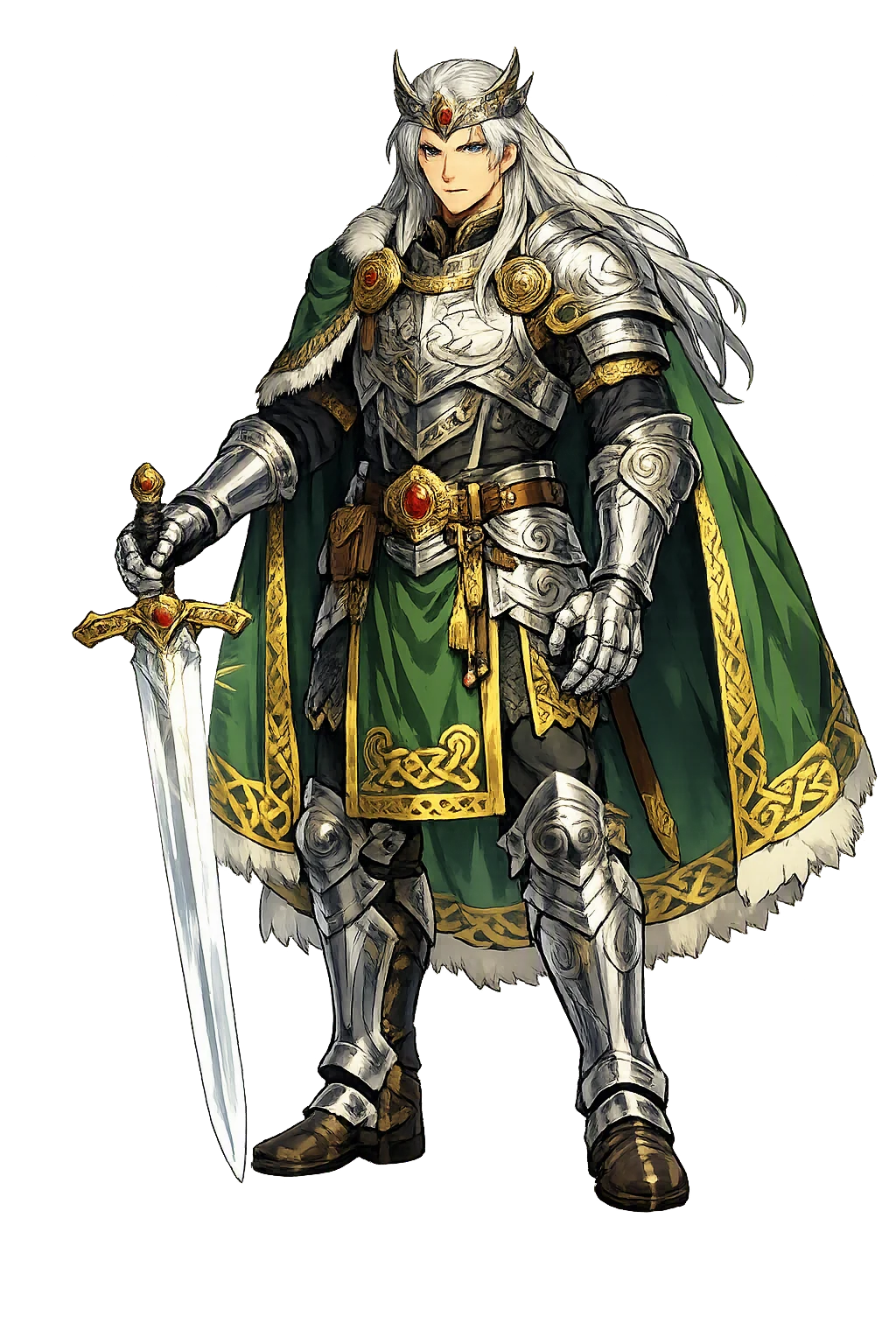
Nuada Airgetlám is the first king of the Tuatha Dé Danann in Ireland — the ruler who lost his arm at the First Battle of Mag Tuired, lost his throne to the law that a blemished man cannot be king, and won both back through the physicians' craft: first the silver arm that named him, then the living arm that restored him. His sword from Findias was one of the Four Treasures of his people, and he died at the Second Battle of Mag Tuired at the hands of Balor of the Evil Eye.

Nuada in Later Traditions

Nuada belongs to one of the clearest pan-Celtic name families. In Welsh he is Nudd and, in full form, Lludd Llaw Eraint — 'Lludd of the Silver Hand' — the king of Britain in Lludd a Llefelys, whose byname renders Airgetlám word for word (llaw 'hand', eraint 'silver'). In Gaulish he is Nodens (also Nodons, Nudens), worshipped at the great temple at Lydney Park in Gloucestershire, where Roman dedicants equated him with Mars and where the imagery — hounds, fishermen, the sea — suggests a healer and hunter as much as a warrior. The Romano-British curse tablet of Silvianus, asking 'Lord Nodens' to deny health to the thief of his ring, shows the god working as an enforcer of justice. Scholars (Mac Cana, Koch) reconstruct a Common Celtic *Noudont- or *Noudo- behind all three, though the root's meaning — 'cloud-maker' or 'catcher, fisher' — remains genuinely debated.

Modern Legacy

Nuada's afterlife runs through scholarship into fantasy. When R. E. M. and T. V. Wheeler published their excavation of the Nodens temple at Lydney Park in 1932, the young philologist J. R. R. Tolkien contributed the appendix 'The Name Nodens', tracing the god's name to a root of catching and acquiring — a fragment of Tolkien's scholarly life that fans of his fiction still chase. In modern Irish the name survives as Nuadha, and Maynooth University's old arms carried Nuada's sword. In popular culture the silver-handed king rides again as Prince Nuada Silverlance in Hellboy II: The Golden Army (2008), and the motif of the magical prosthetic hand — from A Song of Ice and Fire to Japanese fantasy — descends, knowingly or not, from Airgetlám. Modern Celtic pagans honour Nuada as a god of rightful rule, healing, and sovereignty restored.

Unicode Restoration as Cultural Act

Restoring Nuada in a domain name is more than orthographic accuracy. It is a statement that the internet should recognize the full range of human writing — not only the ASCII keyboard.

05

Frequently Asked Questions

Common questions about Nuada, War, King of Tuatha, and Unicode restoration

01How do you pronounce Nuada?

In reconstructed pronunciation, Nuada is /ˈnuː.að.u/ — approximately 'NOO-ah-oo' — stress the first syllable, hold the 'oo' long, soften the middle d toward the 'th' of 'breathe', and finish on a short 'oo'. Modern English speakers usually say 'NOO-uh-duh'..

02What does Nuada mean?

Nuada means Cloud-maker, hunter in the celtic tradition.

03What are the symbols of Nuada?

Nuada is associated with The silver arm (Wholeness made by craft when nature failed — the prosthesis that kept a king king in all but law), The sword of Nuada (The irresistible weapon from the city Findias, one of the Four Treasures brought to Ireland), Tara (Temair) (The seat of the kingship of Ireland, which a blemished man could not lawfully hold), The physician's craft (Dian Cécht's silver-work and Miach's flesh-work — healing as the instrument of sovereignty), Dog and fisherman (as Nodens) (The hound figurines and sea imagery of the Lydney Park temple, where his Gaulish cognate was worshipped).

04Why restore Nuada in Unicode?

Plain ASCII nuada strips the stress, length, and script that make the name specific. Unicode restoration returns the name to its original written dignity.

05What is the most important myth about Nuada?

When the Tuatha Dé Danann came to Ireland, Nuada had been their king for seven years. They demanded the country from the Fir Bolg, and the two peoples met at Mag Tuired in Connacht. In the battle Nuada fought Sreng, champion of the Fir Bolg, and Sreng struck off his right arm at the shoulder — yet the Tuatha Dé Danann won the field, and the Fir Bolg king Eochaid mac Eirc was driven to his death. The victory that made the Tuatha Dé Danann masters of Ireland cost their king the wholeness the kingship required.

06

Scholarly Sources

The philological foundations of this restoration

Every claim on this page is grounded in established scholarship. The orthographic restorations follow disciplinary convention. The etymological chain follows the best available reference works. This is not invention — it is resurrection through scholarship.

Lexicography & Philology

  • Lebor Gabála
  • MacKillop

Primary Texts

  • The Immram Brain (Voyage of Bran); Tochmarc Étaíne; Cóir Anmann; medieval Irish saga literature.

Archaeology & Art History

  • Wheeler, R. E. M. and T. V., Report on the Excavation of the Prehistoric, Roman, and Post-Roman Site in Lydney Park, Gloucestershire (1932), with J. R. R. Tolkien's appendix 'The Name "Nodens"'
  • Nuada is textual in Ireland — no inscription names him there — but his Gaulish cognate has one of the best-excavated cult sites in Roman Britain. At Lydney Park, Gloucestershire, overlooking the Severn estuary, a temple complex of the late third and fourth centuries CE was dedicated to Nodens: the Wheelers' excavations (1928–29, published 1932 with Tolkien's philological appendix) uncovered mosaic floors, inscribed slabs reading DEVO NODENTI and D M NODONTI ('to the god Mars Nodens'), bronze dog figurines, a fisherman plaque, and pins and bracelets left as votives — the material of a healing-and-hunting cult. The famous curse tablet of Silvianus, asking Nodens to withhold health from whoever stole his ring until it was returned 'to the temple of Nodens', was found on the site; a gold ring inscribed SENICIANE VIVAS IN DEO, plausibly the very ring, surfaced at Silchester. On the Irish side, the texts are the evidence: the Second Battle of Mag Tuired survives in the sixteenth-century British Library Harley MS 5280, the First Battle in a single late vellum copy edited by Fraser, and the Lebor Gabála in its medieval recensions.

Religious Studies

  • Lebor Gabála Érenn (The Book of Invasions of Ireland), ed. and trans. R. A. S. Macalister, Irish Texts Society — the arrival, the First Battle, the silver arm, Miach's healing, and the kingship of Bres
  • Cath Maige Tuired (The Second Battle of Mag Tuired), ed. and trans. Elizabeth A. Gray, Irish Texts Society 52 (1982) — Lugh's coming to Tara and Nuada's death at Balor's hand
  • J. Fraser, 'The First Battle of Moytura', Ériu 8 (1916) — the sole-copy text of the battle against the Fir Bolg and Sreng's stroke
  • Lludd a Llefelys and Culhwch ac Olwen (Mabinogion corpus) — Nudd and Lludd Llaw Eraint, the Welsh silver-hand
  • Mac Cana, Proinsias, Celtic Mythology — the Nuada–Nudd–Nodens name family
  • Koch, John T. (ed.), Celtic Culture: A Historical Encyclopedia — entries on Nuadu, Nodens, and Lydney Park
  • Jackson, Kenneth Hurlstone, The Oldest Irish Tradition: A Window on the Iron Age — the social setting of the kingship and blemish law
Return

The Surface Awaits

You have traced the name from its earliest attestation to its Unicode restoration. Now return to the myth. The story is where the name lives.

Back to Lore
Nuada mascot