
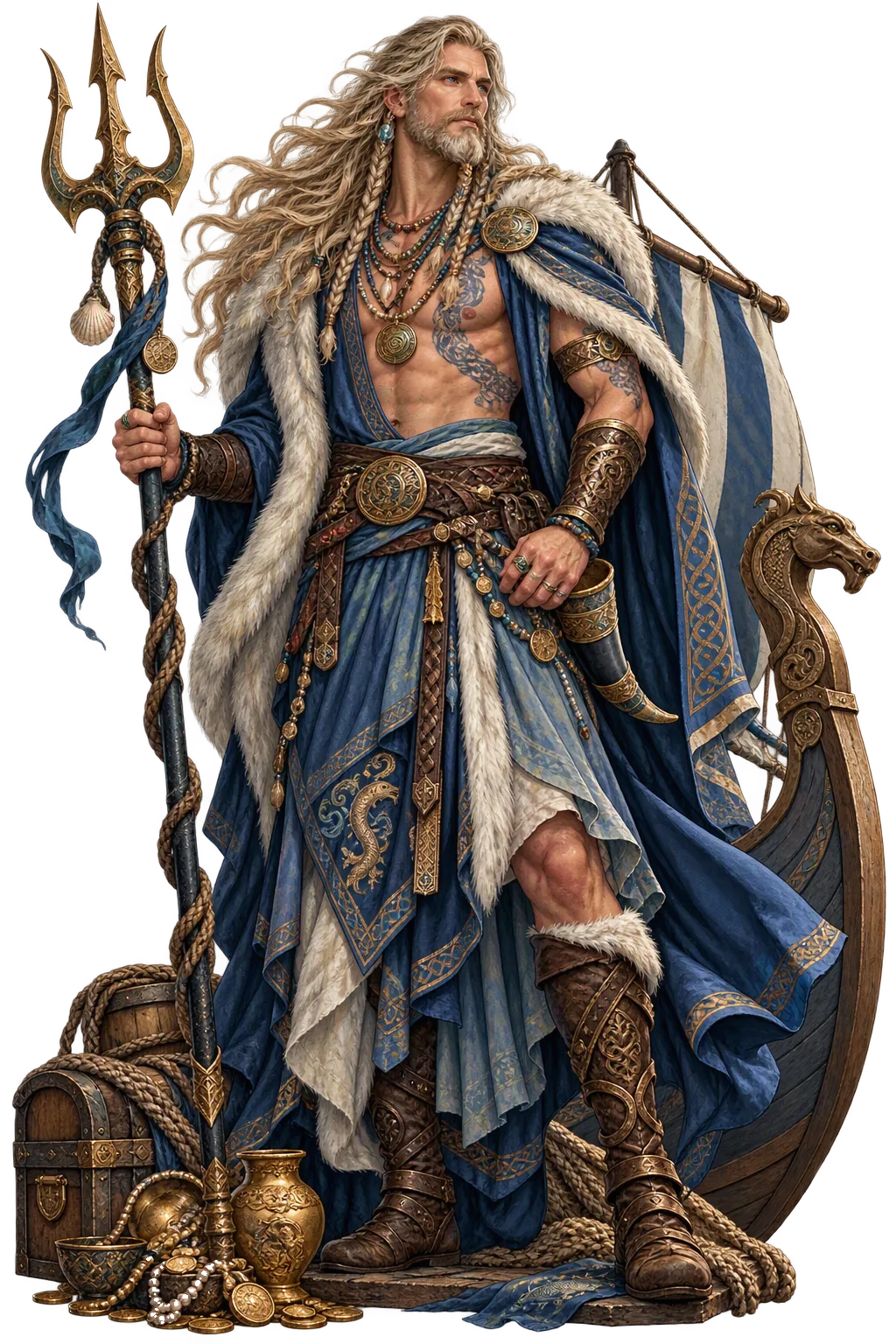
Njord at work: finance, wealth & commerce, maritime, shipping & ocean industries, and the myths that got there first
The myths did not retire. They moved offices. This is the file on where Njord works now.
Njǫrðr’s mythology is the peace-myth: the hostage-exchange that ended the gods’ first war, and the marriage that failed across the divine factions. His two stories — the Æsir–Vanir peace and the nine nights with Skaði — are the Norse pantheon’s domestic politics, and both end in the same lesson: some bonds hold, and some were never possible.
The pattern atlas — which maps every flagship temple to the industries its archetype demonstrably resonates with, each match argued and open to challenge — seats this temple in 3 industries. This file reads those seats the way they were earned: through the myths.
At a Glance
- Temple: Njord
- Pantheon: Norse
- Domain of influence: Sea, Wind, Wealth
- Pattern seats: 3
- Sectors touched: Commerce & Governance · Energy & Natural World · Culture & Entertainment
- Strongest seat: Finance, Wealth & Commerce
- Series: The Resonance Files, No. 375 of 597
The Myth at Work
The Æsir–Vanir Peace. The first war in the world — Æsir against Vanir — ended not in victory but in exchange: Njǫrðr and his children went to the Æsir, and the Vanir received Hœnir and Mímir in return. Snorri notes the exchange’s unevenness (the Vanir beheaded Mímir in disgust) and its durability: Njǫrðr became the Æsir’s own sea-lord, the living treaty between the divine races. — hold that image; the industries below are where it goes to work.
The Nine Nights with Skaði. Skaði, the ski-goddess, chose her husband by his feet among the veiled gods — she reached for Baldr and got Njǫrðr. Their marriage split on geography: he could not sleep in her mountain halls, where the wolves’ howling kept him from rest; she could not sleep by the sea, where the gulls’ crying drove her mad. — hold that image; the industries below are where it goes to work.
The Seats
Each of these is argued in the atlas with a weight and a why-line. What the atlas cannot fit in one line is the whole myth — so here is each seat with its story restored.
Finance, Wealth & Commerce
Banking, investment, and commercial enterprise. (Sector: Commerce & Governance)
The sea-lord of wealth and fair trade — the Norse merchant's patron, commerce under his calm. Swap the costume and the sentence is indistinguishable from the myth. That is what a resonance seat means.
Maritime, Shipping & Ocean Industries
Shipping, ports, fishing, and ocean exploration. (Sector: Energy & Natural World)
The Norse sea-lord of the safe shore and fair wind — sailors' and merchants' patron par excellence. — the atlas stops there, out of discipline. The myth keeps going: the function Njord performs in the stories is precisely the function this industry sells.
Travel, Tourism & Place Branding
Destinations, heritage tourism, and city branding. (Sector: Culture & Entertainment)
The why-line says it in one breath: The sea-lord of the safe shore — every coastal passage under his calm is his branding. That is not a resemblance; it is the same act, performed in a newer building.
The Long Employment
The nine-nights marriage is the Norse corpus’s most quoted domestic story — the gods’ own lesson that love does not survive incompatible homes. Scandinavia’s coastal placenames keep him; and the modern North’s shipping-prayers, where they survive, address the sea-lord by his name. The age changed. The work did not.
The Method, Stated Plainly
The atlas is not a horoscope. Seats are earned from the sources — argued, weighted, published — and every one of them can be challenged at the methodology page. A match that cannot survive an argument does not survive review. That is the whole trick: the patterns are claims, and claims can be tested.
For the Ones Who Work There
If you work in finance, wealth & commerce, maritime, shipping & ocean industries, or any trade this temple holds a seat in, this is the honest version of what a placement means: your industry beside the story it has been re-telling all along — on the temple floor itself, before an audience that came specifically to read it. The patron tier and the advertising terms describe the mechanics; the resonance above describes the fit.
The File Continues
One of 597 Resonance Files — the series where the pantheon goes to work. Read the founding dispatch for the name, the Restoration File for the spelling, or the whole archive end to end.
Continue the series — previous: Nisien (read it) · next: Njǫrðr (read it).
The Resonance Files are argued from the same canonical record as the pattern atlas itself: the lexicon, the lore catalog, and the cited sources. Every seat can be challenged at the methodology page — and the challenge is the point.