The Living Myth
Sea, Wind, Wealth · The Sea, Wealth, the Vanir Hostage · Variant
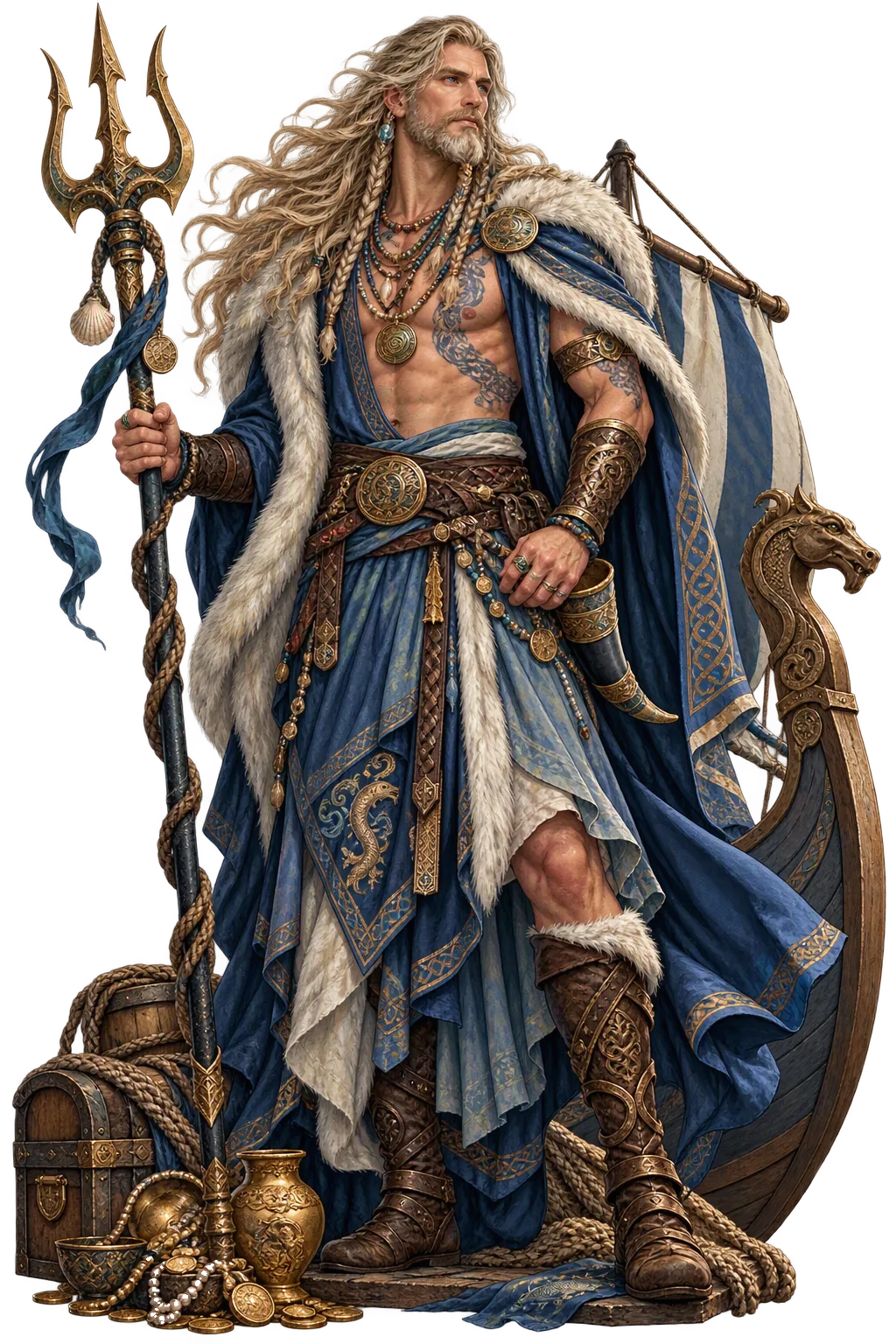
Stories of Njord
Njǫrðr’s mythology is the peace-myth: the hostage-exchange that ended the gods’ first war, and the marriage that failed across the divine factions. His two stories — the Æsir–Vanir peace and the nine nights with Skaði — are the Norse pantheon’s domestic politics, and both end in the same lesson: some bonds hold, and some were never possible.
The first war in the world — Æsir against Vanir — ended not in victory but in exchange: Njǫrðr and his children went to the Æsir, and the Vanir received Hœnir and Mímir in return. Snorri notes the exchange’s unevenness (the Vanir beheaded Mímir in disgust) and its durability: Njǫrðr became the Æsir’s own sea-lord, the living treaty between the divine races.
Skaði, the ski-goddess, chose her husband by his feet among the veiled gods — she reached for Baldr and got Njǫrðr. Their marriage split on geography: he could not sleep in her mountain halls, where the wolves’ howling kept him from rest; she could not sleep by the sea, where the gulls’ crying drove her mad. Nine nights in each home, then the parting — the gods’ most honest divorce.
Loki’s taunting catalogue in the gods’ hall accuses Njǫrðr of fathering his children on his own sister — the Vanir custom the Æsir condemned — and of letting the hostage’s price be paid in shame. Njǫrðr’s answer is dignity itself: ‘small harm in a lover, when sisters and husbands are beyond the gods’ borders’ — the hostage’s quiet defense of his people’s ways.
Tacitus’ Germania describes the North’s first-century goddess Nerthus — an earth-deity drawn in a covered wagon, feasted, and drowned in her lake in secret rites. Linguists and historians of religion long ago set Njǫrðr and Nerthus side by side: the same divine name, perhaps, before the sea claimed the land’s share — the gender and the element exchanged across the centuries.
God of the Shore and the Fair Wind
Njǫrðr is the Norse sea-god of the safe shore: the Vanir hostage who chose the sea-cliffs over the mountains, father of Freyr and Freyja, giver of wealth and fair winds to sailors and merchants. He is the gods’ peacemaker — the hostage-exchange that ended the Æsir–Vanir war made him the divine guarantee that treaties hold, and the sea’s temper mirrors his: calm, rich, and implacable when crossed.
He rules the sea’s edge and the fair wind — sailors and merchants call on him for safe passage and good trade.
Given to the Æsir to seal the peace with the Vanir; the gods’ own guarantee that oaths bind.
Freyr and Freyja are his children by his sister — the Vanir marriage-custom the Æsir could not accept.
Sea-wealth flows from him — the Norse word for wealth and the sea’s gift are his domain together.
From the original script to the living URL
Njord
The name survives in scholarly transliteration. Njord is the standard Norse romanisation, documented in academic sources — “Variant: plain anglicization (no o-slash)”. Because the spelling uses only Latin letters, the form is the same in both ASCII and Unicode.
The original script for this norse name has not yet been added to PUNICODEX. The form shown is a scholarly transliteration.
njord
The plain njord form is identical to the Unicode restoration. Because this name is already written in Latin letters, no diacritics, stress, or script information were lost — only capitalization differs.
Njord
The Unicode restoration does not need to recover lost marks for Njord. Its value is canonical spelling and consistent cataloguing, not the reconstruction of erased orthography. The domain is readable as-is to both DNS and humanity.
Njord.com
This restoration is written entirely in ASCII letters — no Punycode encoding stands between Njord and the DNS. The domain reads identically to machines and to human eyes.
The attested spelling family of Njord
Njord
The full Unicode restoration. njord.com is not in the PuniCodex collection — it is watched for release; if it drops, this temple upgrades to an owned flagship. Attested by Poetic Edda, Cleasby-Vigfusson.
How Njord was spoken
How Njord is preserved in writing
A bespoke provenance study for Njord is being prepared by the PUNICODEX scholarly team.
Contribute scholarly provenance →The lore you have read is the living myth. Extended Lore opens the scholarly vault beneath it: the cult and its material remains, a history of the image, the name after antiquity, a meditation on what the name still means, and the full scholarly apparatus — etymology, orthography, sources.
Enter Extended Lore