
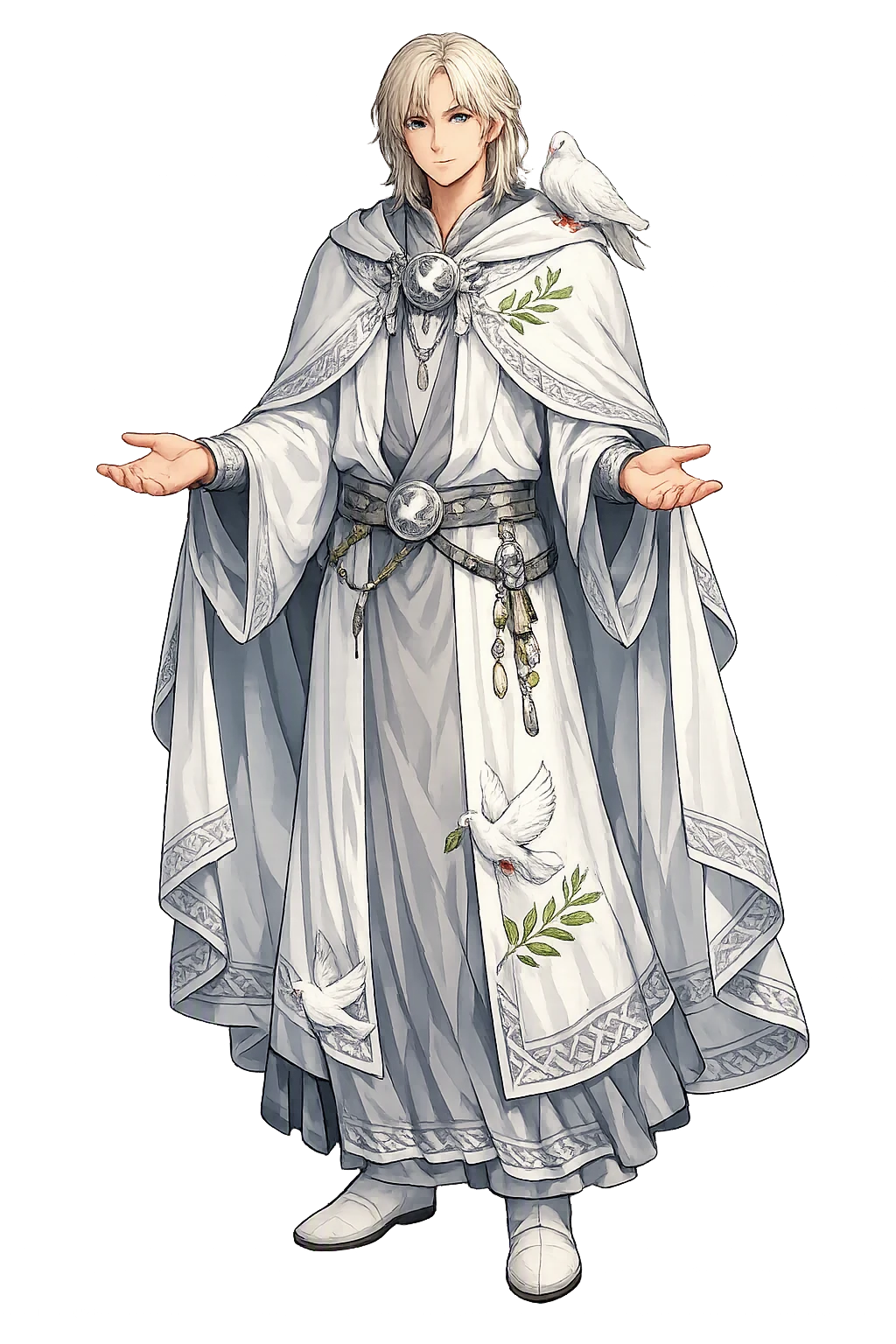
Nisien in 2026: why scholars still care
In 2026, names are treated as data points. Nisien is a reminder that they are also cultural artifacts — and that the difference matters for search engines, AI training corpora, and anyone who types the name of a Celtic figure into a browser. Scholars never stopped caring about the difference between nisien and Nisien; the web simply made that care actionable. What follows is the full scholarly picture — name, script, sound, myth, cult, and legacy — followed by the engineering compromise that lets a restored spelling live at a real address. The question is not whether the name is old. It is whether the digital world is old enough to hold it.
At a Glance
- Restored name: Nisien
- ASCII form: nisien
- Meaning: "Peaceful one"
- Domain of influence: Peace, Brother of Efnysien
- Pantheon: Celtic
- Classification: Tier 2
Overview
Nisien (nisien) — Peace, Brother of Efnysien · Peaceful one — is the gentle twin of the Second Branch of the Mabinogi: son of Euroswydd by Penarddun, half-brother to Brân the Blessed, Branwen, and Manawydan, and the twin of Efnysien. The tale defines him in a single matched sentence — Nisien, the good man, would bring about peace between two armies when they were most furious; his brother would set two loving brothers fighting — and then gives the whole war to the cruel twin, keeping the peace-maker present at the court and never once letting him prevail.
The tradition behind the pair is the Welsh redactor's own: the twins are read by the modern handbooks as a personified antithesis, peace and strife embodied as brothers, and no Irish original has ever been proposed for either name.
PuniCodex restores the name as Nisien — identical to the ASCII input, because normalized Middle Welsh writes no diacritic in this name. The mechanical rule therefore places it in Tier 2: nothing distinctive is lost in transit, a statement about orthography and never about the figure. No domain is claimed: the plain-ASCII nisien.com is registered to a third party outside the collection and is watched for release.
The Name
The name is attested in Middle Welsh as Nissyen in the White and Red Book manuscripts and normalized in modern scholarship as Nisien; the y of the manuscript spelling writes the same short vowel modern Welsh spells with i. The lexicon's traditional gloss is 'peaceful one', and it suits the character exactly — but the philology behind the name is honestly unsettled, and the Geiriadur Prifysgol Cymru and the standard handbooks record the derivation as uncertain rather than resolved.
What is certain is the structure the name belongs to. Nisien and Efnysien are twin brothers, sons of Euroswydd by Penarddun — and so half-brothers to the children of Llŷr — and the Second Branch defines them in one balanced sentence as the peace-maker and the strife-maker. The modern handbooks read the pair as a personified antithesis: two abstract forces embodied as kin, each name carrying half of one idea.
The ASCII form is not a compromise here: normalized Middle Welsh writes the name in plain Latin letters, and the restoration recovers no diacritic because none was ever written. Only the capital distinguishes the restored form from the input, which places the name in Tier 2 by the mechanical rule.
The letter-by-letter transformation runs:
- n → N — Same, capitalized
- i → i — Same
- s → s — Same
- i → i — Same
- e → e — Same
- n → n — Same
The project holds no domain for this name: nisien.com is registered to a third party outside the PuniCodex collection and is watched for release. The temple is served at /nisien/ and claims no domain it does not hold.
The Original Script
The name is preserved in Middle Welsh manuscripts in the Latin alphabet as Nissyen (normalized Nisien) — Middle Welsh (Brythonic Celtic), attested in the White Book of Rhydderch (c. 1350) and the Red Book of Hergest (c. 1382–1410), recording material composed centuries earlier. The script is written left-to-right in the medieval Welsh bookhand.
The scholarly rendering proceeds step by step:
- Middle Welsh writes the name in plain Latin letters; the manuscript spelling Nissyen uses y where the modern standard writes i, for the same short vowel.
- No diacritic attaches to the name in any witness: normalized Middle Welsh orthography and the ASCII spelling are identical.
- The etymology is unsettled — the traditional gloss 'peaceful one' is scholarly convention, not a resolved derivation, and the Geiriadur Prifysgol Cymru records the name without settling its origin.
- The Unicode restoration Nisien therefore changes nothing but the capital; the name stands in Tier 2 by the mechanical rule, and the plain-ASCII domain nisien.com — held by a third party outside the PuniCodex collection and watched for release — is the philologically complete form.
One caution attaches to the record: the character note that defines Nisien — the peace between furious armies — is the tale's own, and this edition attributes no deed to him beyond what the Second Branch records.
Pronunciation
The pronunciation of the name is /ˈnɪsɪɛn/ — Modern Welsh.
Phoneme by phoneme:
- Ni- — Voiced alveolar nasal [n] and short close [ɪ], the light unstressed opening; Welsh i is close and short, never the English diphthong of 'nine'
- -si- — Voiceless sibilant [s] and short [ɪ] again, the stressed penult where Welsh accent always falls; a clean hiss, never voiced to z
- -en — Short open [ɛ] and final nasal [n], the syllable that falls away unstressed
For the modern speaker, the closest approximation is: 'NISS-yen' — stress the middle syllable, keep every vowel short, and never let the s soften into a z.
Kindred and historical forms of the name:
- Middle Welsh — Nissyen, the manuscript spelling of the White and Red Books
- Modern Welsh — Nisien, the standardized modern spelling
- The twin pair — Efnysien (Middle Welsh Efnissyen), his brother and antithesis
- Patronymic — Nisien fab Euroswydd, son of Euroswydd by Penarddun
Nisien is Tier 2 because the restoration preserves nothing ASCII loses: the letters of the normalized manuscript form are the letters of the keyboard. The capital alone marks the temple form.
Mythology
Nisien's whole dossier is the Second Branch of the Mabinogi, Branwen ferch Llŷr — one character note, one lineage, and a presence that shadows the war from first cause to last survivor.
The Two Sons of Euroswydd (Branwen ferch Llŷr)
The branch introduces the twins in a single balanced construction: Nisien was a good man, and would bring about peace between two armies when they were most furious; Efnysien would bring about a quarrel between two brothers when they loved each other most. They are twins, sons of Euroswydd by Penarddun, and so half-brothers to Brân the Blessed, Branwen, and Manawydan, her children by Llŷr. Welsh prose has no other pair like it: the tradition does not describe two temperaments but defines two forces — peace and strife — as brothers born in one hour.
The Horses at Aberffraw (Branwen ferch Llŷr)
When Brân gives Branwen in marriage to Matholwch, king of Ireland, and the wedding is held at Aberffraw, it is Efnysien — insulted that the match was made without his leave — who mutilates the groom's horses, cutting off lips, ears, tails, and eyelids to the bone. The outrage is patched over with reparation and the gift of the Cauldron of Rebirth, and reopened in Ireland when Branwen is made a scullion in her husband's kitchen. Through all of it the text never once shows Nisien acting: the peace-maker, gifted by his own description with the one power the crisis needs, is present in the household and absent from every scene.
The War Over the Sea (Branwen ferch Llŷr)
Brân wades the sea at the head of the hosts of Britain — no ship can carry him — and the war destroys both kingdoms. The Irish revive their slain in the Cauldron of Rebirth until Efnysien, flung living into it among the corpses, stretches himself out and bursts it, dying in the act: the strife-twin consuming himself to undo the weapon his own first outrage helped set in motion. Of the men of Britain seven come home; Branwen dies of a broken heart on the shore of the Alaw. Nisien's name is not among the dead, the seven, or the counsellors — the tale simply stops mentioning him.
The Antithesis Made Flesh (Scholarly Reading)
The modern handbooks are unusually agreed. Mac Cana reads the twins as the Mabinogi's clearest case of abstract forces embodied as kin: the redactor names Nisien and Efnysien in one breath because they are one idea in two bodies. MacKillop keeps both entries short for the same reason — there is no cycle, no second tale, no folklore of Nisien to collect. The names themselves resist resolution: the traditional glosses, 'peaceful one' and 'double enemy', are scholarly convention rather than settled etymology. What is certain is the structure: two names, two clauses, one cradle.
Symbols & Iconography
Nisien's regalia are not objects but positions — the working parts of the antithesis:
- The paired sentence — The Second Branch's balanced character note: peace and strife defined as twin brothers, one clause each
- The twin's shadow — Efnysien's cruelty as the measure of his gentleness; each brother the other's definition
- The house of Euroswydd — The second father-line of Penarddun's children, the gentler inheritance beside the children of Llŷr
- The mutilated horses — His brother's unprovoked outrage against Matholwch's team, the act of strife that no peace in the tale can undo
- The silent presence — The peace-maker carried with the host to Ireland and given no scene: the might-have-been that haunts the branch
Archaeology & Evidence
Nisien is a purely textual figure: no inscription, votive deposit, or cult site names him, and the early inscribed stones of Wales — the Latin and ogham memorials of roughly the fifth to seventh centuries — record personal names in funerary formulae, not theonyms or tale-figures. His evidence is manuscript evidence. The Four Branches survive complete in the White Book of Rhydderch (Aberystwyth, NLW Peniarth MSS 4–5, c. 1350) and the Red Book of Hergest (Oxford, Jesus College MS 111, c. 1382–1410), with earlier fragments in Peniarth 6; the tales' date of composition is argued rather than documented, with current scholarship generally holding a range around 1060–1120.
The geography of his branch is real: Aberffraw, where the wedding and the outrage are set, was the historic principal seat of the kings and later princes of Gwynedd on Anglesey, and the Alaw, where Branwen dies of her broken heart, is an Anglesey river. The giant who wades the sea and the cauldron of revival belong to the tale's mythic furniture; the courts and the crossings are drawn from the Welsh world the redactor knew.
Realm & Domain
Nisien is catalogued under the domain 'Peace, Brother of Efnysien' — the lexicon's own summary, and an unusually exact one: his domain is peace, and his identity is the twin he is defined against.
Peace
The Second Branch gives him one power and one only: he would bring about peace between two armies when they were at the height of their fury. It is the largest claim the Mabinogi makes for any figure short of the giants and enchanters — peace not as a truce or a treaty but as a personal force, carried in one man, effective at the worst possible hour.
Brother of Efnysien
The other half of the domain is the antithesis itself. Nisien and Efnysien are twin brothers, sons of Euroswydd, and the tradition defines each by the other: the peace-maker exists in the text as the matched opposite of the man who would set loving brothers fighting. The handbooks read the pair as personified forces — peace and strife in one cradle.
The Kin of Llŷr
By his mother Penarddun, Nisien is half-brother to Brân the Blessed, Branwen, and Manawydan — the family at the center of the Second and Third Branches. His place in the household is what makes his dossier so pointed: the peace-maker was kin to every party in the war his brother kindled.
The Might-Have-Been
Nisien's standing function in the branch is the road not taken: the peace that was in the house, crossed the sea with the host, and was never once deployed. The tale's silence about him is the domain statement in its sharpest form.
Across Cultures
Nisien has no counterpart anywhere, and the honesty of that fact is part of his record. No Irish figure bears his name or his office: the Irish cycles know war-goddesses and peace-breaking satirists in abundance, but no personified peace-twin, and Sims-Williams's survey of Irish influence on Welsh literature — which finds deep Irish strata in the Second Branch itself, from the giant king who wades the sea to the cauldron of revival — supplies no Irish original for the sons of Euroswydd. The twins look like the Welsh redactor's own construction.
The nearest comparisons are structural, drawn from inside the Welsh corpus: his brother Efnysien, the necessary other half of the antithesis; Manawydan, his half-brother, whose own branch turns on patience and forbearance rather than force; and Matholwch, the wronged king whose horses his brother maimed. Beyond the Mabinogi, the device of paired abstract forces made kin has analogues in other traditions, but the Welsh pair needs no borrowing to explain it: peace and strife as twin brothers is exactly the sort of idea a mature prose tradition invents in a single sentence.
Cultural Legacy
Nisien's afterlife is as quiet as his dossier. Lady Charlotte Guest's translation of the Mabinogion (1838–49) carried the twins into English, and every retelling of Branwen since has kept the paired sentence — it is the one line of the Second Branch that anthologies quote whole. The scholarly tradition made the antithesis canonical: Mac Cana's study of the Mabinogi and MacKillop's dictionary fixed the reading of the twins as personified peace and strife, and the pair now serves Celtic studies as the standard example of the Welsh redactor's art of definition-by-contrast.
Nisien himself never became a cult figure, a comic antihero, or a popular given name in the way louder Mabinogi figures did — Efnysien, the interesting twin, took all of that. The gentle brother's legacy is the sentence itself: in a tale about a war no one could stop, Welsh literature wrote its peace-maker in one clause and let the silence around him say the rest.
The Scholarly Record
The account of Nisien given in this edition rests on the witnesses and reference works listed below. The Second Branch of the Mabinogi supplies the whole narrative dossier; the manuscript and translation history frames it; the handbooks arbitrate the name's unsettled etymology and the reading of the twin antithesis.
- Davies, Sioned, trans., The Mabinogion (Oxford: Oxford University Press, 2007), 'Branwen Daughter of Llŷr'.
- Williams, Ifor, ed., Pedeir Keinc y Mabinogi (Cardiff: University of Wales Press, 1930).
- Guest, Lady Charlotte, trans., The Mabinogion, 3 vols. (London, 1838–49).
- Mac Cana, Proinsias, The Mabinogi, 2nd ed. (Cardiff: University of Wales Press, 1992).
- Mac Cana, Proinsias, Celtic Mythology (London: Hamlyn, 1970).
- MacKillop, James, Dictionary of Celtic Mythology (Oxford: Oxford University Press, 1998), s.vv. Nisien, Efnysien.
- Koch, John T., ed., Celtic Culture: A Historical Encyclopedia, 5 vols. (Santa Barbara: ABC-CLIO, 2006), s.vv. Nisien, Efnysien, Branwen ferch Llŷr.
- Sims-Williams, Patrick, Irish Influence on Medieval Welsh Literature (Oxford: Oxford University Press, 2011).
- Geiriadur Prifysgol Cymru / A Dictionary of the Welsh Language (Cardiff: University of Wales Press, 1950–2002), s.vv. Nisien, Efnysien.
- Nash-Williams, V. E., The Early Christian Monuments of Wales (Cardiff: University of Wales Press, 1950).
A Meditation
Nisien is the proof that a figure can be made of almost nothing and still be one of the most exact things in his tradition. One sentence, one lineage, no deeds — and from that the Second Branch draws a whole theology of peace: that it exists, that it lives in the same house as strife, that it can be kin to the war-makers and married into every court, and that a host can carry it over the sea and never once take it out.
The tragedy of Branwen is often told as Efnysien's story, but it is just as much Nisien's: the war happens in the presence of the one man whose nature is to end it, and the text makes sure we notice by telling us his nature first and his absence always. Every court has a Nisien. The Mabinogi's question is why he is so seldom asked.
The Unicode Restoration
Nisien is classified as Tier 2: the restoration needs no distinctive letters or diacritics its ASCII form would lose. The ASCII fallback nisien still resolves everywhere, but it is the restored form that carries the name's full information. That is the whole thesis of this temple: the marks are the message.
Why This Restoration Matters
In 2026 the stakes are practical. Search indexes, language models, and localization pipelines all inherit whatever spelling the web normalizes — which means every Unicode domain is also a training signal. Nisien teaches the machinery that the restored form exists, that it is used, and that it points to a real place. That is why a project built on philology ends up caring about DNS: the infrastructure decides which names the future sees. This restoration makes sure the future sees the whole name.
Explore Further
This post is one doorway into the temple. The home page carries the full character breakdown and the ambient canvas; the lore page tells the myths in long form; the Scholarly Edition preserves the sources, pronunciation data, and revision history; and the patron wall supports the restoration directly. For the wider map, browse the Lexicon, explore the Pantheon, or return to the PuniCodex blog.
Related Names
Sources
The full scholarly apparatus — every citation, revision, and review — lives in the Scholarly Edition. Key references for this post:
- Davies, Sioned, trans., The Mabinogion (Oxford: Oxford University Press, 2007), 'Branwen Daughter of Llŷr'; Welsh text ed. Ifor Williams, Pedeir Keinc y Mabinogi (Cardiff: University of Wales Press, 1930).
- Mac Cana, Proinsias, The Mabinogi, 2nd ed. (Cardiff: University of Wales Press, 1992); MacKillop, James, Dictionary of Celtic Mythology (Oxford: Oxford University Press, 1998), s.vv. Nisien, Efnysien.
- Koch, John T., ed., Celtic Culture: A Historical Encyclopedia, 5 vols. (Santa Barbara: ABC-CLIO, 2006), s.vv. Nisien, Efnysien.
- Williams, Ifor, ed., Pedeir Keinc y Mabinogi (Cardiff: University of Wales Press, 1930), text and notes.
- Lexicon authorities for this entry: Mabinogion, MacKillop.