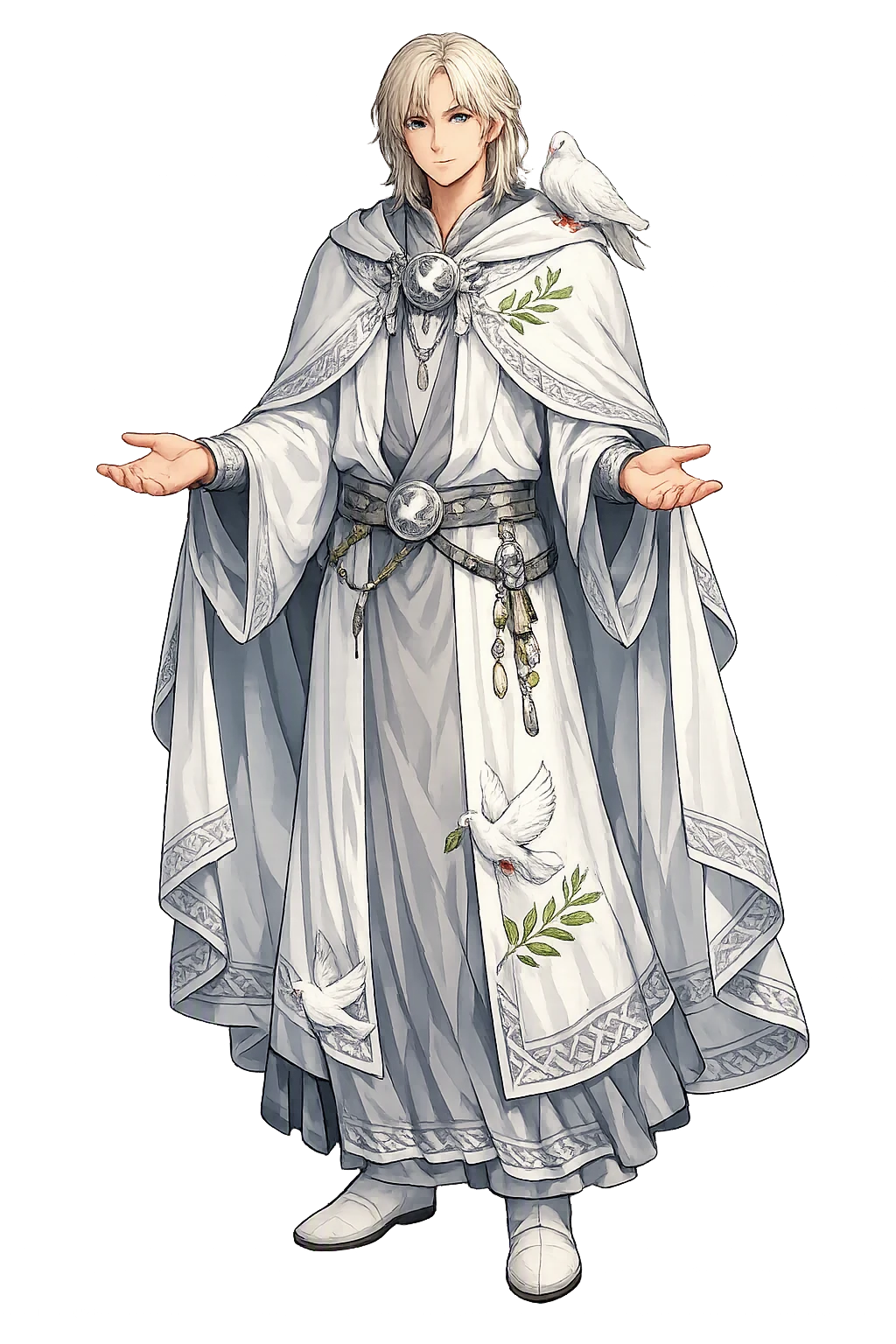
Stories of Nisien
Nisien has the smallest dossier in the Mabinogi and the clearest definition: he exists as one half of an antithesis. The Second Branch of the Mabinogi, Branwen ferch Llŷr, names him exactly once as a character and then spends its whole length on the war his brother kindles. What survives of him is a sentence, a lineage, and a presence — and the Welsh tradition built an entire moral pole out of that spareness.
The Second Branch introduces the twins in a single balanced construction, the most quoted sentence either brother ever gets. Nisien, the tale says, was a good man: he would bring about peace between two armies when they were at the height of their fury. Efnysien would bring about a quarrel between two brothers when they loved each other most. They are twins, sons of Euroswydd by Penarddun — and so half-brothers to Brân the Blessed, Branwen, and Manawydan, Penarddun's children by Llŷr.
The construction is the whole point: Welsh prose has no other pair like it. The tradition does not describe two temperaments; it defines two forces — peace and strife — as brothers born in one hour, and then sets them loose in the same household. Every reader of the branch knows, before the horses are harmed, exactly which twin will act and which will stand by.
When Brân consents to give Branwen in marriage to Matholwch, king of Ireland, and the wedding is held at Aberffraw, it is Efnysien — insulted that the match was made without his leave — who takes revenge on the groom's horses: he cuts off their lips to the teeth, their ears to their heads, their tails to their backs, and the eyelids to the bone. The outrage becomes the war's first cause, patched over with reparation and the gift of the Cauldron of Rebirth, and reopened in Ireland when Branwen is made a scullion and struck daily in the kitchen.
Nisien's place in all this is the tale's deliberate emptiness: the peace-maker is there, kin to all parties, gifted by his own description with the one power the crisis needs — and the text never once shows him using it. The mutilation stands unappeased from its author; no embassy of Nisien's is ever recorded. The Second Branch's tragedy is written so that the reader supplies the missing twin.
Brân wades the sea at the head of the hosts of Britain, for no ship can carry him, and the war that follows destroys both kingdoms. The Irish revive their slain in the Cauldron of Rebirth, so that they rise to fight again, and the balance breaks only when Efnysien — feigning death among the corpses, flung living into the cauldron — stretches himself out and bursts it, dying in the act: the strife-twin consuming himself to undo the one weapon his own first outrage helped set in motion. Of the men of Britain only seven come home; Branwen dies of a broken heart on the shore of the Alaw.
Nisien's name is not among the dead, the seven, or the counsellors: the tale simply stops mentioning him. Scholars have long read the silence as the branch's own verdict — Mac Cana and MacKillop alike treat the twins as a personified antithesis, peace and discord hypostatized as brothers, and on that reading Nisien's function is complete the moment the paired sentence is spoken. He is not a character the tale forgot; he is the peace the tale declined.
The modern handbooks are unusually agreed about what the twins are. Mac Cana reads the pair as the Mabinogi's clearest case of abstract forces embodied as kin: the redactor names Nisien and Efnysien in one breath because they are one idea in two bodies. MacKillop's dictionary keeps both entries short for the same reason — there is no cycle, no second tale, no folklore of Nisien to collect; the dossier is the Second Branch and nothing else. Koch's encyclopedia files both under Branwen ferch Llŷr.
The names themselves resist resolution. The traditional glosses — 'peaceful one' for Nisien, 'double enemy' for Efnysien — are older scholarly convention rather than settled etymology, and the Geiriadur Prifysgol Cymru and the handbooks record the derivations as uncertain. What is certain is the structure: two names, two clauses, one cradle. The Welsh tradition made its peace-maker the way myth usually makes its gods — by naming the opposite and letting the pair do the work.
The Gentle Twin of the Second Branch
Nisien is one half of the strangest doublet in the Mabinogi: twin brothers, sons of Euroswydd, whom the Second Branch introduces with a single matched sentence — Nisien, the good man who would make peace between two armies when they were most furious; Efnysien, who would set two loving brothers fighting to the death. The tale then gives the whole war to the cruel twin and keeps the gentle one as its standing might-have-been: peace personified, present at the court that marches to Ireland, and never once allowed to prevail.
The tale's whole dossier in one clause: he would bring two armies to peace at the very height of their rage.
Son of Euroswydd and Penarddun, twin of Efnysien — the gentle half of a pair the tradition built as peace and strife in one cradle.
Half-brother to Brân the Blessed, Branwen, and Manawydan — kin to the children of Llŷr by his mother's side.
Wherever the Second Branch's counsel is weighed, Nisien is the standing alternative: the peace that was in the house and was not chosen.
From the original script to the living URL
Nisien
The name survives in scholarly transliteration. Nisien is the standard Celtic romanisation, documented in academic sources — “Peaceful one”. Because the spelling uses only Latin letters, the form is the same in both ASCII and Unicode.
No indigenous writing system is securely attested for individual celtic names. The form shown is a modern scholarly transliteration.
nisien
The plain nisien form is identical to the Unicode restoration. Because this name is already written in Latin letters, no diacritics, stress, or script information were lost — only capitalization differs.
Nisien
The Unicode restoration does not need to recover lost marks for Nisien. Its value is canonical spelling and consistent cataloguing, not the reconstruction of erased orthography. The domain is readable as-is to both DNS and humanity.
Nisien.com
This restoration is written entirely in ASCII letters — no Punycode encoding stands between Nisien and the DNS. The domain reads identically to machines and to human eyes.
Owned, ideal, and ASCII forms of Nisien
Nisien
The full Unicode restoration. nisien.com is not in the PuniCodex collection — it is watched for release; if it drops, this temple upgrades to an owned flagship.
How Nisien was spoken
How Nisien is preserved in writing
No indigenous writing system is securely attested for individual celtic names. The form shown is a modern scholarly transliteration.
Contribute scholarly provenance →The lore you have read is the living myth. Extended Lore opens the scholarly vault beneath it: the cult and its material remains, a history of the image, the name after antiquity, a meditation on what the name still means, and the full scholarly apparatus — etymology, orthography, sources.
Enter Extended Lore