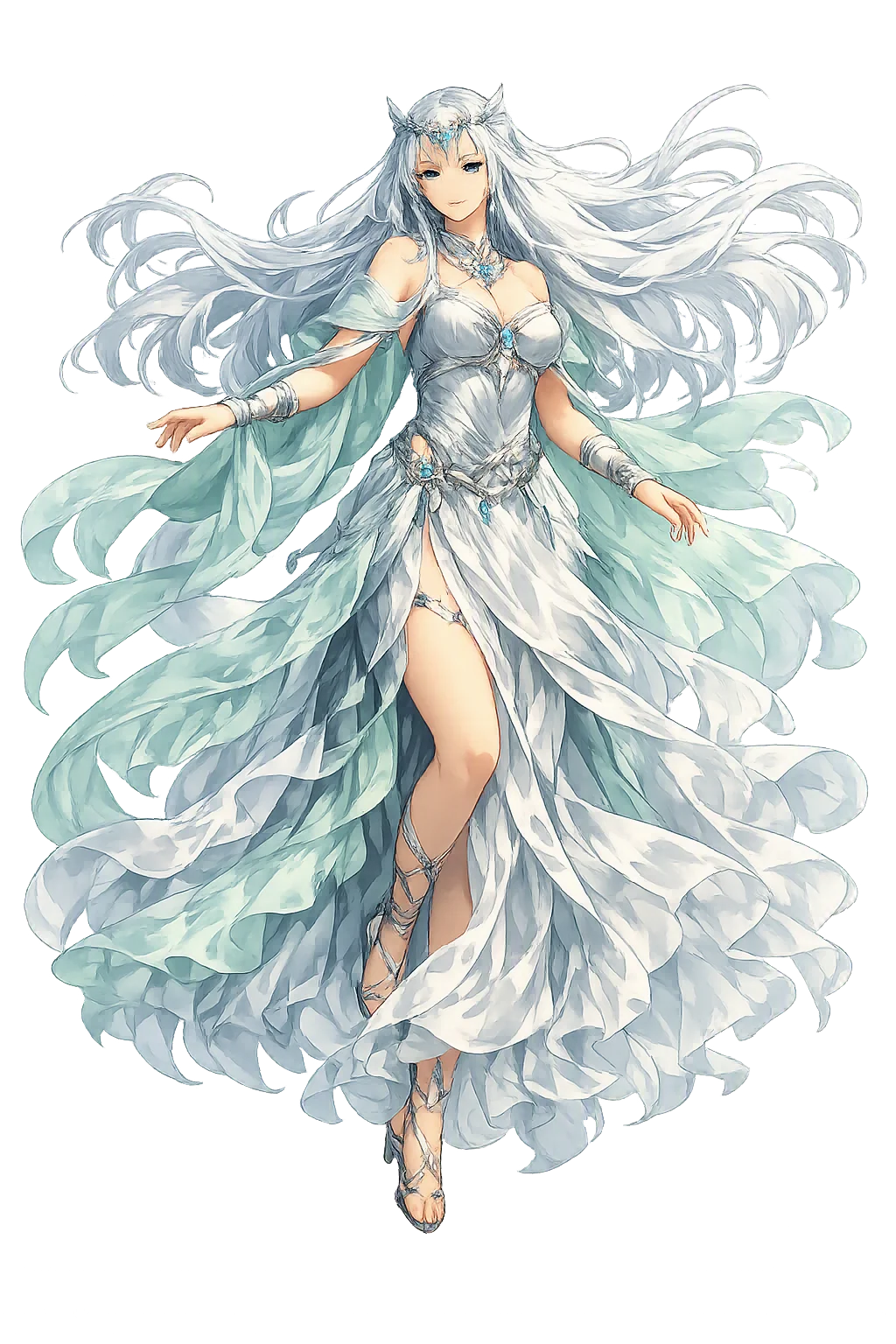
Stories of Ninlil
Ninlil's myths are stories of boundary-crossing: the wind that moves between worlds, the queen who descends into darkness, and the mother whose children personify moon, death, water, and order. She is not a passive consort; she is the necessary counterpart without whom Enlil's kingship would be incomplete.
The Sumerian poem Enlil and Ninlil (ETCSL 1.2.1) opens on the pure canals of Nippur, where the young goddess bathes and the young god Enlil sees her and desires her. Guided by her mother's advice, she goes to the river; three times Enlil speaks to her of love, and three times 'the lord, wishing to speak to her of lovemaking, could not make her take his words to heart' — until she does, and conceives the moon god Suen. The assembled gods judge Enlil's offence and banish him to the underworld, 'the land of no return, where no one who enters comes back up.' Ninlil refuses to be parted from him: she follows him down, and in the depths he meets her three times in disguise — the gatekeeper, the river-man of the Id-kura, the ferryman of the dead — and each meeting begets a deity: Nergal-Meslamtaea, Ninazu, and Enbilulu, the lords of the netherworld and its waters, generated by stratagem so that the underworld's tally of souls would balance. The poem is the Sumerians' great myth of necessary descent: love, exile, and the underworld are one continuous road, and the queen of the air walks it to make the darkness fruitful.
A second Sumerian poem, Enlil and Sud (ETCSL 1.2.2), tells how the goddess got her royal name. Sud is a young woman of the city of Eresh, daughter of the goddess Nisaba; Enlil sees her, and instead of seizing her — the pattern the other myth begins with — he sends his vizier Nuska to sue properly for her hand. What follows is the most worldly scene in Sumerian literature: a bride-price negotiation, in which Enlil's envoy promises grain, livestock, and treasure to Sud's mother, and Nisaba drives a hard bargain before consenting. Sud is brought in procession to Nippur, welcomed by the great gods, and there Enlil names her anew: 'Ninlil shall be her name' — Lady of the Air — a name spoken by the assembly of the gods themselves. The poem thus supplies a civilized etiology for the queen of heaven: sovereignty not taken but contracted for, and a goddess remade by naming. The two poems read together are the tradition's own commentary — desire unrestrained becomes exile; desire conducted through proper forms becomes a throne.
The genealogies agree on the child Ninlil carries out of the Nippur canal: Suen, Sumerian for the moon, Akkadian Sîn — the first luminous power, born of the air itself. With Nanna/Sîn the line continues upward: he and the goddess Ningal become the parents of Utu/Shamash, the sun, and of Inanna/Ištar, the morning and evening star — so that wind, moon, sun, and star form one celestial dynasty descending from Ninlil's union. Royal hymns of the Ur III and Old Babylonian periods invoke the couple as the divine parents who legitimate the king: 'Enlil and Ninlil' stand together in the blessing formulas of coronation prayers, and city laments mourn Nippur's Ekur as the house of both. The tradition even gives her a role in the earliest youth of the moon-god, hymns describing her rocking the young Suen in the heavens as a mother rocks a cradle. The myth is the pantheon's theory of atmosphere: everything that moves across the sky is the visible progeny of the invisible element, and the night light that governs the calendar is the air-queen's firstborn child.
Ninlil's principal cult centre was Nippur, where she shared the great sanctuary of Enlil — the Ekur, 'Mountain House' — and possessed within the complex her own shrine, the Tummal, celebrated in the royal building inscriptions of the Ur III kings; Sumerian temple hymns praise her house with the same honorifics as the god's. In the second millennium the city laments — the Lament for Ur, the Lament for Nippur — mourn her deserted sanctuary alongside Enlil's, proof of how completely her cult was entwined with the religious capital of Sumer. Her worship then travelled north: in the Neo-Assyrian period Ninlil was identified with Mullissu, consort of the national god Aššur, and Assyrian kings from Aššurnasirpal II to Aššurbanipal built and endowed her temples at Assur and Nineveh, invoking her in their inscriptions as the divine consort who crowns their legitimacy. Her worship thus spans Sumer, Babylonia, and Assyria across more than two thousand years — the longest continuous career of any Mesopotamian goddess.
Wind, Air, Queenship, and the Descent into Darkness
Ninlil is the Sumerian goddess of the wind and the air, the consort of Enlil and queen of the Mesopotamian pantheon. Her name, written 𒀭𒊩𒌆𒆤, simply means 'Lady of the Wind' — nin ('lady, queen') plus lil ('wind, air'). Where Enlil commands the storm and the decree of kingship, Ninlil is the gentler sovereign of the moving air itself: the breath that fills the lungs, the breeze that carries pollen, and the unseen presence that links heaven and earth.
This temple honours Ninlil as both queen and mother. She is the mother of Nanna/Sîn the moon, of Nergal lord of the underworld, of Ninazu, and of Enbilulu the canal inspector. The myth Enlil and Ninlil (ETCSL 1.2.1) weaves her story together with the theological geography of Mesopotamia: even the queen of the air must know the underworld, because descent and generation are inseparable in the Sumerian cosmos.
The moving air itself — breath, breeze, and the life-giving currents that cross the Mesopotamian plain.
Consort of Enlil and queen of the gods; the divine matriarch from whom lunar and netherworld powers descend.
Mother of Nanna/Sîn; the lunar crescent is her descendant's sign, linking wind-queen to night-light.
The mythic journey into the underworld that generates new gods and new seasons of life.
From the original script to the living URL
𒀭𒊩𒌆𒆤
The name in its original Mesopotamian form. Ninlil (𒀭𒊩𒌆𒆤) is attested in the source tradition — “Lady of the wind”. Its original diacritics and script distinctions carry the full phonetic and orthographic weight of the source tradition.
ninlil
The plain ninlil form is identical to the Unicode restoration. Because this name is already written in Latin letters, no diacritics, stress, or script information were lost — only capitalization differs.
Ninlil
The Unicode restoration does not need to recover lost marks for Ninlil. Its value is canonical spelling and consistent cataloguing, not the reconstruction of erased orthography. The domain is readable as-is to both DNS and humanity.
Ninlil.com
This restoration is written entirely in ASCII letters — no Punycode encoding stands between Ninlil and the DNS. The domain reads identically to machines and to human eyes.
Owned, ideal, and ASCII forms of Ninlil
Ninlil
Restores 𒀭𒊩𒌆𒆤. The full Unicode restoration. ninlil.com is not in the PuniCodex collection — it is watched for release; if it drops, this temple upgrades to an owned flagship.
How Ninlil was spoken
How Ninlil travels from ancient script to the modern URL
Sumerian NIN.LÍL “lady of the wind/air"; consort of Enlil and mother of Nanna/Sîn.
The lore you have read is the living myth. Extended Lore opens the scholarly vault beneath it: the cult and its material remains, a history of the image, the name after antiquity, a meditation on what the name still means, and the full scholarly apparatus — etymology, orthography, sources.
Enter Extended Lore