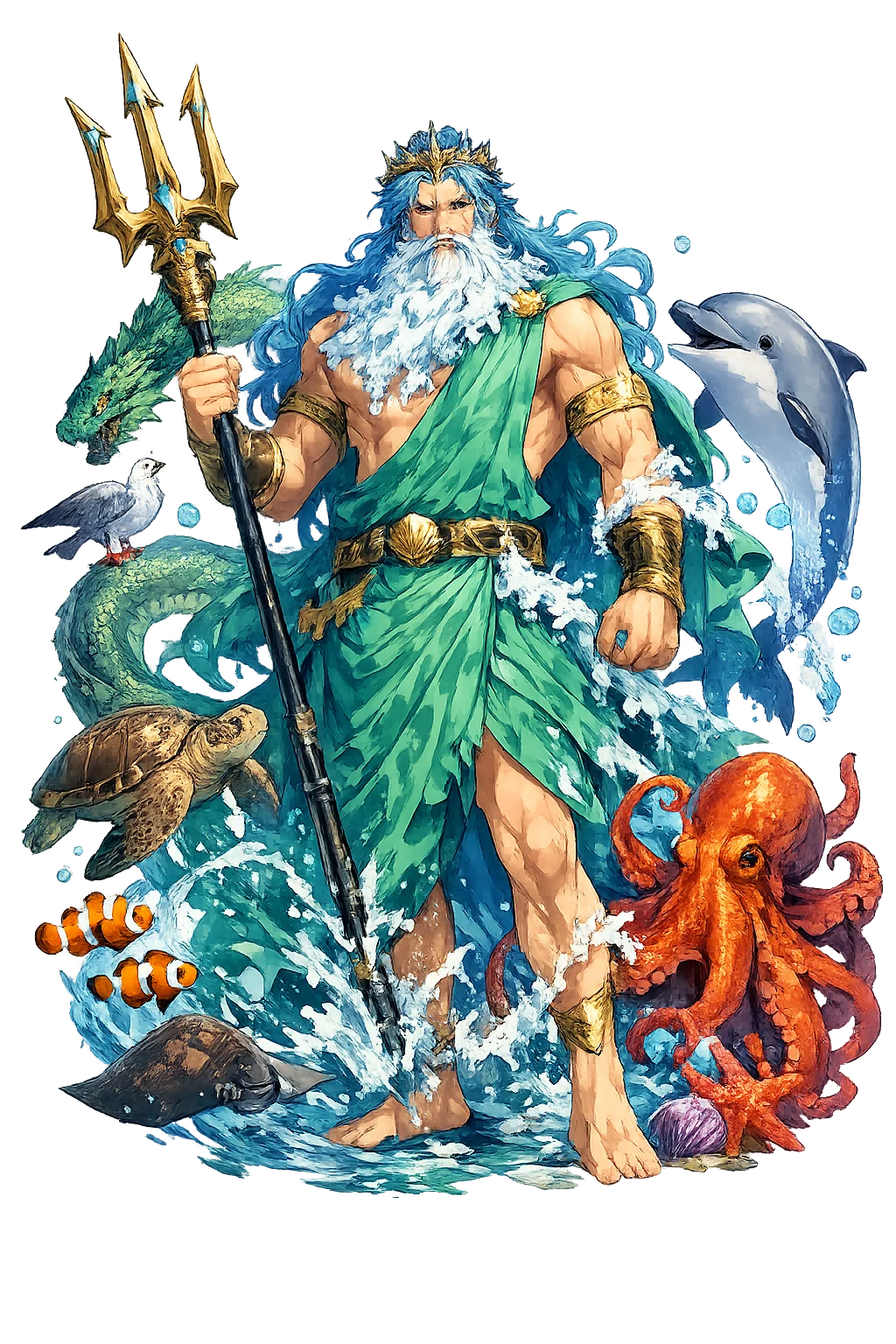
Stories of Neptūnus
Rome gave Neptūnus few native myths — his biography is Poseidṓn's translated — but the festival and the horse-cult are Italy's own, older than the sea-borrowing.
The Neptunalia of July 23 is Rome's oldest water rite, and Festus' dictionary preserves its strangest detail: the people kept holiday in huts woven of leafy branches — umbrae, 'shades' — drinking and feasting in the green dark of their own making while the sun stood at the year's hottest (Festus, s.v. Neptunalia). The antiquarians argued about the god's name — Varro (De lingua Latina 5.72) weighs a derivation from nubere, 'to cover,' as the sky covers the earth — but the festival's meaning needs no philology: it is a prayer said in the vocabulary of architecture, shade and water asked of the power who withholds them. Neptūnus' first realm was the spring, the stream, the well that keeps a farm alive; the Mediterranean, with its fleets and fortunes, was the empire's later gift to him. Every arbour was a small theology: that water, like mercy, is most worth begging for when it is scarcest.
As Neptūnus Equester he shared the underground altar of Consus, the old god of the stored grain whose altar lay buried near the Circus Maximus and was uncovered only for his games (Tertullian, De spectaculis 5). At the Consualia in August, horses and mules were garlanded and rested from their labor, and chariots raced for the year's honor. It was at one such festival that Romulus staged the seizure of the Sabine women, inviting the neighboring tribes to watch the games and then giving the signal (Livy 1.9; Plutarch, Romulus 14). Rome's foundation story thus begins at Neptūnus' racetrack, with the horses watching: the god of the hidden granary and the god of the hidden water meet underground, and above them the city performs its oldest transaction — spectacle in exchange for wives, horses in exchange for luck. The partnership makes economic sense the farmers understood: the horse pulls the plough to the water, and both, properly honored, pull the city through the year.
Roman retellings kept the Greek contest for Athens and read it as a civic lesson. Poseidōn struck the rock of the Acropolis with his trident and brought forth either the salt spring — Herodotus (8.55) saw the marks of the trident still — or, in another version, the first horse (Apollodorus 3.14.1). Athēnâ's olive won the city's name, and the god of force went away sullen, his spring turning salty in his anger. Roman authors delighted in the moral: wisdom outranks strength, and the tree that feeds beats the wave that drowns — a reading that let the conquerors of the Mediterranean patronize the sea they had just conquered. But the story keeps a second edge that Rome could not blunt: the loser never leaves. The salt spring stayed on the Acropolis, and Neptūnus stayed in the Roman calendar, and the contest is never really finished — every harbor is an olive and a trident still arguing about which of them feeds the city.
Roman sea-power came late, and when it came it dedicated itself. In 36 BCE Marcus Agrippa destroyed the fleet of Sextus Pompeius at Naulochus, the decisive victory of the war against the pirate-prince, and the honor was assigned to Neptūnus: Appian (Bellum Civile 5.118) records that Agrippa was awarded a golden crown adorned with ships' prows — the corona rostrata, minted afterward on coins. Vergil, closing the shield of Aeneas, had already pictured the sea-god ranged among Octavian's gods at Actium (Aeneid 8.698). The gesture is the interpretatio Romana in action: a borrowed god made genuinely Roman by a Roman victory, his temple and games the empire's thank-you note to the water that had nearly been lost. By the high empire, altars to Neptūnus stood from Ostia to the Tyne — sailors' religion, contracted port by port, where every crossing is a small Naulochus and every harbor a god's fee.
Sea, Horses, Earthquakes, and the Drought Festival
Neptūnus was god of fresh water before he was god of the sea: his oldest festival, the Neptunalia, falls in the parching days of late July, when Romans built huts of branches and prayed the waters not to fail. The Greek sea came later, and with it Poseidṓn's whole mythology.
The three-pronged fisher's spear that became the sceptre of the sea — and of a planet.
His Roman title as horse-lord: the consus-cult of underground granaries and racing.
Ennosigaios in Greek, but Rome knew him too — the power that moves the ground the city stands on.
July 23: arbours of woven branches, water rites at the height of the drought.
From the original script to the living URL
NEPTVNVS
The name in its original Roman form. Neptūnus (NEPTVNVS) is attested in the source tradition — “Possibly related to nepos (descendant) or a pre-Roman water root”. Its macron-length vowels carry the full phonetic and orthographic weight of the source tradition.
neptunus
Reduced to plain neptunus, the name loses everything that made it specific: macron-length vowels. What remains is an ASCII string that machines can parse but that no longer speaks with its original voice.
Neptūnus
The Unicode restoration recovers what ASCII flattened. Neptūnus restores macron-length vowels, returning the name to its original written dignity. The domain encodes to Punycode, but the browser displays the truth.
Neptūnus.com → xn--neptnus-3sb.com
The non-ASCII characters in Neptūnus are encoded while the ASCII remains visible. To the DNS, it is Punycode. To humanity, it is Neptūnus.
Owned, ideal, and ASCII forms of Neptūnus
Neptūnus
Restores NEPTVNVS. The live temple domain — neptūnus.com.
neptunus
Flattens NEPTVNVS. The plain ASCII fallback — what DNS and legacy systems see.
How Neptūnus was spoken
How Neptūnus travels from ancient script to the modern URL
The lore you have read is the living myth. Extended Lore opens the scholarly vault beneath it: the cult and its material remains, a history of the image, the name after antiquity, a meditation on what the name still means, and the full scholarly apparatus — etymology, orthography, sources.
Enter Extended Lore