PuniCodex

Extended Lore

NEPTVNVS Neptūnus

Etymology · Orthography · Cult · Iconography · Reception · Sources

Tier 1 Neptūnus.com
Neptūnus — Sea, Horses, Earthquake
01

Quick Facts

Essential information about Neptūnus, Sea, Horses, Earthquake

Original ScriptNEPTVNVS
Unicode RestorationNeptūnus
Reconstructed Pronunciation/nepˈtuː.nus/
PantheonRoman
DomainSea, Horses, Earthquake
MeaningPossibly related to nepos (descendant) or a pre-Roman water root
ClassificationTier 1
Primary DomainNeptūnus.com
Sacred SymbolsThe trident, The horse, The dolphin, The leafy arbour (umbra)
02

Etymology & Word Family

From original script to Unicode restoration

Original Script NEPTVNVS Neptūnus — "Possibly related to nepos (descendant) or a pre-Roman water root"
Unicode Restoration Neptūnus Restored stress, length, and script
Modern ASCII neptunus Plain-ASCII fallback

The name Neptūnus carries the orthographic signature of the roman tradition: NEPTVNVS. Unicode restoration recovers what ASCII flattens.

03

Unicode Character Breakdown

Character-by-character philological analysis

CharacterUnicodeNameBlockPhonetic Role
NU+004ELatin Capital Letter NBasic LatinSame letter
eU+0065Latin Small Letter EBasic LatinSame letter
pU+0070Latin Small Letter PBasic LatinSame letter
tU+0074Latin Small Letter TBasic LatinSame letter
ūU+016BLatin Small Letter U with MacronLatin Extended-AMacron marks the long vowel
nU+006ELatin Small Letter NBasic LatinSame letter
uU+0075Latin Small Letter UBasic LatinSame letter
sU+0073Latin Small Letter SBasic LatinSame letter

The Tier 1 classification reflects how much of the original phonology this restoration preserves — stress and vowel length for Greek names, distinctive letters and diacritics for every other tradition.

04

Cult & Worship

How the sacred was kept — rites, sanctuaries, remains

The Cult

Rome worshipped Neptūnus with festivals rather than myth. The oldest is the Neptunalia of 23 July, kept — Festus records — in huts woven of living branches against the year's worst heat, a water-prayer built of shade; it still stood in the calendar of 354 CE. His temple rose in the Circus Flaminius, vowed by Gnaeus Domitius Calvinus on a Gaulish battlefield in 206 BCE (Livy 28.11) and famous enough to name the district. As Neptūnus Equester he shared an underground altar with Consus beside the Circus Maximus — stored grain and hidden water honored together — and the Consualia garlanded the horses he claimed. When Rome became a sea-power the cult went maritime: after Naulochus the Senate struck the rostral crown for Agrippa, and by the high empire altars to Neptune stood wherever soldiers met water they could not master — on the Tyne at Newcastle and South Shields, at Chichester — every harbour a sailor's vow made stone.

In the Earth

The Piacenza liver (3rd–2nd century BCE) inscribes Nethuns on the liver's sea-zone — the Etruscan original caught in bronze. His Roman temple stood by the Circus Flaminius; the great marine-thiasos mosaics of North Africa and Ostia show the imperial image: the god in his hippocamp chariot. In Britain, the genuine Neptune dedications stand on the empire's wet edge: altars to Neptune and Oceanus set up on the Tyne at Newcastle and South Shields (RIB 1319–20) and the Neptune-and-Minerva altar from Chichester (RIB 91).

05

Iconography

How Neptūnus was imaged across the ages

The Image

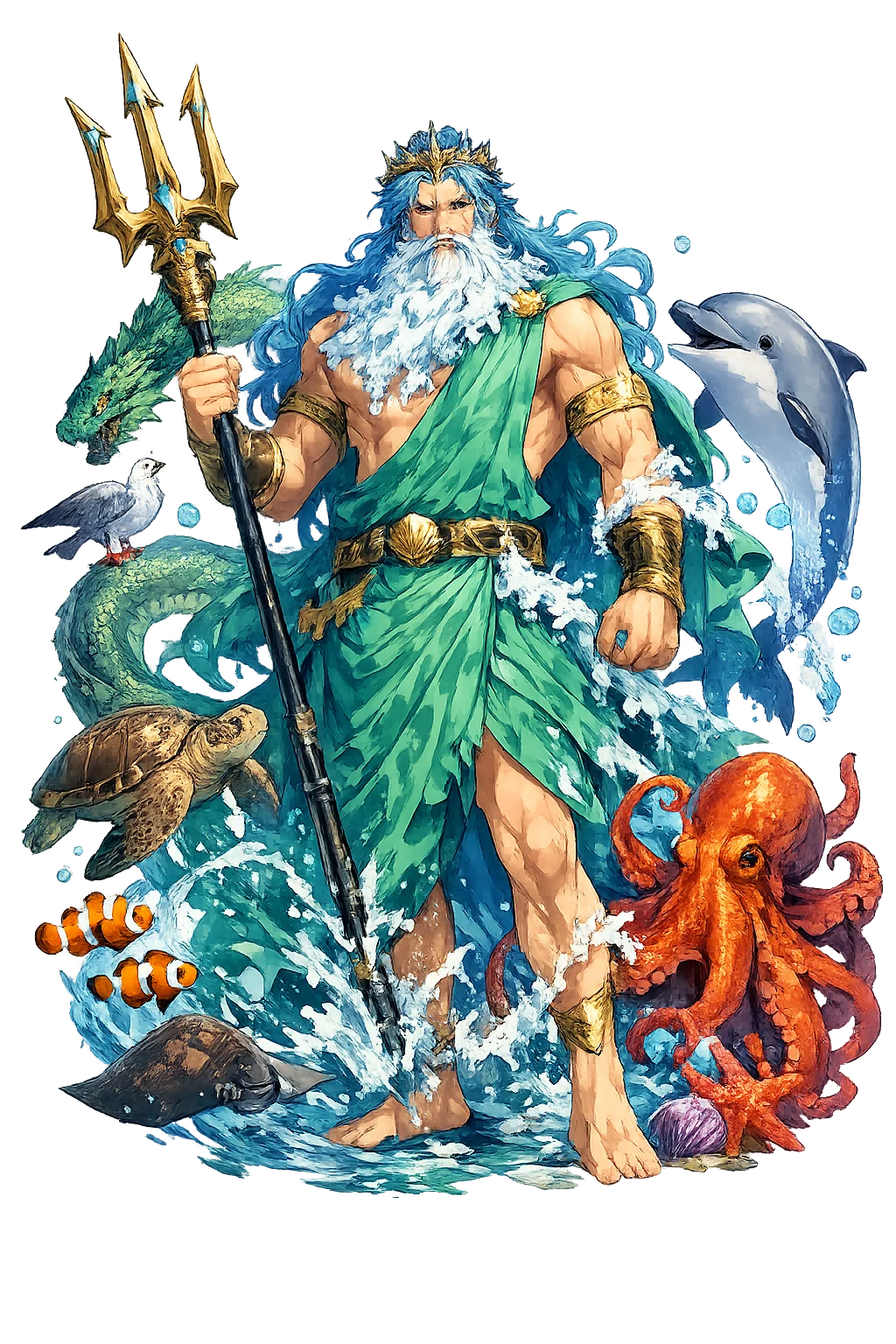
Neptūnus' portrait is Poseidṓn's with a Roman face — the interpretatio worked in bronze. After the Greek borrowing the attributes never varied: the trident, the dolphin, the hippocamp chariot, the wind-blown beard; what changed was the audience. Republican coinage is the earliest Roman gallery: Sextus Pompeius, styling himself the sea-king's favorite, struck denarii about 40 BCE showing Neptune with trident and dolphin, one foot on a ship's prow — propaganda in miniature. Empire made the image domestic: mosaics from Ostia to North Africa carpet dining rooms with the marine thiasos, the god in his chariot while fish-crewed Nereids dance — the triumph of Neptune from La Chebba in the Bardo, and the Baths of Neptune at Ostia, are the type at its most splendid. The truly Italic image survives only as a name on the bronze Piacenza liver (3rd–2nd century BCE), where Nethuns holds the sea-sector of a sheep's-liver map of the cosmos: before the beard and trident, there was the organ.

06

Reception & Transformation

The name after its own age — transmission, translation, survival

Afterlives

With the empire's conversion Neptūnus lost his altars but not his image, and the Middle Ages kept the beard afloat. Medieval mythographers — Boccaccio's Genealogia deorum gentilium among them — filed him in the learned hierarchy of planet-gods and sea-kings; Renaissance cities raised him in bronze as their own emblem of authority: Giambologna's Neptune of 1566 still strides in Bologna's Piazza Maggiore, and Ammannati's great fountain (1563–1575) fronted Florence's seat of justice with a sea-god the Medici could read as their dominion. The name's strangest journey was mathematical. When the eighth planet betrayed its existence by wobble in 1846, the naming quarrel — Le Verrier's own name proposed and resisted abroad — ended in Neptūnus, a Roman of borrowed Greek stock, crowned by international convention where his cult had once been purely Italian. The trident he inherited became the planet's astronomical sign, and so a water-god of the drought-festival rules, by an irony Rome would have enjoyed, the coldest water in the solar system.

Identifications Across Traditions

His equation with Poseidṓn is one of the oldest certain instances of interpretatio Romana, but the substrate is Etruscan: Nethuns, whose name is inscribed on the Piacenza liver in the sea-zone of the bronze, Rome's borrowing filtered through a Tuscan lens. In the western provinces the name glossed whatever power ruled the local deep water — the springs and rivers of Gaul and Britain received altars to Neptūnus wherever the legions found water they could not master, and the Celtic horse-and-water cults of the frontier found in him a ready-made equation. His trident became the standard answer to an imperial question: not 'which god is this?' but 'which of ours does he match?' — the taxonomic habit by which Rome absorbed an ocean of local religions.

Modern Legacy

The planet Neptune — discovered by mathematics before telescopes (Adams and Le Verrier, 1846) — carries his name and trident symbol into every classroom. "Neptune's realm" is still navy slang for the open sea; the Order of Neptune initiates sailors crossing the equator; and the trident survives from Ukrainian heraldry to Maserati's badge. Every western image of the sea as a person is his portrait.

07

The Meditation

What Neptūnus means — beyond the dictionary

Neptūnus began as the water that must be prayed for and became the water that must be crossed. He holds both truths: the sea that feeds and the sea that swallows, the spring in the drought and the earthquake under the harbour. To sail, to drill a well, to trust the ground — each is a small treaty with him.

The drought-festival and the sea-empire belong together, and the old god keeps both books still: the water we pray for and the water we fear, the well and the wave. Every age that pumps an aquifer or insures a coastline is doing his liturgy in engineering — asking the question his festival asked in the July heat: will the water come, will it be enough, and what will it cost when it does?

08

Frequently Asked Questions

Common questions about Neptūnus, Sea, Horses, Earthquake, and Unicode restoration

01How do you pronounce Neptūnus?

In reconstructed pronunciation, Neptūnus is /nepˈtuː.nus/ — approximately nep-TOO-nus, long ū on the stressed second syllable.

02What does Neptūnus mean?

Neptūnus means Possibly related to nepos (descendant) or a pre-Roman water root in the roman tradition.

03What are the symbols of Neptūnus?

Neptūnus is associated with The trident (The fisher's tool exalted to kingship of three water-realms), The horse (His second domain — waves and stallions share one crest), The dolphin (His messenger and the sailor's friend), The leafy arbour (umbra) (The woven-branch huts of the Neptunalia — shade built by hand against the July sun, the festival's one surviving image).

04Why restore Neptūnus in Unicode?

Plain ASCII neptunus strips the stress, length, and script that make the name specific. Unicode restoration returns the name to its original written dignity.

05What is the most important myth about Neptūnus?

“The Huts of Branches” — the The Drought story that anchors the mythology of Neptūnus, told in full on the lore page.

09

Scholarly Sources

The philological foundations of this restoration

Every claim on this page is grounded in established scholarship. The orthographic restorations follow disciplinary convention. The etymological chain follows the best available reference works. This is not invention — it is resurrection through scholarship.

◈

Lexicography & Philology

  • Lewis & Short
  • Varro
◎

Primary Texts

  • Virgil
  • Herodotus 8.55; Apollodorus 3.14.1 (the contest for Athens)
◉

Archaeology & Art History

  • Material evidence — iconography, inscriptions, and temple archaeology — for Neptūnus and related cults.
✦

Religious Studies

  • Varro, De lingua Latina 5.72
  • Festus, De verborum significatu s.v. Neptunalia
  • Livy 1.9 (the Consualia and the Sabine women)
  • Tertullian, De spectaculis 5 (the altar of Consus)
  • Appian, Bellum Civile 5.118 (Naulochus and the rostral crown)
Return

The Surface Awaits

You have traced the name from its earliest attestation to its Unicode restoration. Now return to the myth. The story is where the name lives.

Back to Lore
Neptūnus mascot