
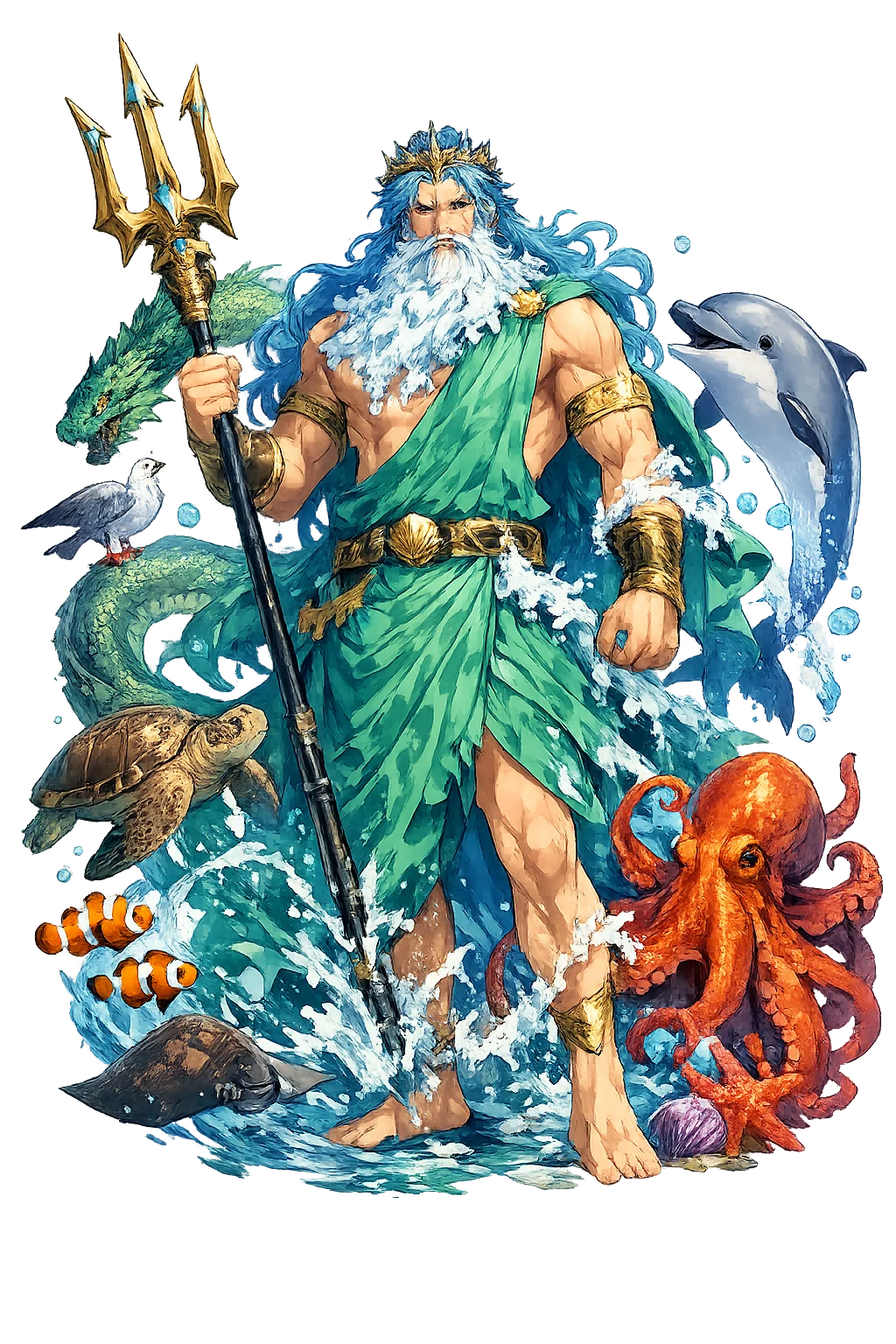
The provenance file on Neptūnus
Provenance record 330 · Neptūnus · one temple, fully accounted for.
Provenance
1. The attestation. NEPTVNVS, from the tradition's own record. On record: Varro, De lingua Latina 5.72, Festus, De verborum significatu s.v. Neptunalia, Livy 1.9 (the Consualia and the Sabine women), Tertullian, De spectaculis 5 (the altar of Consus).
2. The preserved evidence. u → ū (Macron marks the long vowel) — absent from the ASCII form neptunus, present in the restoration, verifiable against the sources above.
3. The narrative record. The Huts of Branches — The Neptunalia of July 23 is Rome's oldest water rite, and Festus' dictionary preserves its strangest detail: the people kept holiday in huts woven of leafy branches — umbrae, 'shades' — drinking and feasting in the green dark of their own making while the sun stood at the year's hottest (Festus, s. v. Lord of the Race — As Neptūnus Equester he shared the underground altar of Consus, the old god of the stored grain whose altar lay buried near the Circus Maximus and was uncovered only for his games (Tertullian, De spectaculis 5). At the Consualia in August, horses and mules were garlanded and rested from their labor, and chariots raced for the year's honor.
4. The physical record. The Piacenza liver (3rd–2nd century BCE) inscribes Nethuns on the liver's sea-zone — the Etruscan original caught in bronze. His Roman temple stood by the Circus Flaminius; the great marine-thiasos mosaics of North Africa and Ostia show the imperial image: the god in his hippocamp chariot. In Britain, the genuine Neptune dedications stand on the empire's wet edge: altars to Neptune and Oceanus set up on the Tyne at Newcastle and South Shields (RIB 1319–20) and the Neptune-and-Minerva altar from Chichester (RIB 91).
5. The current holding. The temple at /neptunus/, classified Tier 1. The restoration preserves more than the ASCII form can express — stress, length, or a letter the Latin keyboard lost — which places it, mechanically, in Tier-1.
6. The documented resonances. Maritime, Shipping & Ocean Industries, Freshwater & Hydrology, Disaster Resilience & Recovery — seats argued and weighted in the pattern atlas, read through the myths in this temple's Resonance File.
7. The primary sources. Metamorphoses — the library this file answers to, open at the Sacred Texts collection.
8. The continuing record. The planet Neptune — discovered by mathematics before telescopes (Adams and Le Verrier, 1846) — carries his name and trident symbol into every classroom. "Neptune's realm" is still navy slang for the open sea; the Order of Neptune initiates sailors crossing the equator; and the trident survives from Ukrainian heraldry to Maserati's badge.
At a Glance
- Restored name: Neptūnus
- ASCII form: neptunus
- Meaning: "Possibly related to nepos (descendant) or a pre-Roman water root"
- Domain of influence: Sea, Horses, Earthquake
- Pantheon: Roman
- Classification: Tier 1
- Original script: NEPTVNVS
- Series: The Restoration Files, No. 330 of 546
The File Continues
Read the founding dispatch for the name's full story, the Resonance File for the archetype at work — or the whole archive in one sitting.
Continue the series — previous file: Narasiṃha (read it here) · next file: Nergal (read it here).
The Restoration Files are written from the same canonical record as the temples themselves: the lexicon, the lore catalog, the pattern atlas, and the cited scholarly sources. If a file ever disagrees with its temple, the temple is right — tell us, and the file will be corrected.