
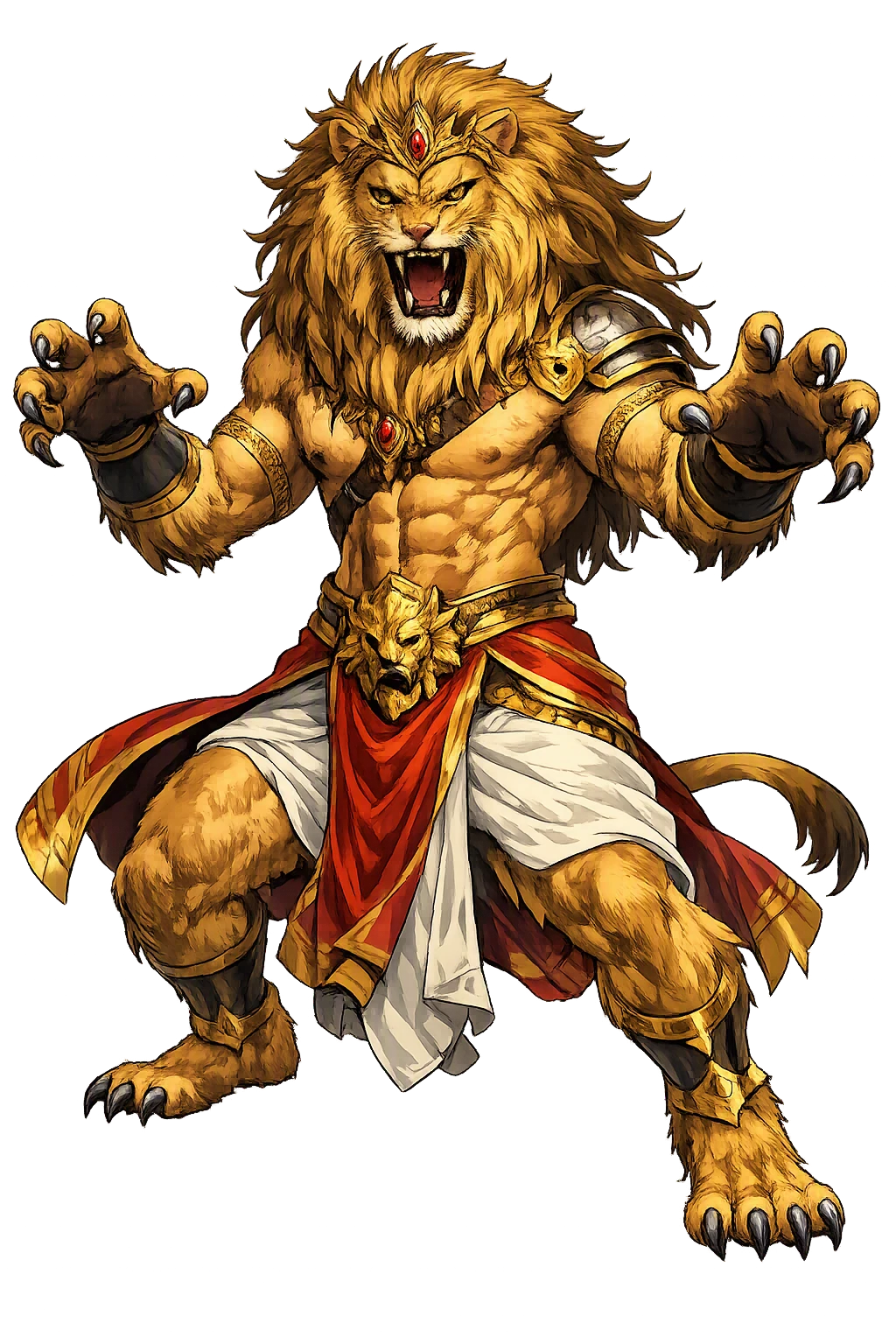
The many faces of Narasiṃha
No important name has only one face. Narasiṃha appears as a figure of myth, a scholarly reconstruction, a piece of material culture, a memory carried across languages, and — most recently — a Unicode domain. This post looks at each face in turn: the name and its roots, the Devanagari original, the reconstructed pronunciation, the mythological record, the symbols and sanctuaries, the cross-cultural afterlife, and the engineering that lets the restored spelling resolve in a browser. Taken together, those faces explain why narasimha was never going to be enough — and why the restored form is worth a domain of its own.
At a Glance
- Restored name: Narasiṃha
- ASCII form: narasimha
- Meaning: "The Man-Lion — the fourth avatāra of Viṣṇu"
- Domain of influence: Man-Lion Avatar
- Pantheon: Sanskrit
- Restoration: Preserves distinctive marks
- Original script: नरसिंह (Devanagari)
- Live domain: narasiṃha.com
Overview
Narasiṃha (narasimha) — Man-Lion Avatar · The Man-Lion — the fourth avatāra of Viṣṇu — belongs to the Sanskrit tradition, where it is catalogued under the domain "Man-Lion Avatar". The name means "The Man-Lion — the fourth avatāra of Viṣṇu".
Narasiṃha belongs to the Sanskrit tradition, where it is associated with man-lion avatar.
PuniCodex restores the name as Narasiṃha and serves its temple at narasimha.com. The restoration preserves at least one distinctive feature — a diacritic or a distinctive letter — that the ASCII form loses, and exactly one historically valid Unicode restoration exists. The plain ASCII form narasimha survives as a modern convenience imposed by the early domain-name system; the restoration, not the fallback, is the form the project defends as philologically complete.
The Name
The name is attested in Devanagari as नरसिंह. Etymologically it means "The Man-Lion — the fourth avatāra of Viṣṇu".
Sanskrit Narasiṃha, from nara 'man' + siṃha 'lion'; the man-lion avatāra of Viṣṇu who slew Hiraṇyakaśipu.
The ASCII form narasimha survives only because the early domain-name system could not carry diacritics; it is a technological compromise, not an ancient spelling. The Unicode restoration Narasiṃha recovers the full diacritic detail of the scholarly transliteration directly in the address bar. The restoration preserves at least one distinctive feature — a diacritic or a distinctive letter — that the ASCII form loses, and exactly one historically valid Unicode restoration exists.
The letter-by-letter transformation runs:
- n → N — Same, capitalized
- a → a — Same
- r → r — Same
- a → a — Same
- s → s — Same
- i → i — Same
- m → ṃ — M with dot: anusvara
- h → h — Same
- a → a — Same
The canonical temple for this name is served at narasimha.com.
Etymology & Roots
The recorded derivation reads: Sanskrit Narasiṃha, from nara 'man' + siṃha 'lion'; the man-lion avatāra of Viṣṇu who slew Hiraṇyakaśipu.
The root gloss is "man-lion."
The reconstruction is classed as attested.
The Original Script
The name is preserved in Devanagari as नरसिंह.
The scholarly transliteration is Narasiṃha.
The rendering proceeds step by step:
- Sanskrit Narasiṃha is written in Devanagari as नरसिंह
- IAST transliteration maps each Devanagari vowel and consonant to a Latin equivalent
- Macrons mark long vowels (ā, ī, ū); dots beneath consonants mark retroflex articulation (ṭ, ḍ, ṇ, ṣ)
Pronunciation
The reconstructed pronunciation of the name is /narasimha/ — Sanskrit Reconstruction.
Phoneme by phoneme:
- N — Initial character of the restored form Narasiṃha.
- arasiṃha — Remainder of the name, preserving the distinctive marks of the Sanskrit tradition.
For the modern speaker, the closest approximation is: 'NARASIMHA' — pronounce the restored form with attention to the preserved diacritics and length.
Kindred and historical forms of the name:
- Sanskrit — Narasiṃha, the restored Unicode form of the name
Narasiṃha preserves both features because the Sanskrit form preserves distinctive features that ASCII loses: stress, length, or special characters.
Mythology
The stories of Narasiṃha circulate within the Sanskrit corpus, where the figure embodies man-lion avatar.
Primary Attestation (Sources)
Narasiṃha is attested in the canonical Sanskrit sources as a figure associated with man-lion avatar.
Name and Meaning (Etymology)
The name means "The Man-Lion — the fourth avatāra of Viṣṇu" and reflects the figure's role in the tradition. Narasiṃha is the man-lion avatāra of Viṣṇu who destroys the demon Hiraṇyakaśipu. Appearing from a pillar at dusk, he uses claws rather than weapons to circumvent the demon's boons of invulnerability. The myth celebrates divine ingenuity and the protection of the devout child Prahlāda. The image of Narasiṃha bursting from the pillar became a favorite iconographic subject, representing the omnipresence of divine protection in places where violence is forbidden.
The Boon of Hiraṇyakaśipu (Bhāgavata Purāṇa 7.3)
Hiraṇyakaśipu, king of the daityas, performed austerities so severe that Brahmā offered him a boon. Suspicious of every loophole, the demon stipulated that he should not die by day or night, indoors or outdoors, on earth or in the sky, by weapon or by hand, by man or beast, by god, demon, or nāga. Granted near-invulnerability, he conquered the three worlds and forbade the very name of Viṣṇu — commanding his own subjects, on pain of death, to worship him alone. The Bhāgavata Purāṇa (7.3) makes the stipulation a masterpiece of conditional theology: Hiraṇyakaśipu does not ask for immortality, which Brahmā cannot give, but for a contract so airtight that only the maker of loopholes could breach it. His blasphemy completes his doom, for by banning Viṣṇu's name from his own household he makes his own son — the boy Prahlāda, who loves the banned god from the womb — the hinge on which the entire boon will turn.
Prahlāda, the Devotee (Bhāgavata Purāṇa 7.5–7.8)
Prahlāda, the tyrant's son, refused the milk of his father's ideology along with his nurse's milk: asked what he had learned, the boy answered that the best of all teachings is devotion to Viṣṇu. Hiraṇyakaśipu tried to destroy him — poison in his milk, serpents in his bed, mantra-hurled weapons, a mountain dropped on his head, a fire fed by sorcery. Each attempt failed as devotion summoned rescue, and the boy emerged unburned, unbitten, unbroken, reciting the names of the god (Bhāgavata Purāṇa 7.5–7.8). The text's power lies in the contrast it never softens: the father holds every worldly power — armies, sorcery, a boon from Brahmā himself — and the son holds only a name, and the name keeps winning. Prahlāda became, for later bhakti theology, the type of the devotee whom nothing can finally injure. His serenity in the face of death is the cycle's quiet, indestructible center — the still point around which all of his father's fury breaks.
Out of the Pillar (Bhāgavata Purāṇa 7.8)
'Is your Viṣṇu in this pillar?' Hiraṇyakaśipu smashed a golden column of his own palace with his mace — and the pillar answered. From within the masonry came a sound no one in the three worlds had heard before; the column split, and out of it erupted a being that was neither man nor beast: Narasiṃha, the man-lion, maned and roaring, filling the hall with radiance and terror (Bhāgavata Purāṇa 7.8; Viṣṇu Purāṇa 1.19–20). The dying light that streamed through the lattices was neither day nor night. The threshold on which the god seized the tyrant was neither indoors nor out. The claws that disemboweled him were neither weapon nor hand. And the avenger was neither man nor god, neither demon nor beast — exactly the thing for which the boon's careful clauses had never been written. Every condition was honored to the letter and annulled by a form the letter could not imagine. The Purāṇas stage the scene as a trial in which the cosmos itself acts as counsel for the prosecution — and in which devotion, not force, set the whole machinery in motion.
Symbols & Iconography
The iconography associated with Narasiṃha concentrates in a small set of recurring attributes, each a compressed statement about the name:
- Restored Name — The Unicode form Narasiṃha carries the original marks of the Sanskrit tradition.
- Source Script — Preserved through scholarly transliteration and canonical sources.
- Domain — Man-Lion Avatar
- Etymology — The Man-Lion — the fourth avatāra of Viṣṇu
- The man-lion form — The theriomorphic body that defeats the boon: leonine mane and claws joined to human torso and intelligence.
- Claws (nakha) — Neither weapon nor hand — the talons that honor the letter of the boon while breaking its intent; the nails themselves are hymned (nakhastuti).
- The pillar (stambha) — The palace column that conceals the god; in theology, the stambha is the imperishable inner support of all beings.
- Twilight (sandhyā) — Neither day nor night — the loophole hour at which the law of the boon is honored and destroyed at once.
- The serene child — Prahlāda standing unafraid beside the killer — devotion as the one power the man-lion will always answer.
Archaeology & Evidence
The material record for Narasiṃha survives in a small number of securely identified remains, catalogued below; the corpus is thin but unambiguous, and each site is tied to the name by ancient testimony.
Narasiṃha is attested in the textual and iconographic record of the Sanskrit tradition.
Realm & Domain
Narasiṃha belongs to the Sanskrit tradition, where it is associated with man-lion avatar.
Man-Lion Avatar
The central domain of Narasiṃha in the sanskrit tradition.
The Man-Lion
The name signifies "The Man-Lion — the fourth avatāra of Viṣṇu".
Unicode Restoration
The restoration Narasiṃha recovers what plain ASCII narasimha flattens.
Original Attestation
Attested in the sources as —.
Across Cultures
Narasiṃha appears within the Sanskrit tradition and has influenced later retellings, artistic depictions, and scholarly study. The Unicode restoration preserves the name's distinctive orthography for contemporary use.
Within the Sanskrit tradition, closely related names in the corpus include Aṃśa, Dakṣa, Dhātṛ, Durgā, Gaṇeśa, and Gaṅgā.
Cultural Legacy
Narasiṃha continues to appear in scholarship, art, and popular reception as a significant figure of the Sanskrit tradition. Restoring the name in Unicode returns the original marks that ASCII removes. Narasiṃha is a popular subject in South Indian temple sculpture, dance drama, and festival iconography.
The Scholarly Record
The account of Narasiṃha given in this edition rests on the witnesses and reference works listed below. Lexica and etymological dictionaries secure the form and meaning of the name; the literary and religious texts supply the narrative evidence.
- Monier Monier-Williams, A Sanskrit-English Dictionary, Oxford; Cologne Digital Sanskrit Dictionaries, 1899. Full text
- Bhagavata Purana.
- Rāmāyaṇa, Vālmīki; translated by Hari Prasad Shastri, 500 BCE. Full text
A Meditation
Narasiṃha embodies man-lion avatar in the Sanskrit imagination. The name's restoration is not merely cosmetic: it recovers the stress, length, and script that make the figure recognizable in the source tradition.
The Unicode Restoration
Narasiṃha preserves distinctive marks. The ASCII fallback narasimha still resolves everywhere, but it is the restored form that carries the name's full information. Across the 9 characters of the name, the restoration adjusts 1: 1 further adjustment (ṃ). That is the whole thesis of this temple: the marks are the message.
Character by Character
The journey from narasimha to Narasiṃha, one character at a time:
- n → N — Same, capitalized
- a → a — Same
- r → r — Same
- a → a — Same
- s → s — Same
- i → i — Same
- m → ṃ — M with dot: anusvara
- h → h — Same
- a → a — Same
The Domain Name
The restored name is live as a working domain: narasiṃha.com, which the DNS carries in punycode form as xn--narasiha-m89c.com — an ASCII-compatible encoding that lets a non-ASCII name travel the global network without breaking older infrastructure. The visitor sees Narasiṃha; the machines see the encoding. That duality is the engineering compromise on which the entire restoration rests, and it is why a name written the way its own tradition wrote it in Devanagari can now be typed into any browser on earth.
The Sanskrit Pantheon
Narasiṃha is one of 102 entries the PuniCodex lexicon catalogues under the Sanskrit pantheon. The Pantheon page gathers the tradition's major figures in one place, and the Lexicon lets you filter all 983 restorations by tradition or script — the fastest way to see where this name sits among its kin.
Frequently Asked Questions
What does Narasiṃha mean? The traditional gloss is "The Man-Lion — the fourth avatāra of Viṣṇu."
Which tradition does Narasiṃha belong to? Narasiṃha is catalogued in the Sanskrit pantheon of the PuniCodex lexicon.
What does Narasiṃha preserve that ASCII cannot show? The form itself answers: Narasiṃha preserves distinctive marks — and the marks in the restored spelling are exactly that evidence.
Is Narasiṃha a working domain? Yes — narasiṃha.com resolves today and routes to this temple.
What is the punycode for narasiṃha.com? The DNS encoding is xn--narasiha-m89c.com; browsers perform the translation automatically, so visitors only ever see the restored name.
Can I use Narasiṃha in a normal browser? Yes. The DNS resolves the punycode form automatically, and the type tool on this site converts narasimha to Narasiṃha for copying and pasting.
Where does the scholarly information come from? The entry is built from lexica, inscriptional evidence, and reviewed scholarly sources listed in the Scholarly Edition. Every claim is traceable to a canonical source.
Typing Narasiṃha
You do not need a special keyboard to use this restoration. The PuniCodex Type Tool converts the ASCII form narasimha into Narasiṃha as you type, and the browser extension offers the same conversion inside any text field. Copy the restored form, paste it into the address bar, and the DNS does the rest.
Sister Temples
Other temples in the Sanskrit pantheon include Karṇa, Kūrma, and Māyā — each with its own restoration story, its own scholarly record, and its own place in the lexicon.
Why This Restoration Matters
Myth, script, sound, cult, legacy, domain: the faces of Narasiṃha add up to a single argument — that a name is a record, and records deserve fidelity. The PuniCodex restoration keeps that record in working order: the temple presents it, the Scholarly Edition footnotes it, the lexicon catalogs it, and the domain makes it addressable. narasimha will always exist as a fallback. But fallback is not identity. Narasiṃha is the name; everything else is a convenience.
Explore Further
This post is one doorway into the temple. The home page carries the full character breakdown and the ambient canvas; the lore page tells the myths in long form; the Scholarly Edition preserves the sources, pronunciation data, and revision history; and the patron wall supports the restoration directly. For the wider map, browse the Lexicon, explore the Pantheon, or return to the PuniCodex blog.
A Closer Look at the Marks
A restored name is a small map. In Narasiṃha, the journey from the ASCII fallback narasimha to the Unicode form can be read letter by letter, and each letter tells a story. Of the 9 characters, 8 remain unchanged; they anchor the name to its modern shape. The remaining adjustments recover marks the source tradition used to distinguish this name from every other word built from the same letters.
The n stays as it is — Same, capitalized.
The a stays as it is — Same.
The r stays as it is — Same.
The a stays as it is — Same.
The s stays as it is — Same.
The i stays as it is — Same.
The m becomes ṃ — M with dot: anusvara.
The h stays as it is — Same.
The a stays as it is — Same.
Together these changes are not decoration. They are the minimum set of marks needed to keep the name legible in its own tradition. Remove them and you still have a string of letters; you no longer have the name as it was written.
Narasiṃha in Its Tradition
Narasiṃha does not stand alone. It belongs to the Sanskrit tradition, where it is counted among 102 names in the PuniCodex lexicon. Its sphere — Man-Lion Avatar — places it beside other figures who govern similar aspects of experience. The restored spelling is therefore not only a philological decision; it is a way of keeping the name in the company of its kin. When the address bar shows Narasiṃha, it marks the boundary between a generic search term and a named entry in a living catalog of myth. That catalog is the point of the project. Every restored name is a vote for specificity: the web should know the difference between a figure and a keyword, between a tradition and a trend. Narasiṃha is one such vote.
Related Names
Sources
The full scholarly apparatus — every citation, revision, and review — lives in the Scholarly Edition. Key references for this post:
- Monier Monier-Williams, A Sanskrit-English Dictionary, Oxford; Cologne Digital Sanskrit Dictionaries, 1899.
- Rāmāyaṇa, Vālmīki; translated by Hari Prasad Shastri, 500 BCE.
- Ṛgveda Saṃhitā.
- Brāhmaṇas (Śatapatha, Aitareya, etc.).
- Upaniṣads.
- Bhagavata Purana.
- Bhagavata Purana.
- Monier-Williams Sanskrit-English Dictionary.
- Macdonell, Sanskrit Grammar for Students.
- Lexicon authorities for this entry: MW, Bhagavata.